Learn · Water and Wastewater
The Federal Frame: Why Every State Certifies Operators
Part of Water Operator, Certified · step 19 of 23 · next: ABC Standardized Exams: How WPI Testing Works
In learning paths: Water Operator, Certified
Section 1419 of the Safe Drinking Water Act is the reason there is no US state where you can run a public drinking water system without a certified operator. It does not certify anyone, and neither does EPA. It makes the states do it, and it pays for the compliance.
Why it matters on the job
You will never hand EPA an exam application. But the shape of your state’s program (why it classifies systems, why it demands exams and experience, why renewal and training requirements exist at all) was set in Washington. Knowing the frame tells you which parts of certification are the same everywhere and which parts are your state’s own choices.
The mechanism
Three moves, in order:
- Congress, 1996. The SDWA Amendments added Section 1419, directing EPA to establish minimum standards for the certification and recertification of operators of community and nontransient noncommunity public water systems.
- EPA, 1999. The agency published its final Operator Certification Guidelines: nine baseline standards a state program must meet. They cover the essentials you now live with: classifying systems, requiring certified operators in responsible charge, exams, experience and education requirements, renewal, and program review.
- The lever. A state that fails to run a compliant program loses 20 percent of its Drinking Water State Revolving Fund capitalization grant, the federal money that finances water infrastructure projects statewide. Every state complied.
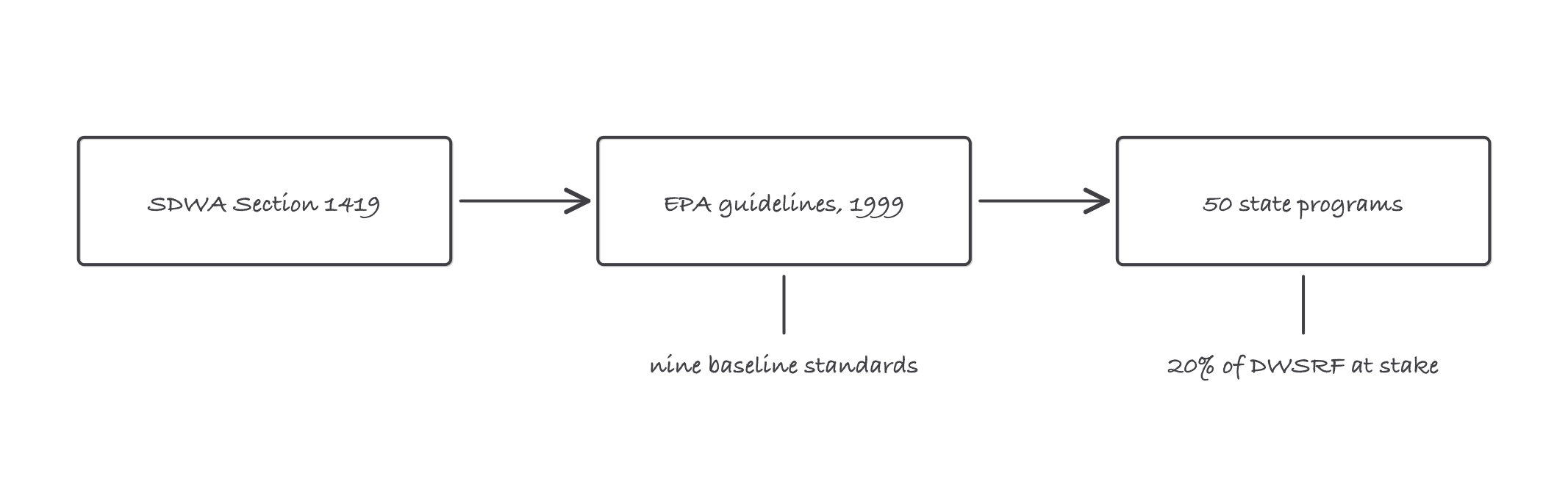
Federal law sets the floor, EPA writes the standards, and the funding penalty makes every state build its own program on top
What the frame does and does not decide
The guidelines set a floor, not a national program. States decide the grade names, the number of grades, the exam provider, the fees, the renewal cycle, and the training hours. That is why an operator moving from Texas to California meets a completely different ladder built on the same nine standards.
The frame also has edges. Section 1419 is drinking water law: it reaches community systems (the ones serving towns and cities) and nontransient noncommunity systems (a school or factory with its own well). Wastewater operator certification sits outside it entirely, required by each state under its own statutes.
Where it bites
- EPA approval is program-level, never personal. EPA reviews state programs against the guidelines. It does not issue, endorse, or verify individual operator certificates, so treat any “federally certified operator” claim as a red flag.
- The floor is not the ceiling. Many states require more than the nine standards demand. Reading the federal guidelines tells you the minimum shape, never your actual requirements: those live with your state program.
- Guidance documents move. EPA republishes its operator certification PDFs and the addresses change. If a link is dead, search the current epa.gov operator certification pages rather than trusting an old path.