Learn · Water and Wastewater
Preliminary and Primary Treatment
Part of Water Operator, Certified · step 7 of 23 · next: Activated Sludge
In learning paths: Water Operator, Certified
Assumes you know: Wastewater Treatment Overview
Preliminary and primary treatment take out everything that would break, clog, or overload the plant before the biology gets to work. Preliminary treatment protects the equipment; primary treatment unloads the process. Neither step treats the waste in any biological sense, and together they set up everything that follows.
Why it matters on the job
The headworks is where the plant meets whatever the collection system delivers: rags, grit, grease, sticks, and toys. Miss it here and it lands somewhere expensive. Rags wrap pump impellers. Grit sands down pipe elbows and fills digesters. Every pound of settleable solids that skips the primary clarifier becomes load the aeration basin must handle with energy you pay for.
Preliminary treatment: protect the plant
Bar screens are the first line: vertical bars that catch rags, plastics, and debris. Coarse screens stop the big material; many plants add finer screens behind them. The screenings are raked off (by hand at small plants, mechanically at larger ones), washed, and hauled to landfill. Screenings are trash, not sludge; they never enter the solids train.
Grit removal comes next. Grit is the heavy, abrasive mineral fraction: sand, gravel, eggshells, coffee grounds. A grit channel or chamber uses controlled velocity to make a clean separation: slow the flow enough for heavy grit to sink, but keep it fast enough that the lighter organic solids stay suspended and move on to real treatment. Grit is washed and landfilled, like screenings.
The velocity target is a balance, and it fails in both directions. Too fast and grit rides through to wear out pumps. Too slow and organics settle with the grit, rot, and turn the grit channel into the smelliest spot in the plant.
Primary treatment: let gravity unload the process
A primary clarifier is a big, calm tank that slows the flow for a couple of hours so physics can sort the waste three ways:
- Settleable solids sink to the floor as primary sludge, collected by scrapers and pumped to the solids train.
- Floatables rise: grease and scum are skimmed from the surface and sent to solids handling too.
- Everything else flows on over the effluent weirs to secondary treatment: the dissolved organics and the fine suspended matter gravity cannot catch.
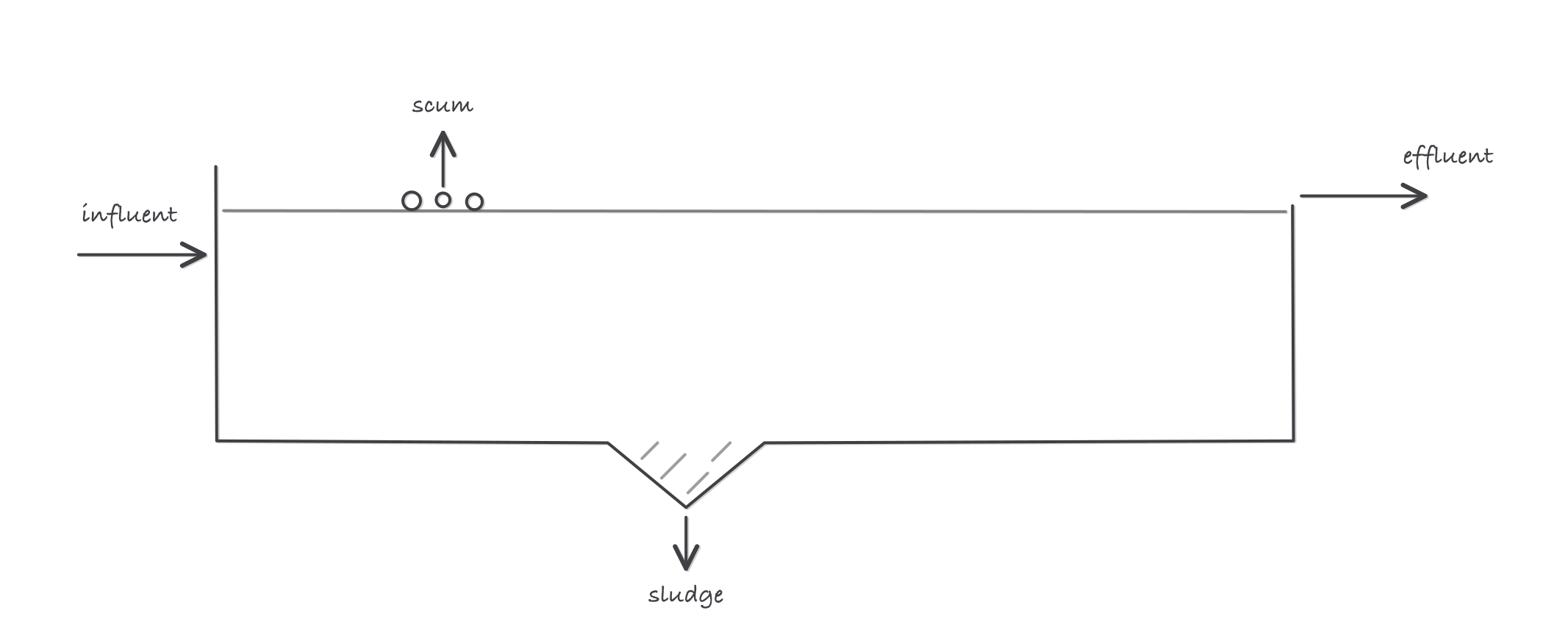
Three ways out of one tank: scum from the top, sludge from the floor, effluent over the weir
A well-run primary clarifier removes a large share of the incoming settleable solids and a substantial fraction of the BOD with no chemicals, no air, and no biology: the cheapest treatment in the plant.
Worked example: detention time
A primary clarifier holds 250,000 gallons and the plant is treating 3 MGD.
Detention time = volume ÷ flow = 250,000 ÷ 3,000,000 = 0.0833 day
0.0833 day × 24 hours = 2 hours
Two hours is a reasonable primary detention. Watch what flow does to it: if a storm pushes plant flow to 6 MGD, detention falls to 1 hour, settling suffers, and solids that should have sunk here arrive at the aeration basin instead. The lightly loaded plant at 2 a.m. and the storm-hit plant at 5 p.m. are different plants.
Where it bites
- Screenings and grit are not sludge. They go to the landfill, not the digester. Grit that reaches a digester never leaves: it fills the tank from the bottom and steals capacity for years.
- “Flushable” wipes are not flushable. They pass the toilet, knit into ropes in the collection system, and arrive at the headworks by the ton. Screens and pumps downstream of a wipes-heavy sewer need constant attention.
- Primary sludge goes septic fast. It is raw, rich, and biologically active. Held too long in the clarifier it gases, floats, and comes back up. Pump it out on schedule, not when convenient.
- Grease is a floater until it cools. It passes warm through the headworks, then hardens on weirs, launders, and downstream pipe. Skimming and regular cleaning are the only fixes.