Learn · Water and Wastewater
Confined Space Entry
Part of Water Operator, Certified · step 14 of 23 · next: Operator Certification: The Mandatory Ladder
In learning paths: Water Operator, Certified
Confined spaces are this trade’s deadliest hazard, and they kill in a specific, repeating way: an atmosphere you cannot see or smell drops a worker, and then it drops the coworkers who climb in to help. The federal rule that exists to break that chain is OSHA’s permit-required confined space standard, 29 CFR 1910.146, and water and wastewater work lives inside it: manholes, wet wells, tanks, digesters, and vaults.
Why it matters on the job
You will be near a confined space in your first month and asked to enter one soon after. The physical work inside is usually routine. The dying happens before the work starts, in the decision to climb in without testing, without a permit, and without someone stationed outside. This lesson is the decision framework.
What makes a space confined, and what makes it a permit space
Under 1910.146, a confined space meets three tests: it is large enough to enter and work in, it has limited means of entry or exit, and it is not designed for continuous occupancy. Every manhole passes all three.
A confined space becomes permit-required when it adds a serious hazard: an atmosphere that is or could become hazardous, a material that could engulf an entrant, walls that converge or a floor that slopes to a point that could trap or asphyxiate, or any other recognized serious hazard. Sewer work is the textbook case: decomposing wastewater generates hydrogen sulfide and methane and consumes oxygen, so treat sewer structures as permit spaces unless your employer’s program has formally reclassified a specific one.
A permit space demands the full system: a written program, a signed entry permit for each entry, atmospheric testing, ventilation where needed, and defined roles.
The three roles
The standard builds every entry around three assignments:
- Authorized entrant: the person inside. Knows the hazards, uses the equipment, and exits immediately on any alarm, symptom, or order.
- Attendant: the person stationed outside. Monitors the entrants and conditions, keeps count of who is in, and never enters, not even for a rescue. The attendant’s job during an emergency is to summon rescue and assist from outside.
- Entry supervisor: the person who verifies the permit conditions, authorizes the entry, and cancels it when conditions change.
Rescue is planned before entry, not improvised during one. Would-be rescuers who enter unprotected become the second and third victims in the classic multiple-fatality pattern, which is why non-entry retrieval (harness and tripod-mounted line) is the preferred arrangement.
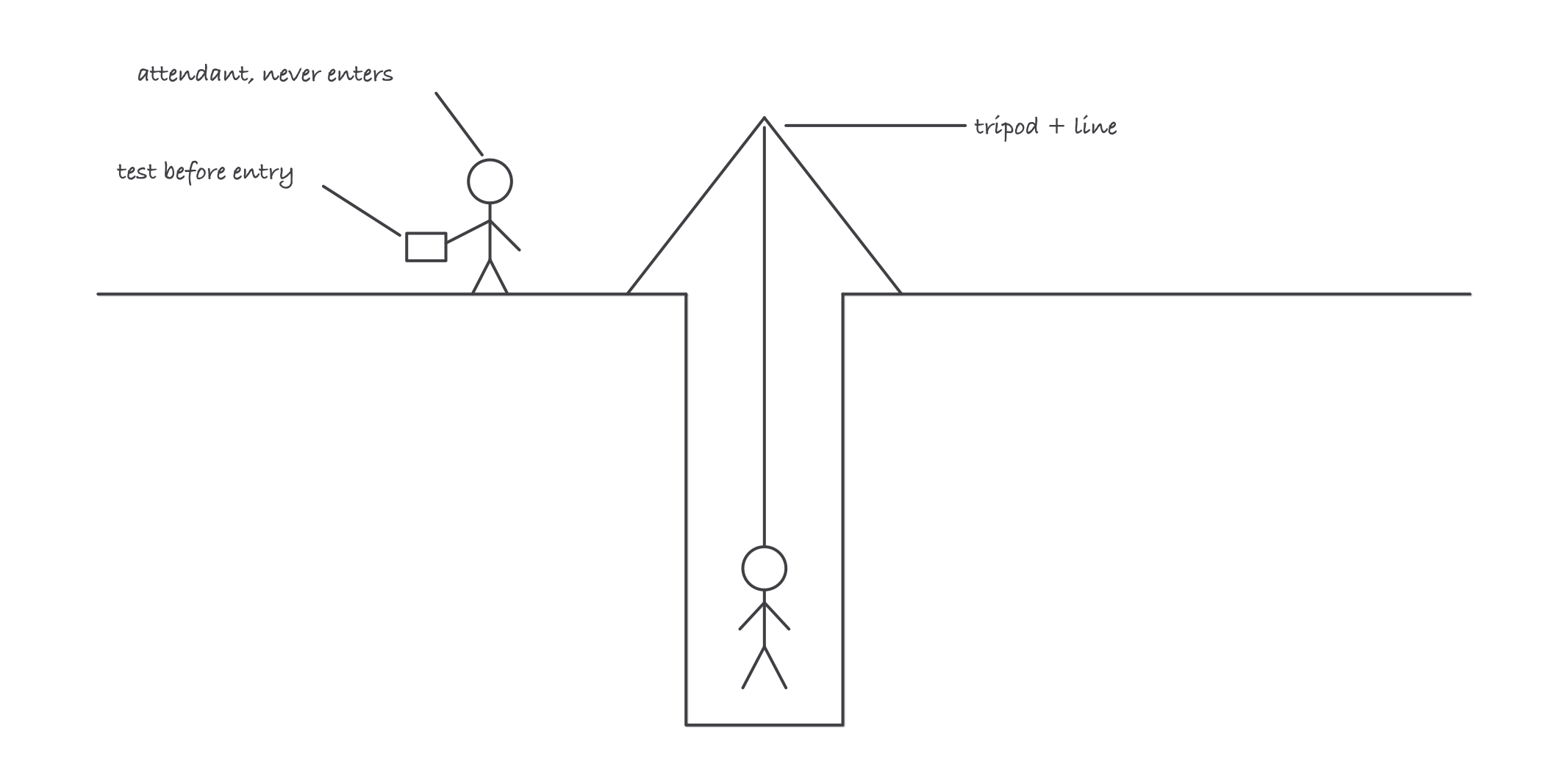
The system that breaks the fatality chain: tested air, a retrieval line to the surface, and an attendant who stays outside no matter what
Worked example: a collection crew manhole entry
A crew needs to enter a sewer manhole to inspect a joint. The sequence the standard drives:
- Permit first. The entry supervisor opens the written permit, listing the hazards, the controls, and the crew by role.
- Test the atmosphere from outside, top to bottom. Oxygen first, then flammables, then toxics, at multiple depths, because gases stratify. Acceptable entry conditions under the standard: oxygen between 19.5 and 23.5 percent, flammable gas below 10 percent of its lower flammable limit, and toxics within their permitted limits.
- Read the result honestly. Surface reading: 20.9 percent oxygen, 0 percent LFL. Probe lowered to the invert: 17.8 percent oxygen. That is below 19.5, so nobody enters. Ventilate with a blower and retest until readings hold in range, and keep monitoring during the entry: sewer atmospheres change while you work.
- Rig retrieval. Harness on the entrant, line to the tripod winch, attendant stationed at the rim with the meter and a way to summon rescue.
- Enter, work, exit, close the permit. Any alarm, odor, or symptom means out immediately: the permit is canceled and conditions reassessed.
Where it bites
- “I’ll only be a minute” is the fatal sentence. Ducking in without testing is the exact scenario the fatality statistics are made of. The atmosphere does not care how briefly you plan to breathe it.
- Your nose is not a meter. Hydrogen sulfide deadens the sense of smell at dangerous concentrations, so “the smell went away” can mean the opposite of safe. Only a calibrated meter counts.
- The attendant rule has no exceptions. The classic multiple-fatality confined space incident is a failed rescue by untrained coworkers. If you are the attendant, your discipline is the crew’s survival.
- Construction excavation work runs under a different standard. New pipeline construction falls under OSHA’s construction confined space rules (29 CFR 1926 Subpart AA), not 1910.146. The concepts match; the citations and details do not. Know which standard governs your site.
Exam relevance
Certification exams and employer safety training both test this material: the three-part confined space definition, what makes a space permit-required, the entrant, attendant, and supervisor roles, the 19.5 to 23.5 percent oxygen window, and the top-to-bottom testing order. These are among the most predictable safety questions in the trade.