Learn · Water and Wastewater
Pumps and Hydraulics
Part of Water Operator, Certified · step 12 of 23 · next: Distribution and Collection Systems
In learning paths: Water Operator, Certified
Assumes you know: Operator Math: Flows, Doses, Detention
Head is pressure expressed as a height of water, and it is the language pumps speak. A column of water 2.31 feet tall pushes with 1 psi at its base; flip that and every foot of water column adds 0.433 psi. Those two constants, inverses of each other, connect every gauge, tank level, and pump curve in the plant.
Why it matters on the job
Operators start pumps, read gauges, and set tank levels all day, and the difference between a pump that runs for decades and one that eats an impeller in a season is usually an operator who understood what the gauges were saying. Certification exams test head-pressure conversions directly, and pump questions hide inside almost every distribution and collection scenario.
Pressure and head are the same thing in different clothes
Water pressure at any point comes from the height of water above it. It does not depend on the tank’s width or the pipe’s length, only the vertical distance.
- feet of head × 0.433 = psi
- psi × 2.31 = feet of head
Worked conversions. A storage tank’s water surface sits 100 ft above a hydrant:
100 × 0.433 = 43.3 psi at the hydrant, with no pump running. That is why systems put tanks on hills.
A gauge at a pump discharge reads 65 psi:
65 × 2.31 = 150.15, or about 150 ft of head. That pump is pushing the equivalent of a 150 ft column of water.
The heads a pump must overcome
Static head is the vertical lift from the source water surface to the destination water surface: the geometry of the job, the same whether the pump is off or running hard.
Friction head is the extra push lost to the pipe walls, fittings, and valves, and it grows steeply as flow increases: pushing twice the flow through the same pipe costs roughly four times the friction.
Total dynamic head (TDH) is the sum: static plus friction (plus any pressure the destination is held at). TDH is what the pump actually works against, and it changes with flow even though static head does not.
The pump curve
A centrifugal pump cannot be told what to do; it obeys its curve. The pump curve, supplied by the manufacturer, plots the head the pump can produce at each flow: high head at low flow, sliding down to low head at high flow. The system curve plots what the system demands: it starts at the static head and rises with flow as friction piles up.
Where the two curves cross is the operating point: the one flow and head at which that pump in that system will actually run. Not where you wish; where the curves cross.
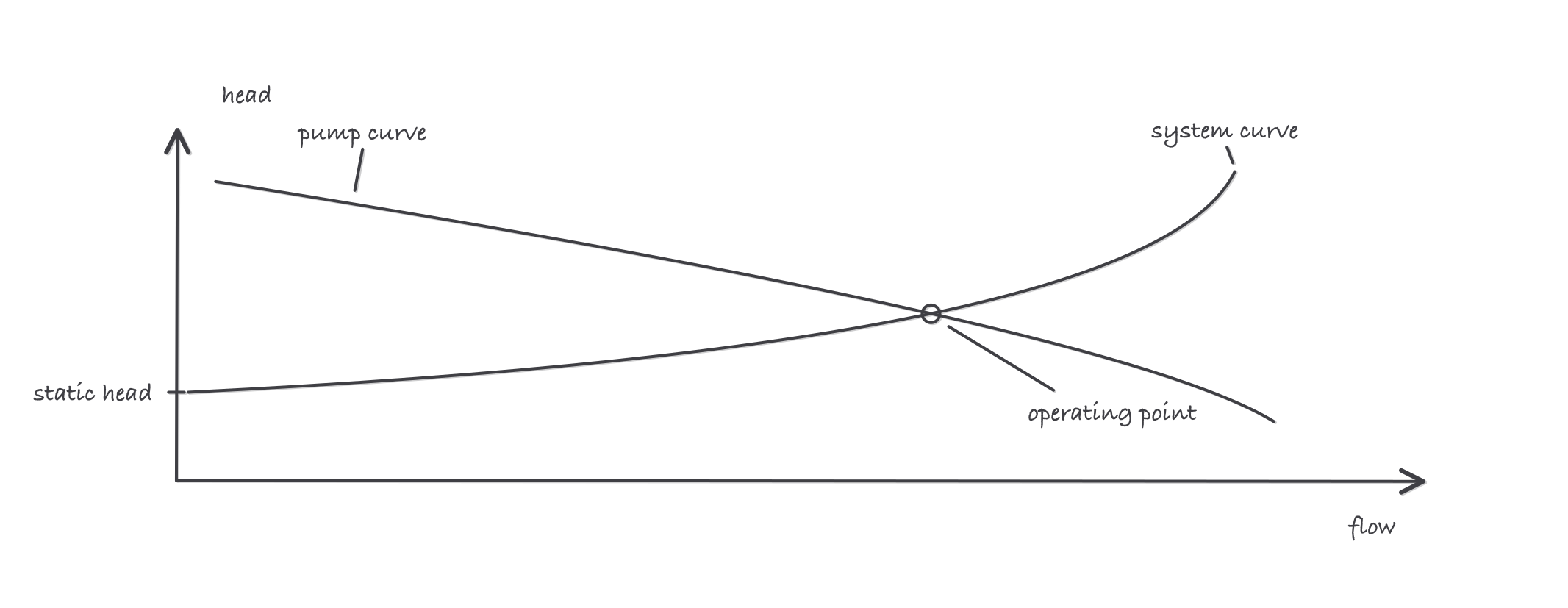
The pump runs where the curves cross: change either curve and the operating point moves
Throttle a discharge valve and you steepen the system curve, sliding the operating point left: less flow, more head. Open it and the point slides right. A worn impeller sags the pump curve itself. Reading symptoms as curve movements is what turns gauge-watching into diagnosis.
Cavitation: the sound of a starving pump
If the pressure at the impeller inlet drops too low (suction lift too high, suction line clogged, valve half-closed on the suction side), the water flashes into vapor bubbles, which collapse violently against the impeller as pressure recovers. That collapse is cavitation, and it sounds like the pump is pumping gravel or marbles. It hammers pits into the impeller, shakes bearings loose, and shortens a pump’s life dramatically.
The fix is always on the suction side: more submergence, a cleared strainer, a fully open suction valve, a flooded suction instead of a lift. Which points to the iron rule: throttle on the discharge side, never the suction. A discharge valve moves the operating point; a suction valve starves the pump.
Where it bites
- A pressure gauge reads only the water above and beyond it. Gauge pressure at the bottom of the plant tells you nothing about a closed valve two blocks away; map readings to the hydraulics, not to hope.
- 2.31 and 0.433 are inverses; use one, not both. Multiplying by the wrong constant is the classic exam slip. Feet to psi shrinks the number (×0.433); psi to feet grows it (×2.31). Sanity-check direction before moving on.
- Static head does not change when flow changes; friction head does. A pump that performed at winter flows and struggles at summer peak is meeting a steeper system curve, not necessarily failing.
- Gravel sounds mean stop and find the suction problem. Running a cavitating pump because “it is still moving water” trades a strainer cleaning today for an impeller replacement next month.