Business · Water and Wastewater
The Chief Operator Path
Part of Water Operator, Certified · step 18 of 23 · next: The Federal Frame: Why Every State Certifies Operators
In learning paths: Water Operator, Certified
Chief operator is the top of the plant’s ladder: the operator in responsible charge, the one whose name and grade the regulators hold accountable for what leaves the plant. It is where certification, process mastery, and supervision meet, and it is the destination this trade’s ladder was built to produce.
Why it matters on the job
Every plant of any size has exactly one person in this seat, and every operator below it is (knowingly or not) either building toward it or deciding not to. Knowing what the seat requires lets you make that decision on purpose and collect the right experience years before you need it.
What the chief operator owns
The title varies (chief operator, lead operator, operator in responsible charge), but the job is consistent:
- Compliance. The chief answers for permit limits, sampling schedules, and reporting to the state. When something is out of spec at 2 a.m., the escalation path ends here.
- The process. Setting treatment strategy, approving process changes, and being the tie-breaking judgment on anything the shift operators cannot settle.
- People. Scheduling, training, and signing off the logged experience that junior operators need for their own exam applications. Chiefs grow the next chiefs.
- The budget and the plant. Chemical purchasing, maintenance priorities, and the capital wish list usually route through the chief before management sees them.
The path there
The pattern across state programs is stable even where the details differ:
- Certification first. The plant’s classification sets the grade its responsible operator must hold, so a chief at a high-class plant needs one of the top grades on the state’s ladder. The exams get harder up the ladder precisely because they are screening for this seat: Class IV level exams test evaluation, supervision, and responsible-charge judgment, not routine operation.
- Years in the middle grades. Time as a shift operator at increasing grades is both the state’s experience requirement and where the process judgment actually forms.
- Supervision on purpose. Lead-operator and shift-lead roles are the apprenticeship for the people half of the job. Take them when offered, even without a pay bump: the resume line matters at chief-hiring time.
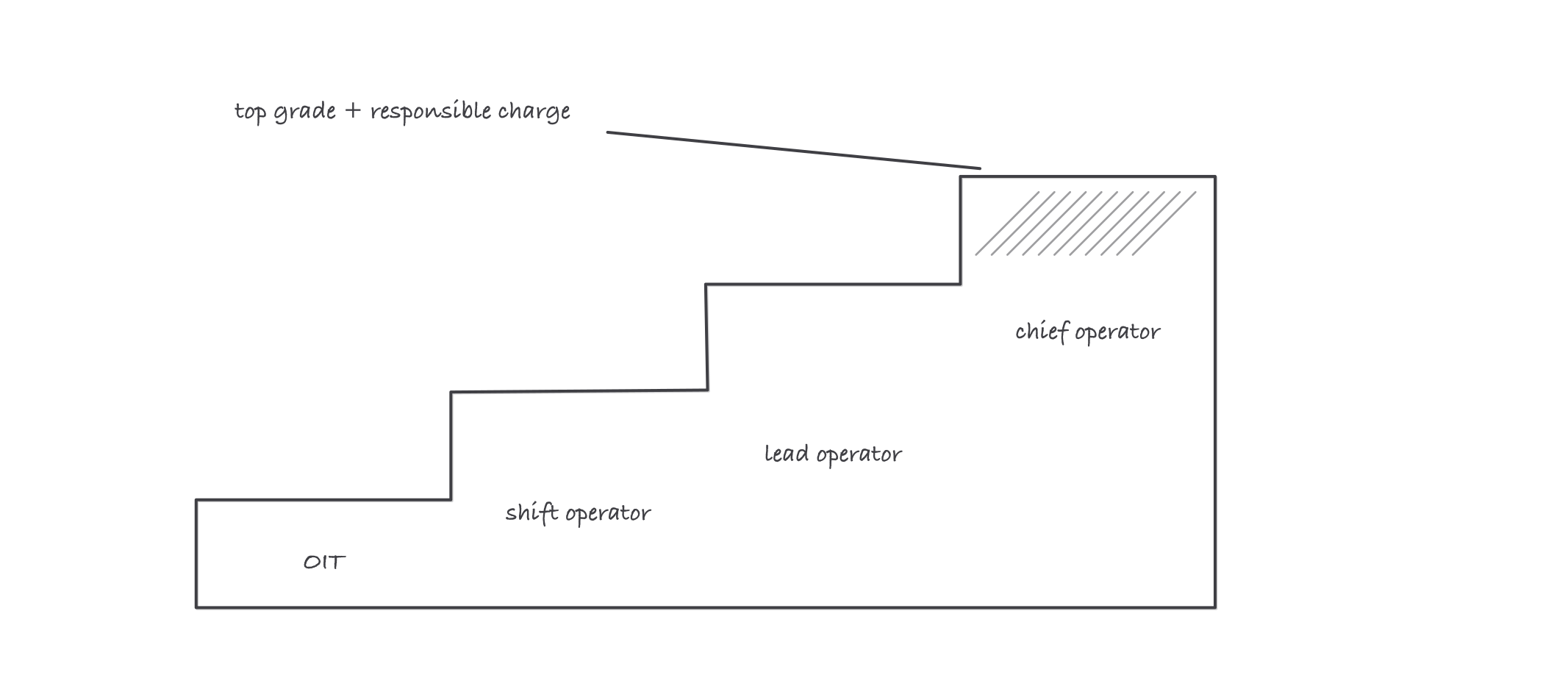
The seat at the top takes both halves: the state’s top grades and years of deliberately collected supervision
The numbers, honestly
The Bureau of Labor Statistics puts the 2024 median pay for water and wastewater treatment plant and system operators at $58,260 per year ($28.01 per hour), with chiefs and senior operators above the median. Employment is projected to decline 7 percent from 2024 to 2034 as plants automate, yet the occupation still averages around 10,700 openings a year, most of them replacing operators who retire. Declining employment, steady openings: an aging workforce means the ladder above you is emptying out on schedule, and the top grades are exactly where shortages bite hardest.
Where it bites
- The grade is necessary, not sufficient. Holding the top certificate does not make you a chief; plants hire chiefs on judgment and track record. But not holding it disqualifies you outright, so never let the certification lag your ambition.
- Small plants promote faster and teach narrower. You can reach responsible charge quickly at a small system, then find a big-plant chief job wants process breadth your plant never had. Trade breadth for speed deliberately, not accidentally.
- Supervision hours are easy to lose. If your state’s upper grades or your target job want documented supervisory experience, get lead assignments in writing as they happen. Reconstructing them at application time is painful.
Verified requirements
| Where | Expires | Renewal | Continuing education |
|---|---|---|---|
| California | Yes | Confirm with issuer | Continuing education required for renewal; approved-provider list and acceptable technical and safety topics published by DWOCP |
| California | Yes | Confirm with issuer | Confirm with issuer |
| Texas | Yes | 3 years | 30 hours of continuing education per 3-year term, including at least 2 hours of approved resiliency training (required for all water operators since April 1, 2024, under Senate Bill 3 after Winter Storm Uri). Class A and B operators may not count the Basic Water course for renewal credit. |
| New York | Yes | 5 years | Renewal training contact hours per 5-year cycle scale with grade: Grade 1/1A 20 hours, Grade 2/2A 40 hours, Grade 3/3A 60 hours, Grade 4/4A 80 hours |
| New York | Yes | Confirm with issuer | Confirm with issuer |
Information comes from issuing-authority sources. Confirm current rules, fees and eligibility with the authority before acting.