Learn · Water and Wastewater
Activated Sludge
Part of Water Operator, Certified · step 8 of 23 · next: Solids Handling and Digestion
In learning paths: Water Operator, Certified
Assumes you know: Preliminary and Primary Treatment
Activated sludge is a farmed culture of microorganisms that eats wastewater for a living. The plant keeps billions of bacteria suspended in an aerated basin, feeds them the incoming waste, settles them out in a clarifier, and pumps most of them straight back to eat again. The organisms are the treatment; everything the operator does is husbandry.
Why it matters on the job
Activated sludge is the most common secondary process in US plants, and it is the part of the job that separates operators from valve-turners. The process answers to a handful of numbers (F/M, MCRT, SVI), and senior operators adjust one thing daily to hold them: how much sludge to waste. Get the biology right and the plant nearly runs itself; get it wrong and no amount of downstream effort saves the effluent.
The loop
Mixed liquor is the working fluid: wastewater mixed with the microbial culture, kept suspended and oxygenated in the aeration basin. Its solids concentration is the MLSS (mixed liquor suspended solids), in mg/L.
From the basin, mixed liquor flows to the secondary clarifier, where the organisms settle out as a blanket of sludge and clear effluent leaves over the weirs.
The settled sludge splits two ways:
- RAS (return activated sludge) goes back to the aeration basin. This is the loop that keeps the culture concentrated and “activated”: returned organisms arrive hungry.
- WAS (waste activated sludge) leaves the loop for the solids train. The culture grows every day; wasting is how you harvest the growth and hold the population steady.
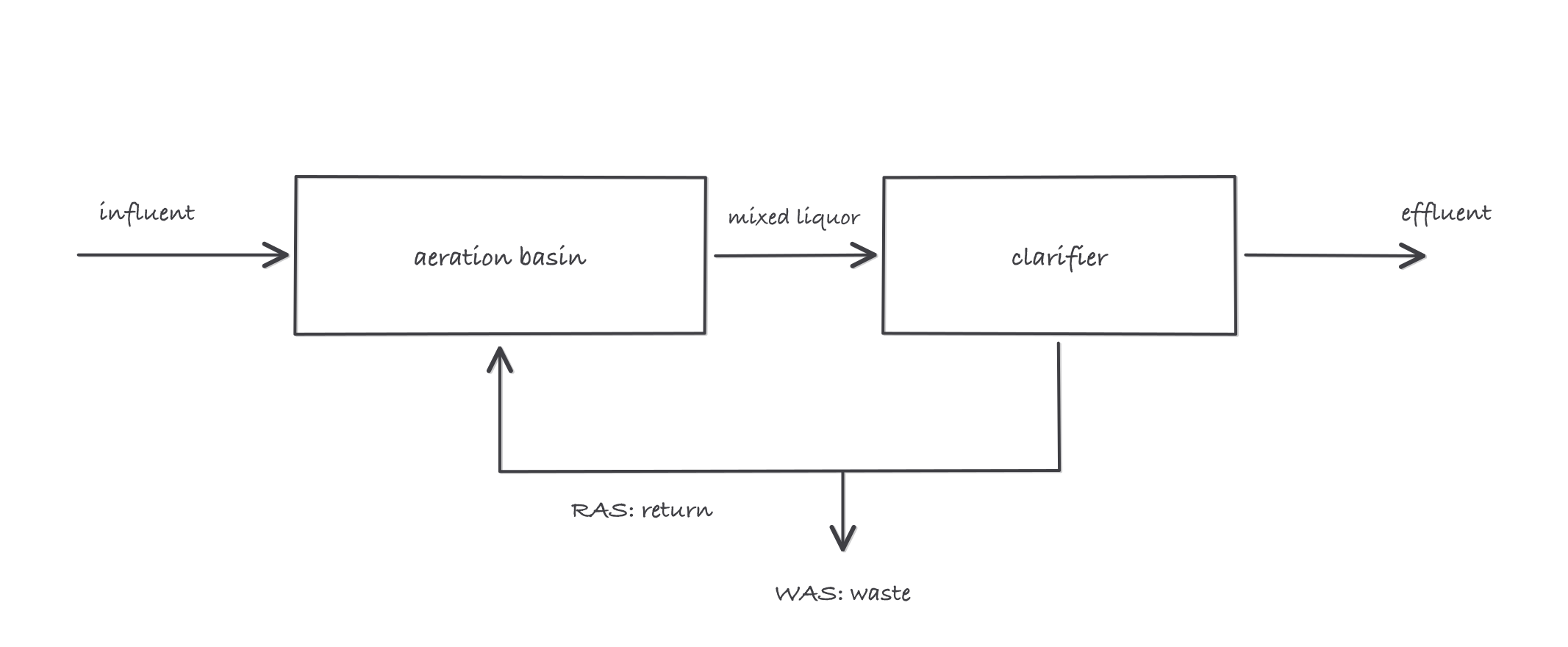
The loop is the process: return keeps the culture working, wasting keeps it the right size
The control numbers
F/M (food to microorganism ratio): pounds of BOD fed per day per pound of organisms under aeration. High F/M means a lean, fast-growing, hungry culture; low F/M means an old, dense, slow one. Plants pick a target range for their mode and hold it.
MCRT (mean cell residence time), also called SRT or sludge age: the average days an organism stays in the system before being wasted. Conceptually it is the solids inventory divided by the solids leaving per day. Longer MCRT grows an older, more stable culture (needed for nitrification); shorter MCRT keeps it young. Plant SOPs differ on exactly which tank volumes count in the inventory, so know which definition your plant’s number uses before comparing it to a book value.
SVI (sludge volume index) measures how well the sludge settles, from a 30-minute settling test on a mixed liquor sample.
The lever behind all three is the WAS rate. Waste more and MCRT drops, MLSS falls, F/M rises. Waste less and everything moves the other way. One valve, three numbers.
Worked example: SVI
Run a settleometer: fill a graduated cylinder with mixed liquor and read the settled sludge volume after 30 minutes. Suppose it reads 250 mL/L and the MLSS is 2,500 mg/L.
SVI = (settled volume, mL/L × 1,000) ÷ MLSS, mg/L
SVI = (250 × 1,000) ÷ 2,500 = 250,000 ÷ 2,500 = 100
An SVI around 100 indicates sludge that settles and compacts well. If the same 250 mL/L settled volume came with an MLSS of only 1,250 mg/L, the SVI would be 200: half the solids taking up the same volume, a light, fluffy sludge on its way to settling trouble.
Where it bites
- Bulking sludge settles poorly (high SVI), often because filamentous bacteria have taken over the floc. The clarifier blanket rises, and solids threaten to go over the weir. Bulking is a biology problem; the clarifier is only where it becomes visible.
- Old sludge makes its own problems. Push MCRT too long and you get pin floc and cloudy effluent, or a nitrified clarifier blanket that floats on nitrogen gas bubbles. More age is not more stability forever.
- RAS is not a cure for a rising blanket. Returning faster thins the return sludge and can push the real problem around the loop. Diagnose with the settling test first.
- MCRT, SRT, and sludge age drift between books and plants. Same idea, different calculation boundaries. When a number looks wrong, check the definition before the process.
- Air is for the bugs, not the number. Dissolved oxygen targets serve the culture; chasing a DO setpoint while F/M and MCRT drift is treating the gauge instead of the biology.