Learn · Water and Wastewater
Operator Math: Flows, Doses, Detention
Part of Water Operator, Certified · step 11 of 23 · next: Pumps and Hydraulics
In learning paths: Water Operator, Certified
Three calculations run the water and wastewater trades: converting flow between units, turning a chemical dose into a feed rate, and computing detention time. Nearly every certification exam problem, whatever it looks like on the surface, is one of these three wearing a costume. Learn them cold, with units attached, and the math section of any operator exam becomes the easiest points on the paper.
Why it matters on the job
This is working math, not exam decoration. The dose calculation sets tomorrow’s chemical feed. The flow conversion sizes the pump you are about to start. Detention time tells you whether the water is spending long enough in the tank to be treated. Operators do these on a clipboard, daily, and state exams at every grade test them because the job does.
Flow conversions: MGD, gpm, cfs
Plants speak three flow languages. Plant capacity lives in MGD (million gallons per day), pumps are rated in gpm (gallons per minute), and stream flow arrives in cfs (cubic feet per second). The bridges:
1 MGD ≈ 694 gpm ≈ 1.547 cfs
The 694 is worth sanity-checking once so you trust it forever: 1,000,000 gallons ÷ 1,440 minutes in a day = 694.4 gpm.
Convert 2.5 MGD to gpm: 2.5 × 694 = 1,735 gpm. To cfs: 2.5 × 1.547 = 3.8675, which rounds to 3.87 cfs.
The pound formula
Chemical doses are prescribed in mg/L, but you buy and feed chemicals by the pound. The bridge is the most important formula in the trade:
lbs/day = flow (MGD) × dose (mg/L) × 8.34
The 8.34 is the weight of one gallon of water in pounds. Flow must be in MGD, dose in mg/L, and the answer comes out in pounds per day.
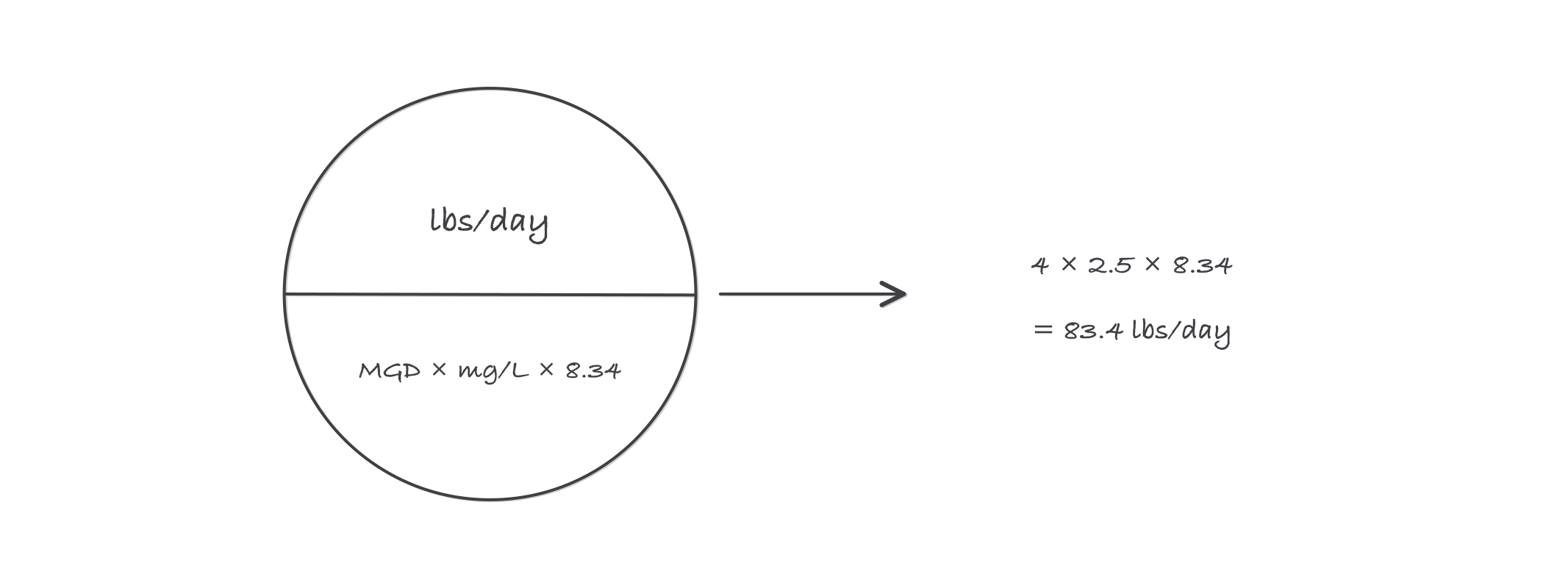
Cover the piece you want: the top is the product of the bottom, and any one piece is the top divided by the other two
The circle is the exam-day memory aid. Want pounds? Multiply everything in the bottom. Want the dose instead? Divide the pounds by the other two pieces.
Worked example: dose to feed rate, and back
A plant treating 4 MGD needs a chlorine dose of 2.5 mg/L:
lbs/day = 4 × 2.5 × 8.34 = 83.4 lbs/day
Now the reverse, the version exams love. The feeder ran at 500 lbs/day into the same 4 MGD. What dose did the water actually get?
dose = lbs/day ÷ (MGD × 8.34) = 500 ÷ (4 × 8.34) = 500 ÷ 33.36 = 14.988, which rounds to 15.0 mg/L
Same circle, different missing piece.
Detention time
Detention time is how long water stays in a tank: volume divided by flow, in matching units.
A 750,000 gallon clearwell receives 3 MGD:
Detention time = 750,000 ÷ 3,000,000 = 0.25 day × 24 = 6 hours
The classic trap is mixed units: a volume in gallons divided by a flow in gpm gives minutes; divided by MGD it gives days. Pick one unit system, convert everything into it, then divide.
Tank volumes
Exam problems supply tank dimensions, not volumes, so two more constants complete the kit: a cylinder’s volume is 0.785 × diameter² × depth (0.785 is π/4), and one cubic foot holds 7.48 gallons.
A circular clarifier 40 ft across and 20 ft deep:
Volume = 0.785 × 40 × 40 × 20 = 25,120 ft³
25,120 × 7.48 = 187,897.6, call it 187,900 gallons
Chain it: that clarifier at 1 MGD gives 187,900 ÷ 1,000,000 = 0.188 day × 24 = 4.5 hours of detention. Most real exam problems are exactly this kind of chain: dimensions to volume to detention, or flow to dose to pounds.
Where it bites
- The pound formula eats MGD only. 700 gpm is roughly 1 MGD; convert first, then multiply.
- Percent and mg/L are the same axis. 1% = 10,000 mg/L. Sludge and solution-strength problems switch between them mid-problem; convert deliberately, not by feel.
- Carry your decimals through the chain. Round only at the end: 500 ÷ 33.36 is 14.988, and writing 15 too early can push a multi-step answer off the choices list.
- Units are the answer key. Write them at every step. When the units cancel to what the question asks for, the setup is right; when they do not, no arithmetic can save it.