Learn · Water and Wastewater
Disinfection: Chlorination and Alternatives
Part of Water Operator, Certified · step 4 of 23 · next: Water Quality Testing
In learning paths: Water Operator, Certified
Assumes you know: Sedimentation and Filtration
Disinfection inactivates the pathogens that survived every barrier upstream, and chlorine remains the workhorse because it does something no other common disinfectant does as well: it keeps working after the water leaves the plant. That lingering protection is called a residual, and understanding the difference between kinds of residual is most of this lesson.
Why it matters on the job
Disinfection is the public health line. Filtration removes most microorganisms, but disinfection is the barrier aimed squarely at the ones that remain, and it is the process regulators watch most closely. Operators measure residuals daily, calculate contact time, and answer for both.
Free, combined, and total residual
When chlorine dissolves in clean water it forms free chlorine residual: the strong, fast-acting disinfectant you want.
But raw water is not clean. Chlorine reacts first with whatever else is in the water, and with ammonia it forms chloramines, also called combined residual: a weaker, slower disinfectant that nonetheless persists a long time in the pipes.
Total residual = free + combined. A test kit can report all three, and “chlorine residual” without a qualifier is ambiguous. Know which number your permit and your test method are talking about.
Breakpoint chlorination
Add chlorine to water containing ammonia and watch the residual as the dose climbs, and you get a curve with a surprise in it. At first the residual rises as chloramines form. Then it falls: more chlorine begins destroying the chloramines it created. Only after the ammonia is fully oxidized, at the breakpoint, does added chlorine finally show up as free residual, rising steadily from there.
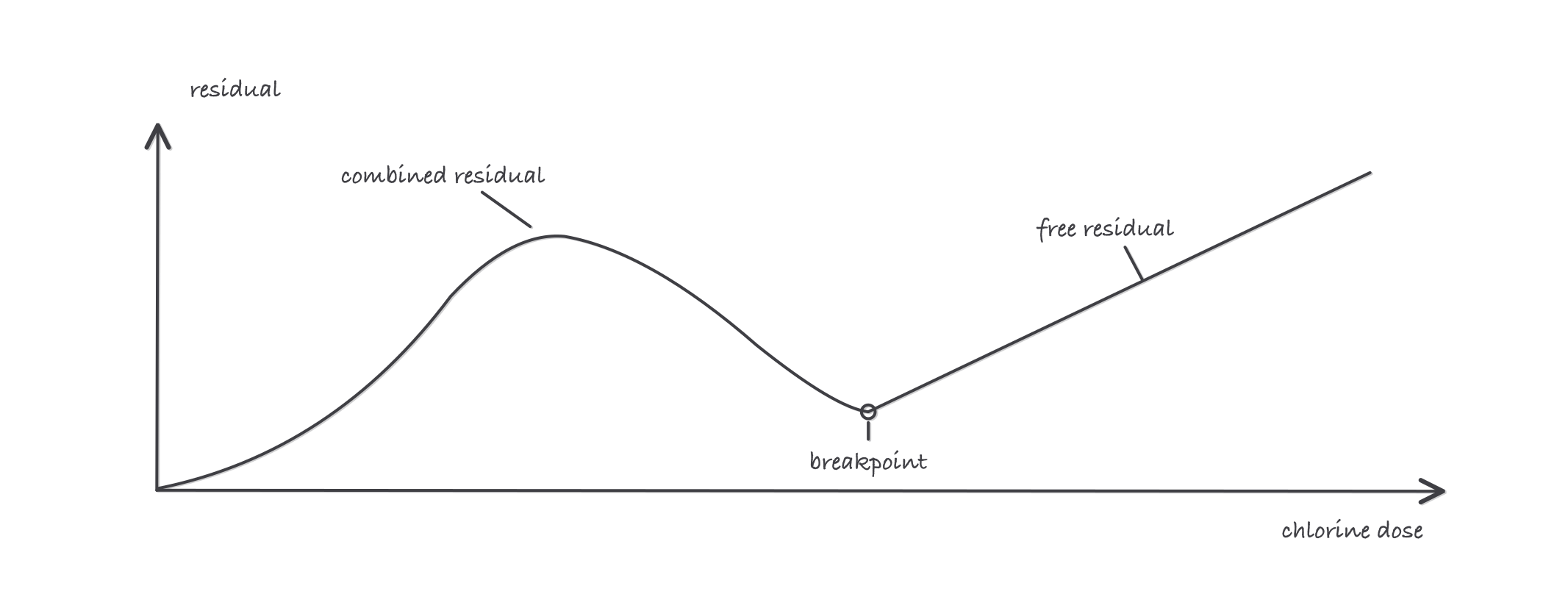
Until the breakpoint, more chlorine does not mean more free residual
The practical meaning: a plant that wants free residual must dose past the breakpoint. A plant that wants chloramines on purpose (many do, for a long-lasting distribution residual with fewer disinfection byproducts) stays deliberately on the near side of the curve.
CT: concentration times time
Killing power is not concentration alone. It is concentration multiplied by contact time: CT, in mg/L times minutes. A low residual for a long time can equal a high residual for a short time. State rules assign required CT values based on the pathogen target and water conditions, and the plant must prove it provides them before the first customer.
Worked example: CT through a clearwell
A clearwell holds 100,000 gallons and the plant runs at 1 MGD, which is 694 gpm.
Theoretical contact time = volume ÷ flow = 100,000 ÷ 694 = 144 minutes.
But water short-circuits through open tanks, so the state assigns a baffling factor based on the tank’s design. Suppose this clearwell rates 0.5:
Effective time T = 144 × 0.5 = 72 minutes.
With a free residual C of 1.0 mg/L measured at the clearwell outlet:
CT = 1.0 × 72 = 72 mg·min/L
Compare that against the CT your state’s tables require for the conditions that day. If flow doubles, contact time halves, and CT halves with it. High-flow days are the days disinfection gets tight.
Alternatives to chlorine gas
- Sodium hypochlorite (bleach): same chemistry, easier handling than gas.
- Chloramination: adding ammonia deliberately to form a persistent combined residual for the distribution system.
- UV light: excellent inactivation, no chemicals, but no residual at all. Water leaves the lamp unprotected.
- Ozone: powerful oxidant, no lasting residual either.
Because US systems must maintain a residual in distribution, plants using UV or ozone still add chlorine or chloramine before the water leaves. The residual requirement, not the kill, is why chlorine never fully leaves the building.
Where it bites
- A DPD test reads what you ask it to read. The free-chlorine reagent and the total-chlorine reagent are different tests. Reporting a total reading as free overstates your real disinfecting power.
- More chlorine can mean less residual. On the falling side of the breakpoint curve, raising the dose lowers the measured residual. Operators who do not know the curve chase their own tails here.
- Chloramines are persistent, not strong. They hold a residual through long dead-end mains but need far more CT for the same kill. Never treat combined residual as interchangeable with free.
- CT is measured at worst case: peak flow, coldest water, lowest residual. Passing on an average day proves nothing.