Learn · Water and Wastewater
Sedimentation and Filtration
Part of Water Operator, Certified · step 3 of 23 · next: Disinfection: Chlorination and Alternatives
In learning paths: Water Operator, Certified
Assumes you know: Coagulation and Flocculation
Sedimentation lets gravity pull the floc out of the water; filtration catches what gravity missed. Together they take water from cloudy to clear, and they are judged by the same number: the turbidity of the water leaving them.
Why it matters on the job
These two processes carry the particle-removal load of the whole plant, and both are controlled by rates you calculate, not guess. Run a clarifier too fast and floc rides over the weirs. Run a filter too long and particles break through into finished water. Operators live on the numbers this lesson teaches.
Sedimentation: slow water, sinking floc
A sedimentation basin (clarifier) works by giving the water almost nothing to do. Flow spreads out across a large, deep basin, velocity drops to a crawl, and the floc built upstream settles to the floor as sludge while clear water rises over the outlet weirs at the far end.
Two numbers govern the basin:
- Detention time: how long the water stays inside, on average. Volume divided by flow.
- Surface loading rate: flow divided by the basin’s surface area, in gpm per square foot. It describes how fast water rises toward the weirs; floc must sink faster than the water rises, or it leaves with the water.
Settled sludge is scraped to hoppers and pumped out for handling. Let it sit too long and it turns septic and refloats.
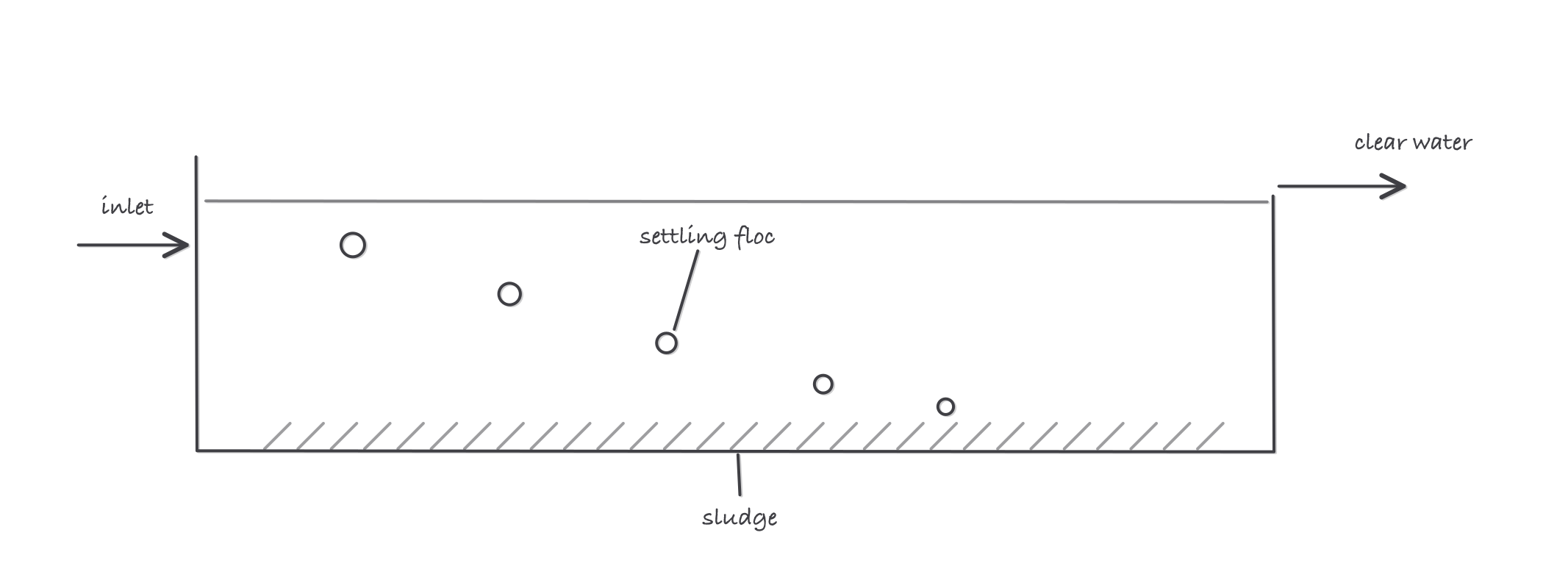
The race inside every clarifier: floc must reach the floor before the water reaches the weir
Filtration: the last barrier for particles
The settled water then passes down through a granular media filter, commonly anthracite coal over sand. Particles are trapped in the bed’s pore spaces through the depth of the media, not on the surface alone.
As a run progresses, the bed clogs and head loss (the pressure needed to push water through) climbs. Eventually one of three things ends the run: head loss hits its limit, effluent turbidity starts creeping up, or the run reaches its scheduled hours. The filter then backwashes: flow reverses, the bed expands, and the trapped solids wash out to a recovery basin. Backwash water is a plant-sized flow for a few minutes, and it is the price of every filter run.
Worked example: the two rates
Detention time. A clarifier holds 500,000 gallons and treats 2 MGD (2,000,000 gallons per day).
Detention time = volume ÷ flow = 500,000 ÷ 2,000,000 = 0.25 day
0.25 day × 24 hours = 6 hours
Filter loading rate. A filter box measures 20 ft by 20 ft, so its surface area is 400 ft². It receives 700 gpm.
Loading rate = flow ÷ area = 700 ÷ 400 = 1.75 gpm/ft²
If flow to the plant doubles, both numbers move against you at once: detention time halves and the loading rate doubles. That is why a flow increase is a process decision, not a valve turn.
Where it bites
- The first water after backwash is the dirtiest of the run. The bed needs time to ripen and start catching particles again, which is why many plants filter-to-waste for the first minutes instead of sending that water forward.
- Short-circuiting steals detention time. Wind, temperature currents, or bad inlet baffling can cut a channel through the basin, so real detention time is less than calculated. The calculation is a ceiling, not a guarantee.
- Filters polish; they do not rescue. A filter fed poorly coagulated water sheds turbidity no matter how well you run it. Fix the chemistry upstream.
- Rising head loss is normal; rising effluent turbidity is not. Head loss says the filter is working. Turbidity breakthrough says it has stopped, and the run must end regardless of the schedule.