Learn · Water and Wastewater
Effluent Limits and NPDES Permits
Part of Water Operator, Certified · step 10 of 23 · next: Operator Math: Flows, Doses, Detention
In learning paths: Water Operator, Certified
Assumes you know: Activated Sludge
An NPDES permit is the legal contract between a treatment plant and the water it discharges to. Under the Clean Water Act, no one may discharge a pollutant to US waters except under a National Pollutant Discharge Elimination System permit, and the permit’s core is a table of effluent limits: the specific numbers your plant’s discharge must meet, measured at a defined sampling point, proven by your own reported data.
Why it matters on the job
The permit is why the plant exists in its current shape, and the senior operator is the person who answers for it. Every process decision upstream eventually lands in one place: the numbers on next month’s report. Operators sign those reports. Knowing what your permit requires, exactly, is not optional at this career stage.
What a permit limits
Permits are written plant by plant, based on the receiving water and the treatment technology, so the exact table is yours alone. The pattern, though, repeats across most municipal permits:
- Oxygen-demanding organics: BOD5 or CBOD5, because they strip dissolved oxygen from the stream.
- TSS: suspended solids that silt and smother.
- pH: held inside a band.
- Bacteria: an indicator such as E. coli or fecal coliform, protecting downstream contact and use.
- Ammonia and nutrients: toxic to fish and fuel for algae; increasingly common as limits tighten.
- Chlorine residual: if you disinfect with chlorine, the residual that protected drinking water pipes is toxic in a stream, so many permits cap it near zero and plants dechlorinate to comply.
Each parameter typically carries more than one number: a monthly average, a weekly average, and a daily maximum are the classic trio, and some parameters carry mass loading limits and percent-removal requirements as well.
Concentration, loading, and percent removal
A concentration limit (mg/L) says how strong the discharge may be. A mass loading limit (lbs/day) says how much total pollutant may leave, no matter how much water carries it, which prevents dilution from hiding a problem. Percent removal requires the plant to actually treat, even when the influent arrives weak. Many permits use all three at once.
Worked example: are we under the loading limit
Suppose a permit’s mass loading limit for BOD5 is 300 lbs/day. Today’s effluent BOD5 is 15 mg/L at a flow of 2 MGD:
lbs/day = flow (MGD) × concentration (mg/L) × 8.34
lbs/day = 2 × 15 × 8.34 = 250.2 lbs/day, under the limit
Now watch what flow does. Same 15 mg/L quality at 3 MGD:
lbs/day = 3 × 15 × 8.34 = 375.3 lbs/day, over the limit
The concentration never moved, and the plant still went out of compliance on load. High-flow days can violate a loading limit with water that looks fine in the beaker.
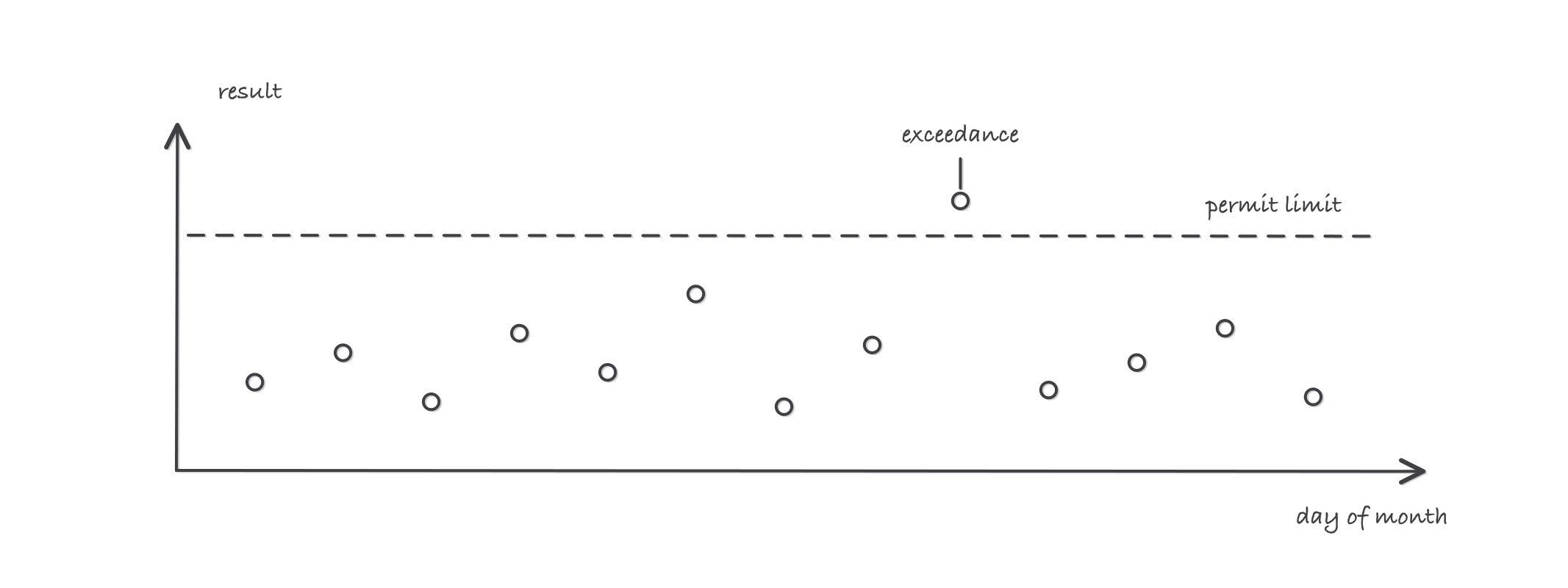
Compliance is every result under the line: one point above it is a reportable exceedance
DMRs: the proof
Compliance is self-reported on discharge monitoring reports (DMRs), filed with the state or EPA on the schedule the permit sets, usually monthly. The permit dictates the sampling location, frequency, and the exact analytical method for each parameter. If it names CBOD5, a BOD5 result is not the required test. The terminology lesson on oxygen-demand tests explains why they read differently. The data comes from your own lab and your own samples, and the signature on the report certifies it.
Exceedances
Go over a limit and the sequence is: document it, report it (serious events such as plant upsets or bypasses carry immediate notification duties, in addition to the DMR), find the cause, and correct it. Penalties under the Clean Water Act can be severe, and falsified reports are treated as crimes rather than paperwork errors. The operator’s protection is the honest record: an exceedance reported promptly, explained, and corrected is a manageable event; a hidden one ends careers.
Your permit, your state permitting agency, and EPA’s NPDES program are the authorities on what applies to your outfall. When this lesson and your permit differ, the permit wins, every time.
Where it bites
- BOD5, CBOD5, and COD are three different tests. The permit names one. Reporting another is a reporting violation even when the treatment is fine.
- Monthly averages hide daily disasters. A great month plus one bad day can still violate the daily maximum. Track against the tightest limit, not the friendliest.
- Loading limits punish wet weather. Compliance on concentration is not compliance on mass. Storm flow is a permit event, not only a hydraulic one.
- The sample point is part of the limit. Results are taken where the permit says, after the processes it says. A perfect grab from the wrong place proves nothing.