Qualifications · Water and Wastewater
Grade Exams: What Each Level Tests
Part of Water Operator, Certified · step 16 of 23 · next: Operator Certification by State (WPI Reciprocity)
In learning paths: Water Operator, Certified
Assumes you know: Operator Certification: The Mandatory Ladder
A grade exam tests whether you can run the class of system that grade unlocks. That single sentence explains the whole design: the questions at each level track the knowledge a real operator needs at that size and complexity of system, and there is a published specification saying exactly what that knowledge is.
*Learn the Trades is a free study resource. We are not a licensing body, an authorized training provider, or an exam administrator. Reading this page does not award any card, license, or certification. Always verify requirements with the issuing authority linked in the sources.*Why it matters on the job
Operators lose exam attempts (and months of waiting) by studying the wrong level: drilling advanced process control for an entry exam, or walking into a top-grade exam with entry-level math. Knowing how the levels differ lets you study what your exam actually tests and nothing else.
The four classes
The standardized exams most states use come from WPI (formerly ABC) in four series: water treatment, water distribution, wastewater treatment, and wastewater collection. Each series is written at four levels, Class I through Class IV, with Class I the entry point and Class IV the top. Your state decides which series and classes it administers and how they map onto its own grade names.
What changes as the class number climbs is not the subject list. It is depth and judgment:
- Class I expects you to know what the processes are, run routine tasks safely, and handle the fundamental math: flows, doses, conversions.
- Class II and III expect you to control processes, not only run them: interpret test results, adjust treatment, troubleshoot, and carry harder calculations.
- Class IV expects responsible-charge thinking: evaluating whole processes, supervising people, and answering for compliance at large, complex systems.
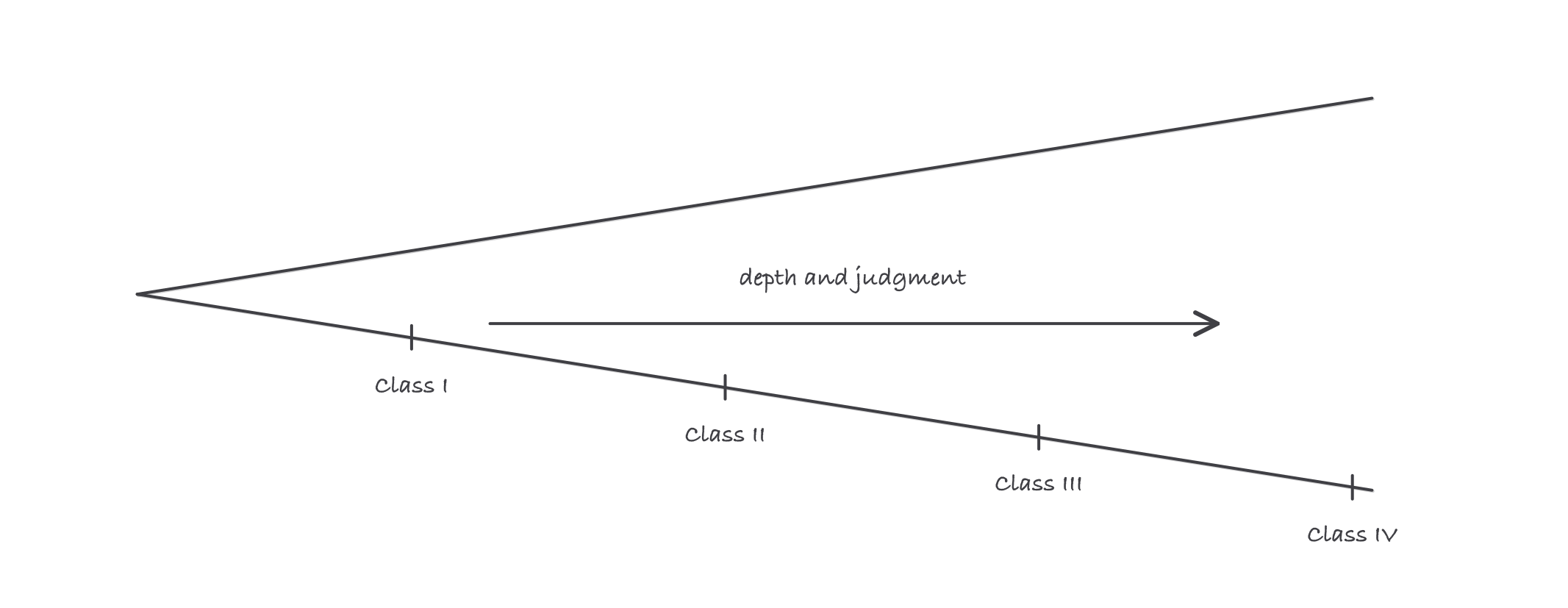
Same subjects at every level: what grows from Class I to Class IV is how deeply you must command them
The specification: Need-to-Know Criteria
Every WPI exam is built against its published Need-to-Know Criteria: a document per series that breaks down, class by class, the tasks and knowledge the exam draws from. This is the closest thing to a syllabus that exists in this trade. The current criteria are the 2025 edition, which replaced the 2019 set, so check the date on anything you download: older criteria still circulate.
Question counts and time limits are not published on WPI’s public pages. Your state’s exam handbook or candidate bulletin is the authority for those logistics, along with fees and scheduling.
Worked example: planning a Class II study run
You operate a small surface water plant and your state has approved you for its Class II water treatment exam.
- Download the 2025 Need-to-Know Criteria for the water treatment series from WPI.
- Read the Class II column, not the whole document. Note which tasks first appear at Class II: those are the level’s signature questions.
- Cross off everything you do weekly at the plant. What remains (typically the processes your plant does not run) is your study list.
- Book math practice last and heaviest. Calculation questions appear at every class.
Where it bites
- Class is not grade. WPI numbers exam classes I to IV; your state’s certificate grades may use other names and even a different count. Always translate through your state program, never assume Class II equals “Grade 2.”
- Old criteria look official. The 2019 documents are still easy to find and still look authoritative. Study the 2025 edition.
- The exam is necessary, not sufficient. Passing at a class does not by itself put a certificate in your hand: experience and education requirements, and your state’s paperwork, complete the rung.
Exam relevance
This lesson is the map of the exams themselves. The lessons that follow cover who writes them and how your state administers them; the operator-math and process lessons in this trade are the content the criteria point at.
Verified requirements
| Where | Expires | Renewal | Continuing education |
|---|---|---|---|
| California | Yes | Confirm with issuer | Continuing education required for renewal; approved-provider list and acceptable technical and safety topics published by DWOCP |
| California | Yes | Confirm with issuer | Confirm with issuer |
| Texas | Yes | 3 years | 30 hours of continuing education per 3-year term, including at least 2 hours of approved resiliency training (required for all water operators since April 1, 2024, under Senate Bill 3 after Winter Storm Uri). Class A and B operators may not count the Basic Water course for renewal credit. |
| New York | Yes | 5 years | Renewal training contact hours per 5-year cycle scale with grade: Grade 1/1A 20 hours, Grade 2/2A 40 hours, Grade 3/3A 60 hours, Grade 4/4A 80 hours |
| New York | Yes | Confirm with issuer | Confirm with issuer |
Information comes from issuing-authority sources. Confirm current rules, fees and eligibility with the authority before acting.