Learn · Water and Wastewater
Water Quality Testing
Part of Water Operator, Certified · step 5 of 23 · next: Wastewater Treatment Overview
In learning paths: Water Operator, Certified
Assumes you know: Water Treatment: Source to Tap
Water quality testing is how a plant proves, hour by hour, that its barriers are working. Four measurements carry most of the routine load: turbidity, chlorine residual, pH, and coliform bacteria. Each one answers a different question, and the fastest way to misread a result is to confuse what the test actually measures.
Why it matters on the job
Operators run these tests, log them, and report them to the state. The numbers drive process decisions in real time: a turbidity bump ends a filter run, a low residual raises the chlorine feed, a coliform hit triggers resampling and notification procedures. Testing is not paperwork after the job; it is the job.
Turbidity: how the water scatters light
Turbidity is cloudiness, measured by shining a light through a sample and reading how much of it scatters off particles. The unit is the NTU (nephelometric turbidity unit). It is an optical proxy for particles, not a weight of anything: a turbidimeter never tells you what the particles are or how many milligrams you have, only how much light they scatter. It is the plant’s most-watched number because it responds instantly and tracks filter performance in real time.
Particles versus dissolved: TSS and TDS
Push a sample through a fine filter and you split the solids into two different worlds.
TSS (total suspended solids) is what the filter catches: the particle mass, dried and weighed, reported in mg/L. TDS (total dissolved solids) is what passes through: salts and minerals in true solution, measured by evaporating the filtered water or by its electrical conductivity.
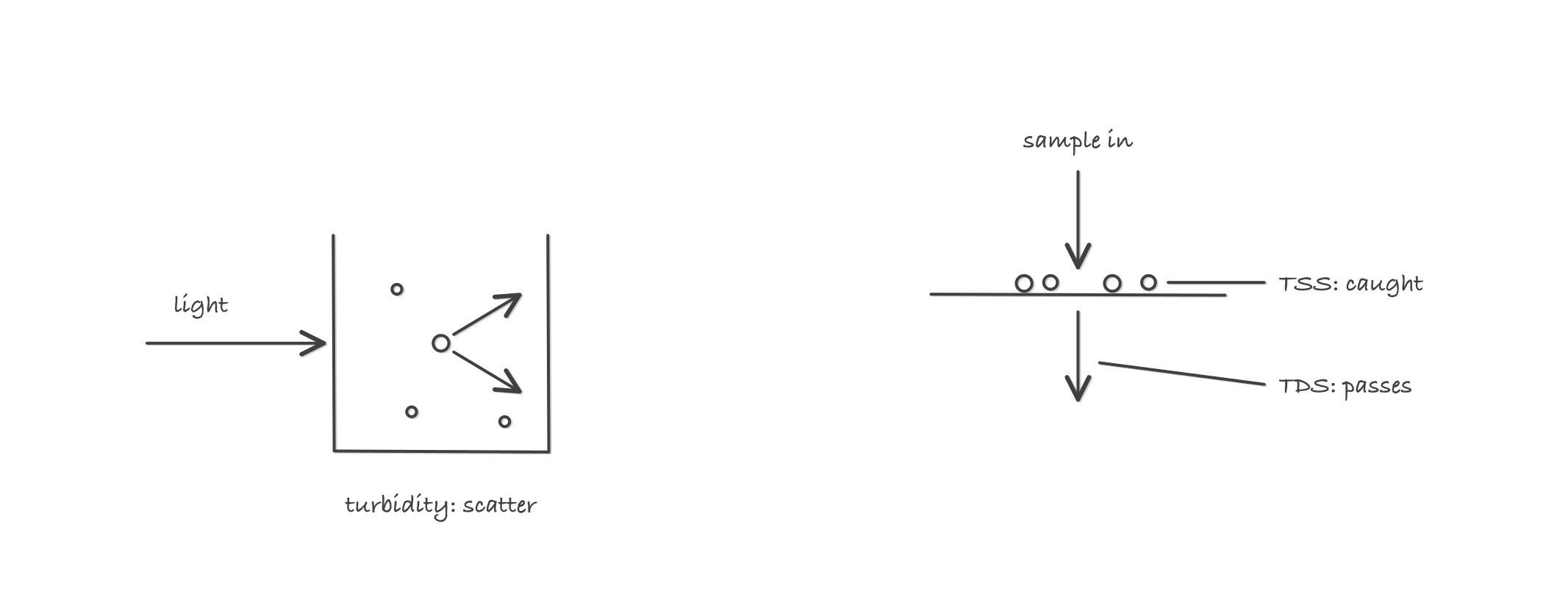
One sample, three different answers: what the filter catches, what passes through, and how the light scatters
The trap: crystal-clear water can have high TDS. Dissolved salt scatters no light, so turbidity and TSS read low while conductivity reads high. Treatment that removes particles (coagulation, settling, filtration) barely touches TDS at all.
Chlorine residual: the protection still in the water
The standard field method is the DPD test: a reagent turns the sample pink in proportion to the chlorine present. Different reagents distinguish free residual from total residual, and the difference between those two readings is the combined (chloramine) residual. The disinfection lesson covers why the distinction matters; the testing point is that you must know which reagent you used and report the right number.
pH and coliforms
pH measures how acidic or basic the water is, on the 0 to 14 scale with 7 neutral. It matters because chlorine chemistry, coagulation, and corrosion control all shift with pH; a drifting pH quietly changes how well every chemical in the plant works.
Coliform bacteria are indicator organisms. Most are harmless, but they live where pathogens live, so their presence flags a pathway for contamination. Samples incubate in a lab; a positive result triggers repeat sampling and, depending on the follow-up, public notification under your state’s rules. Coliform testing answers “did anything get through” rather than “is this pathogen present.”
Worked example: reading a DPD pair
You test finished water twice with DPD reagents:
- Free chlorine reading: 0.8 mg/L
- Total chlorine reading: 1.1 mg/L
Combined residual = total − free = 1.1 − 0.8 = 0.3 mg/L
The disinfecting power you count on for CT purposes is the 0.8 of free residual, not the 1.1. If you had run only the total test, the water would look better protected than it is.
Where it bites
- Turbidity is not TSS. One is light scatter in NTU, the other is particle mass in mg/L. They usually move together, but there is no fixed conversion between them, and exams bait the swap.
- A total residual reported as free overstates protection by the size of the combined fraction. Label your readings.
- Coliforms are indicators, not the disease. A positive does not mean people are sick; it means the barrier integrity question must be answered now.
- Sample handling ruins good tests. Chlorine residual fades in the bottle, so residuals are field tests, run on the spot; bacteriological samples need clean technique and time limits. A perfect lab cannot fix a bad sample.