Learn · Linework
Qualified Employee: What OSHA Requires You to Know
Part of Groundman to Journeyman Lineworker · step 8 of 23 · next: Minimum Approach Distance
In learning paths: Groundman to Journeyman Lineworker
Assumes you know: OSHA 1910.269: The Standard That Governs Line Work
“Qualified employee” under OSHA 1910.269 is a demonstrated training status, not a card: it means your employer has trained you in a specific set of competencies for specific work and has determined, through demonstrated proficiency, that you actually have them. No class, card or certificate confers it by itself, and no lineworker holds it in the abstract; you are qualified for tasks and voltages, established by your employer.
Why it matters on the job
The word gates the work. Throughout the standard, energized tasks, entry to certain spaces, and reduced approach distances are written as things a qualified employee may do and others may not. Misunderstanding qualification as a credential you collect (rather than a status your employer must establish and maintain) is one of the trade’s foundational errors, and it shows up in hiring ads, resumes and toolbox talks alike.
The five competencies
Under 1910.269(a)(2)(ii), qualified employees must be trained and competent in:
- Distinguishing exposed live parts. The skills and techniques to tell which parts of the equipment in front of you are exposed and energized.
- Determining nominal voltage. The skill to establish what voltage those parts operate at, because every protective decision keys off it.
- Minimum approach distances. The distances the standard specifies for the voltages you work, and the voltages they correspond to.
- Proper use of protective methods and tools. Special precautionary techniques, personal protective equipment, insulating and shielding materials, and insulated tools and test equipment.
- Recognizing and controlling the hazards. Identifying the electrical hazards of the work and the techniques to control or avoid them.
Notice the shape: identify the hazard (1, 2), know the boundaries (3), use the defenses (4), and put it together in judgment (5).
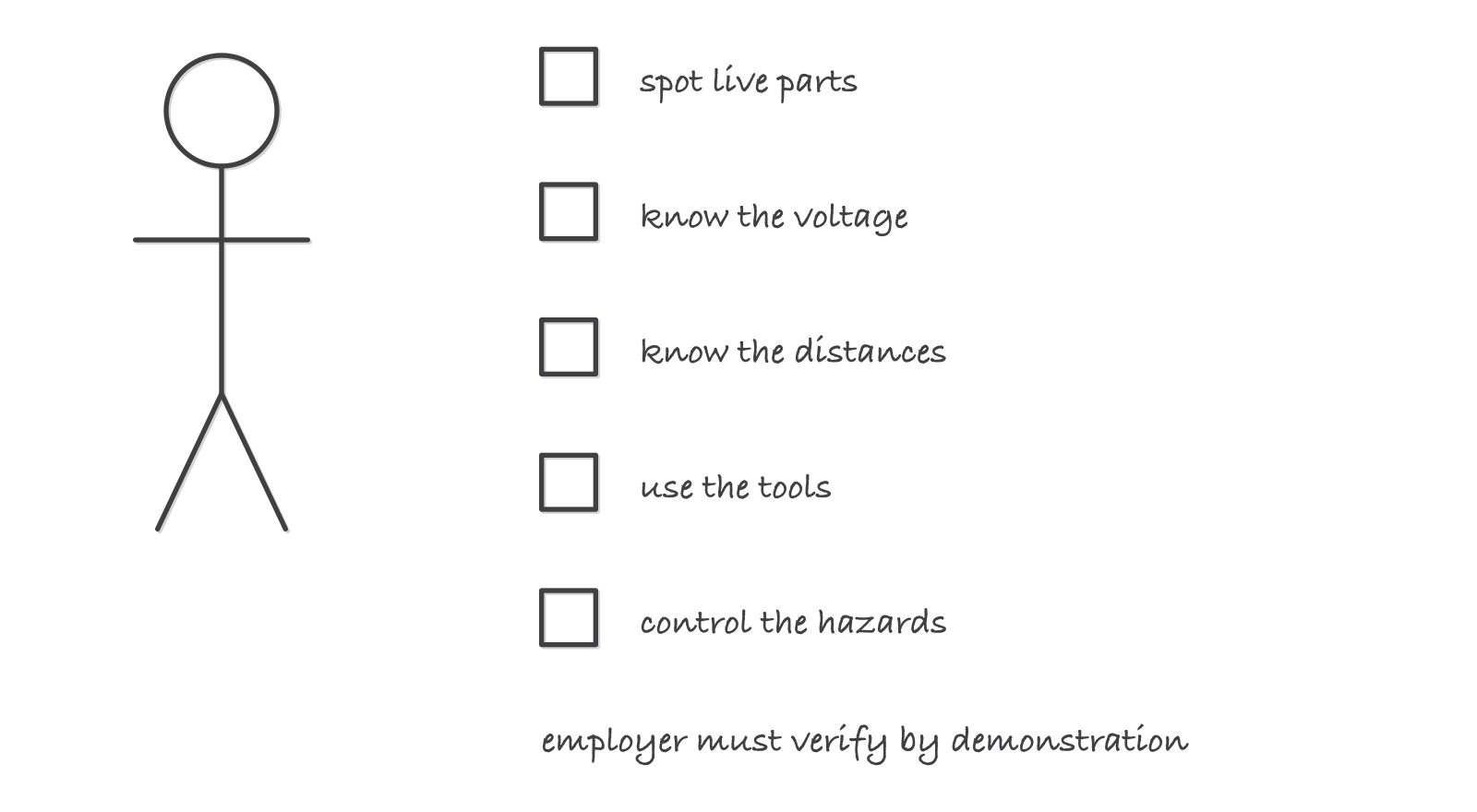
Qualification is five demonstrated competencies, verified by the employer, tied to the tasks and voltages you work
Demonstrated proficiency, and what undoes it
Training alone is not enough. The standard requires the employer to determine, through regular supervision and inspection, that each employee is complying with safety-related work practices, and to confirm demonstrated proficiency in the work before treating an employee as qualified. Retraining is required when supervision or inspections show an employee is not following the practices, when new technology, equipment or procedures change the work, or when an employee must use practices they do not normally use.
An apprentice can be qualified for some tasks long before journeyman status; a twenty-year hand can need retraining when the utility adopts a new method. The status tracks current competence, not tenure.
Worked example: is this employee qualified for this task
A second-step apprentice is asked to test and ground a deenergized 12.47 kV tap under a journeyman’s direction.
Ask the standard’s questions: Has the apprentice been trained to recognize the live parts and determine the voltage on this construction? Do they know the minimum approach distances for 12.47 kV work? Have they been trained on the voltage detector and grounding equipment being used? Has the employer verified, by watching them do it, that they perform the procedure correctly? If any answer is no, the task is not theirs yet, regardless of hours logged. If every answer is yes, they can be qualified for this task while remaining unqualified for others (energized rubber-glove work, for instance) until the same chain is built there.
Where it bites
- “OSHA qualified” is not a thing you get from a course. Courses teach; only your employer’s determination, tied to your demonstrated proficiency on your system, makes you qualified. Be suspicious of any offer to sell qualification.
- Qualification does not travel automatically. A new employer must establish your status for its own work, voltages and procedures. Experienced hires get evaluated, not grandfathered.
- Journeyman and qualified are different axes. Journeyman is a trade status conferred by apprenticeship completion; qualified is a regulatory status per task. Each can exist without the other, and the trade needs you to keep the words straight.