Learn · Linework
OSHA 1910.269: The Standard That Governs Line Work
Part of Groundman to Journeyman Lineworker · step 7 of 23 · next: Qualified Employee: What OSHA Requires You to Know
In learning paths: Groundman to Journeyman Lineworker
Assumes you know: How Power Gets Delivered: Generation to Meter
OSHA 1910.269 is the federal standard for the operation and maintenance of electric power generation, transmission and distribution installations: one regulation that follows the power system from the plant fence to the service drop. Every line-crew practice you will learn (qualification, approach distances, clearances, grounding, energized methods) is an implementation of a paragraph in this standard.
Why it matters on the job
Line work is one of the few trades governed by a single, purpose-built OSHA standard rather than a patchwork of general rules. That makes 1910.269 the trade’s common law: utilities and contractors write their safety manuals against it, apprenticeships teach to it, and incident investigations quote it by paragraph letter. Knowing its map (not its every word) tells you where any safety question lives.
What it covers, and what it does not
Covered. Work on or associated with power generation, transmission and distribution installations: lines, equipment, substations, generation plants’ electric-supply side. The standard also carries special provisions for line-clearance tree trimming, the vegetation work done near energized lines by crews who are not fully qualified lineworkers.
Not covered here. Construction of new transmission and distribution lines falls under OSHA’s construction rules, 29 CFR 1926 Subpart V. The two standards were harmonized in 2014 so their technical requirements align, but they remain separate: operation and maintenance cite 1910.269, construction cites Subpart V. General electrical work in ordinary workplaces (the inside wireman’s territory) lives under Subpart S, not here.
The map of the standard
The paragraphs you will hear cited constantly:
- (a) Training and qualification. Who may do what, and the competencies a qualified employee must demonstrate. The qualified employee lesson unpacks it.
- (l) Working on or near exposed energized parts. The heart of energized work: minimum approach distances and the requirement that work on parts energized above 600 volts have at least two employees, with narrow exceptions.
- (m) Deenergizing lines and equipment. The clearance system: system operator control, tags, testing, release. The switching and tagging lesson walks it.
- (n) Grounding. Protective grounding for deenergized work: treat as energized until tested and grounded, grounds sized for fault current, equipotential zones.
- Plus dedicated paragraphs for mechanical equipment, overhead and underground line work, substations, generation, and special conditions, including storm and emergency provisions.
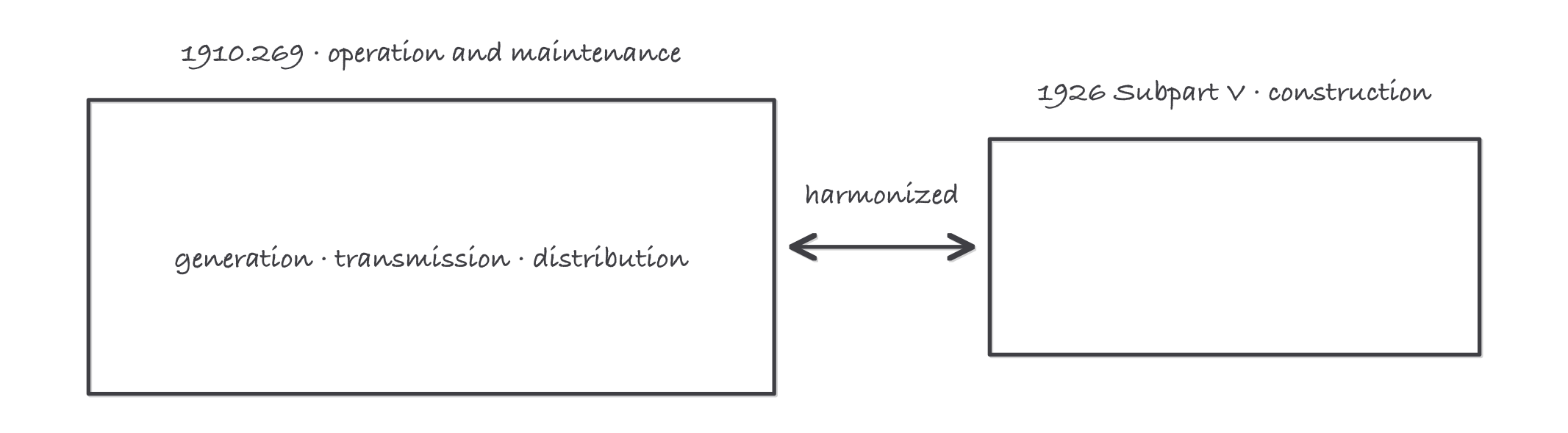
One standard for running and maintaining the system; its construction twin lives in 1926 Subpart V
Worked example: routing a question through the standard
Your crew is asked to replace insulators on an energized 12.47 kV feeder.
- May this crew do the work at all? Paragraph (a): only qualified employees, trained for these tasks and voltages.
- How close may workers and equipment get? Paragraph (l): minimum approach distances for the voltage, and the two-employee requirement applies above 600 volts.
- Could it be done dead instead? Paragraph (m): the clearance procedure if the line is deenergized.
- If dead, what makes it safe to touch? Paragraph (n): test, then ground into an equipotential zone.
Four paragraphs, one job. Every task in the trade routes through the standard the same way.
Where it bites
- Citing the wrong standard is a real error. New-build stringing under 1910.269, or maintenance cited to Subpart V, confuses training records and compliance. Activity decides the standard: operation and maintenance here, construction in 1926.
- The standard sets floors, not procedures. Your utility’s manual will be stricter and more specific. Where the manual and the standard both speak, you follow the stricter rule.
- Tree trimming provisions are not lineworker provisions. Line-clearance tree trimmers work under their own carve-outs with their own training requirements; their qualification is not interchangeable with a lineworker’s.