Qualifications · Linework
Journeyman Lineworker: What It Takes
Part of Groundman to Journeyman Lineworker · step 20 of 23 · next: Utility, Contractor or Co-op: Career Paths
In learning paths: Groundman to Journeyman Lineworker
Assumes you know: The Lineworker Apprenticeship
Journeyman lineworker is a status conferred by the trade, not (in almost every state) a license issued by a government board. You become a journeyman by completing a registered apprenticeship or by holding the classification with a union or employer, and the proof is your program completion and your book, not a state card. Alaska is the verified exception, and it is worth understanding precisely because it is the exception.
*Learn the Trades is a free study resource. We are not a licensing body, an authorized training provider, or an exam administrator. Reading this page does not award any card, license, or certification. Always verify requirements with the issuing authority linked in the sources.*Why it matters on the job
Journeyman is the trade’s center of gravity: the classification that works energized primary without supervision, runs work, and anchors the pay scale. Knowing who actually confers it keeps you from two mistakes: hunting for a state “lineman license” that does not exist in most places, and assuming that a title from any employer travels everywhere.
Who confers the status
Registered apprenticeship completion. Electrical power-line installer and repairer is a registered apprenticeable occupation with the US Department of Labor. Completing a registered program (a JATC, utility or contractor program) is the standard route: the sponsor certifies completion and the trade recognizes you as a journeyman.
Union classification. In IBEW outside line construction, journeyman lineman is a book classification: your standing with the union and its signatory contractors. Note the branch distinction: a journeyman wireman (inside construction) is a different classification with a different apprenticeship, and neither substitutes for the other.
Employer classification. Utilities classify their own workforce, typically mirroring the apprenticeship structure. A utility journeyman card is real standing with that employer and its bargaining unit.
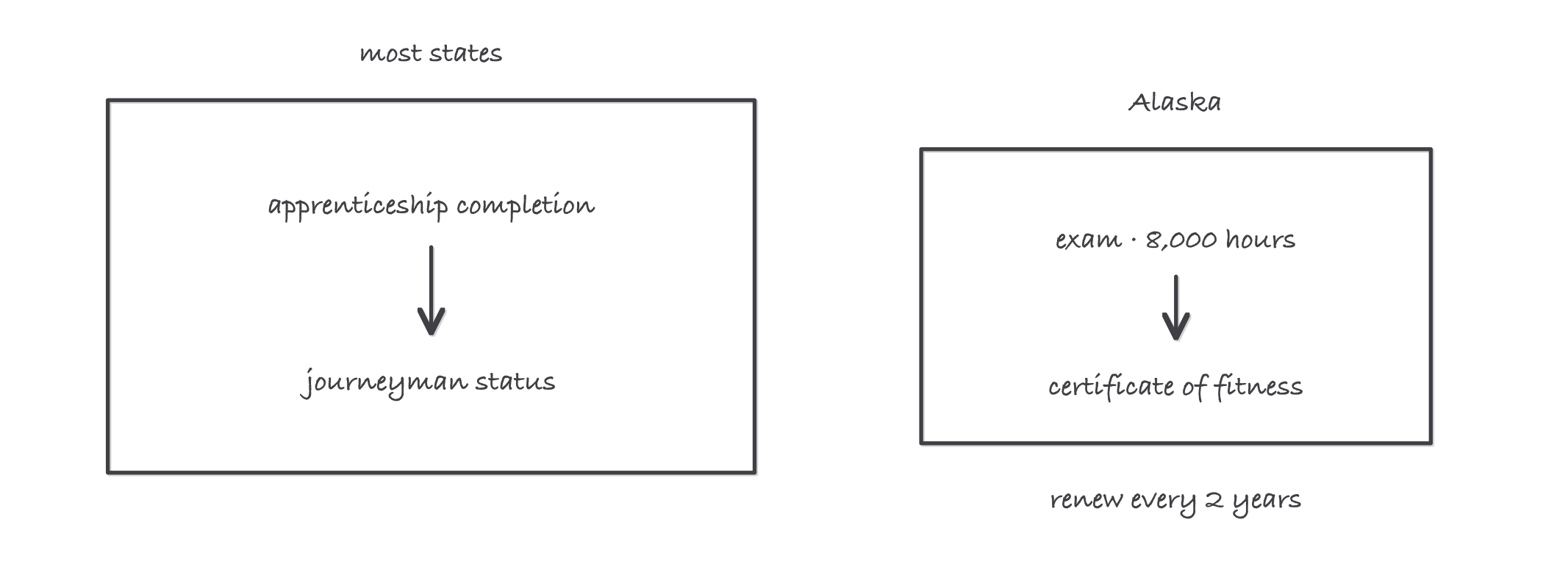
The rule and the exception: the trade confers the status almost everywhere; Alaska adds a state certificate on top
A concrete exemplar: Alaska’s Certificate of Fitness
A journeyman moving to Alaska for utility work encounters the pattern most states lack: an application to the state, documentation of 8,000 NESC-subject hours, a state exam, and a certificate that must be renewed on a 2-year cycle. Treat this as the model for how to verify any state’s posture: go to the state labor department or licensing board and confirm whether a certificate of fitness or license exists for line work, rather than assuming either way.
Where it bites
- “Get your lineman license” is a red flag phrase. Outside Alaska’s certificate and any local exceptions you verify yourself, there is no such license to get, and offers to sell you one are selling something else.
- Journeyman status and OSHA “qualified employee” are different things. Qualified employee is a training status your employer must establish under 1910.269 for specific tasks and voltages. A journeyman card does not by itself make you qualified for a task, and qualification does not make you a journeyman. The qualified employee lesson covers the distinction.
- Portability is social, not legal. Because the status is conferred by programs and unions, recognition travels through those institutions (books, reciprocity between programs, employer verification), not through a state reciprocity statute. Moving means verifying how your completion is recognized, not presenting a license.
Exam relevance
For most journeymen the “exam” is the apprenticeship’s own assessment structure. Where a state exam exists (Alaska’s, under 8 AAC 90.115), it tests trade knowledge for the certificate of fitness; the issuing authority publishes the current scope and process, and its documents are the ones to study from.
Verified requirements
| Where | Expires | Renewal | Continuing education |
|---|---|---|---|
| United States (federal) | No | Confirm with issuer | Confirm with issuer |
| Alaska | Yes | 2 years | Confirm with issuer |
Information comes from issuing-authority sources. Confirm current rules, fees and eligibility with the authority before acting.