Learn · Linework
How Power Gets Delivered: Generation to Meter
Part of Groundman to Journeyman Lineworker · step 1 of 23 · next: Transmission vs Distribution
In learning paths: Groundman to Journeyman Lineworker
Electricity is generated in bulk at central stations, stepped up to high voltage for the long haul, stepped back down at substations, and delivered over distribution lines to a meter on a wall. Every job a line crew does happens somewhere on that chain, and knowing where you are on it tells you the voltage, the structures, and the rules in play.
Why it matters on the job
The same crew truck might roll past 500 kV lattice towers, a fenced substation, and a back-lot wood pole feeding six houses in one morning. Which piece you are working on decides the tools that come off the truck, the approach distances that apply, and which crew even owns the work. OSHA’s line-work standard (1910.269) covers the operation and maintenance of all of it: generation, transmission, and distribution.
The chain, stage by stage
Generation. Power plants (gas, hydro, wind, solar, nuclear, coal) produce three-phase AC power. A generator step-up transformer immediately raises the voltage for transmission.
Transmission. Bulk power moves between regions and substations on high-voltage lines, roughly 69 kV up to 765 kV in the US, carried on lattice towers and tall steel or wood structures. High voltage exists for one reason: it slashes current, and current is what heats conductors and wastes power along the way.
Substations. Transformers step voltage down in stages, breakers and switches let operators reroute power, and protective relays watch for faults. A substation is the junction box of the grid.
Distribution. Medium-voltage primary lines (commonly in the 4 kV to 35 kV range) leave the substation and fan out along streets, overhead or underground. Pole-mounted and pad-mounted transformers make the final step down.
The service. A transformer near the customer delivers secondary voltage (120/240 V for most US homes) through a service drop or lateral to the meter. Past the meter, it is the inside wireman’s world, not yours.
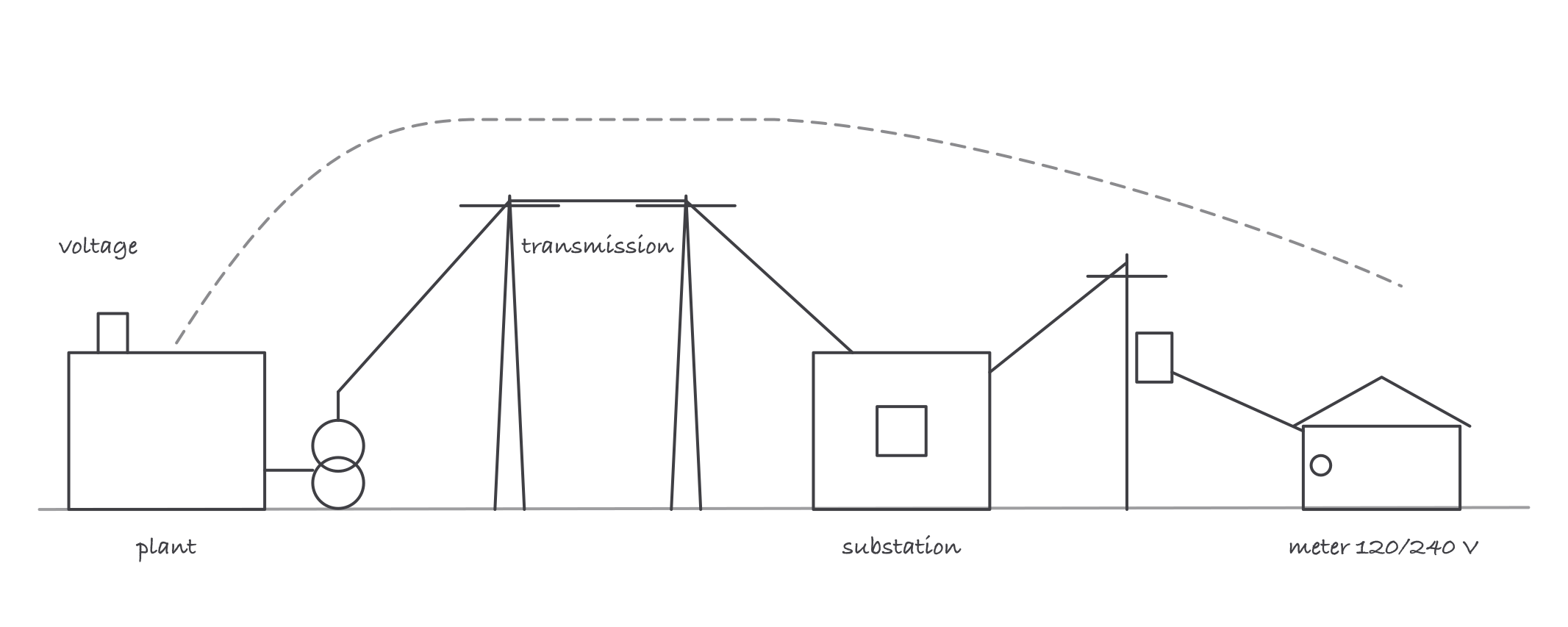
Voltage steps up for the long haul and back down for delivery; line crews work every span between station and meter
Worked example: why transmit at high voltage
A town needs 10 MW delivered over a three-phase line. Current in a three-phase system is I = P ÷ (1.732 × V).
At a distribution-class 12,470 V: I = 10,000,000 ÷ (1.732 × 12,470) = 10,000,000 ÷ 21,598 = 463 A.
At a transmission-class 138,000 V: I = 10,000,000 ÷ (1.732 × 138,000) = 10,000,000 ÷ 239,016 = 41.8 A.
Same power, one eleventh of the current. Since heating loss in a conductor rises with the square of current, the high-voltage line wastes far less energy and can use far smaller conductor for the same delivery. That arithmetic is why the grid steps voltage up and down instead of transmitting at the voltage customers use.
Where it bites
- “Primary” and “secondary” describe voltage position, not importance. Primary is the medium-voltage side of the distribution transformer; secondary is the service-voltage side. Learners who read “secondary” as “less serious” get hurt: 240 V secondaries kill people every year.
- The chain runs both ways. A customer’s portable generator can push power backward through a service transformer and put thousands of volts on a “dead” primary. Later lessons on grounding and downed conductors build on this.
- Boundaries are real. Generation plants, substations, network vaults and customer wiring each have their own crews, rules and switching authorities. Knowing the chain includes knowing where your piece of it ends.