Learn · Linework
Substation Basics
Part of Groundman to Journeyman Lineworker · step 6 of 23 · next: OSHA 1910.269: The Standard That Governs Line Work
In learning paths: Groundman to Journeyman Lineworker
Assumes you know: Transmission vs Distribution
A substation is where the grid changes voltage and where operators can see, switch and protect it. Inside the fence: buses that gather and route power, breakers that interrupt fault current, transformers that change voltage, regulators that fine-tune it, and relays that make decisions in cycles.
Why it matters on the job
Every distribution feeder you will ever ride starts at a substation breaker, and every clearance you take ultimately traces to devices inside a fence. Line crews are not substation crews (most utilities staff substations with their own electricians and technicians), but you work at the boundary constantly: feeder exits, riser poles, getaways and switching orders all meet at the station.
The equipment, in the order power sees it
Incoming line and disconnects. Transmission or subtransmission enters through gang-operated disconnect switches. Disconnects provide a visible open point for isolation; they are not made to interrupt load or fault current.
Buses. Rigid or strain conductors that collect power and distribute it to equipment. A bus fault is the worst fault in the station, which is why bus work is so tightly controlled.
Power transformer. The station’s heart, stepping transmission voltage down to distribution primary voltage. Large units are oil-filled, with cooling radiators and protective devices of their own.
Breakers and reclosers. Circuit breakers interrupt load and fault current on command from relays. Distribution feeder breakers commonly reclose automatically after a trip, because most overhead faults (a branch, an animal, a lightning flash) clear themselves. That habit of the system is exactly why crews disable reclosing before working a line.
Regulators and capacitors. Voltage regulators hold feeder voltage in band as load swings; capacitor banks support voltage and power factor.
Relays and the control house. Protective relays watch currents and voltages and trip breakers in a fraction of a second. The control house also holds the communications gear that gives system operators remote eyes and hands.
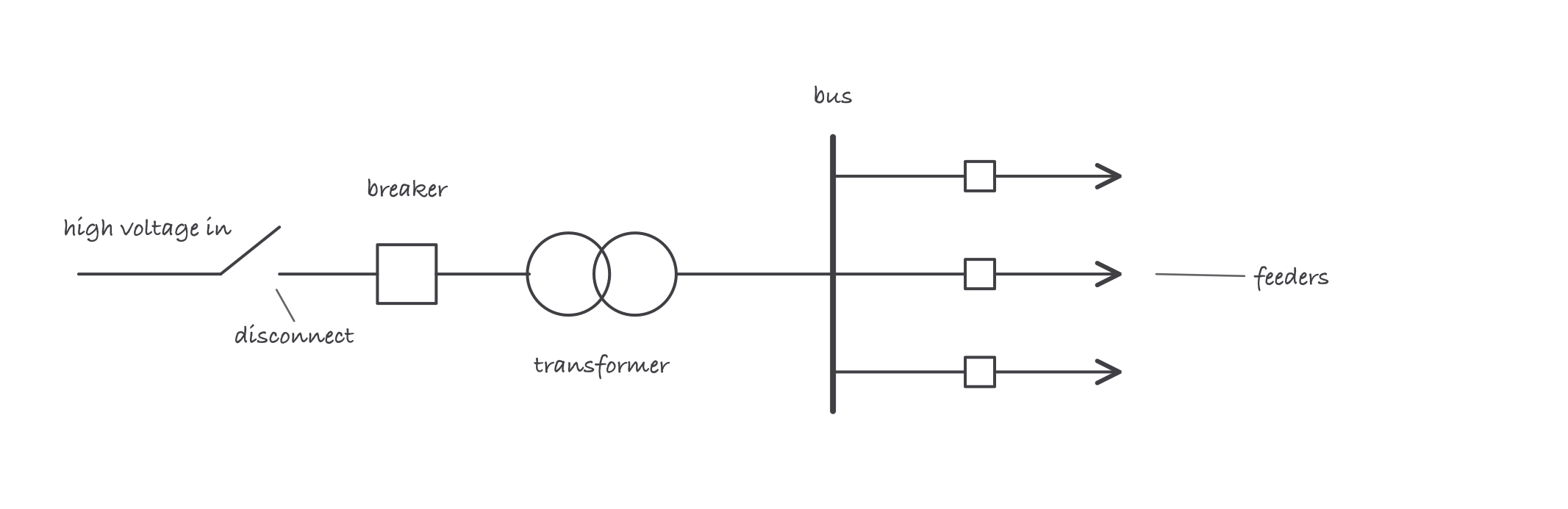
A substation in one line: isolate, interrupt, transform, then split into feeders
Worked example: trace a feeder fault
A car hits a pole and drops a phase on feeder 2.
- Fault current surges from the transformer, through the bus, through feeder 2’s breaker, out to the fault.
- The feeder relay sees current far above load level and trips breaker 2 in a few cycles.
- The breaker recloses after a short delay. The fault is still there (a conductor is on the ground), so the relay trips it again. After its programmed attempts, the breaker locks out.
- The system operator sees the lockout, dispatches the crew, and from that moment every step at the pole happens under the operator’s switching authority, with reclosing disabled before anyone touches the line.
The station did its job: it limited the event to one feeder and gave humans control of what happens next.
Where it bites
- A disconnect is not a breaker. Opening a disconnect under load draws an arc it cannot interrupt. Breakers break current; disconnects make isolation visible afterward.
- Station ground grids exist because earth is not equipotential. During a fault, the soil around a station carries enormous current, and step and touch voltages are controlled by the buried grid and your bonding practices, not by luck.
- The fence is a jurisdiction line. Line crews enter substations under specific rules, escorts or training at most utilities. “I was already switching out on the feeder” does not extend to the bus.