Learn · Linework
Overhead Construction: Poles, Crossarms, Hardware
Part of Groundman to Journeyman Lineworker · step 3 of 23 · next: Underground Distribution (URD)
In learning paths: Groundman to Journeyman Lineworker
Assumes you know: Transmission vs Distribution
An overhead distribution line is a kit of parts: poles to hold elevation, crossarms and brackets to hold spacing, insulators to hold voltage, conductors to carry power, and hardware to hold it all against gravity, wind and ice. Learn the kit and any pole in America becomes readable.
Why it matters on the job
Framing a pole is bread-and-butter apprentice work. You will be sent up (or send material up) to build exactly what the staking sheet shows, and every piece has a name your crew will use at speed over a radio. Knowing a deadend from a tangent structure, or a pin insulator from a suspension bell, is the difference between handing up the right part and holding up the job.
The parts, top down
Pole. Usually pressure-treated wood, classed by length and strength. The pole’s job is clearance: keeping conductors a safe distance above ground, roads and everything below.
Crossarms and brackets. A crossarm spreads the phase conductors apart horizontally; armless (vertical) construction stacks them on standoff brackets instead. Spacing exists to keep conductors from slapping together in wind.
Insulators. Porcelain or polymer stands between energized conductor and grounded structure. Pin and post insulators carry conductors on tangent (straight-line) structures; suspension insulators (strings of discs or polymer rods) take the pull at deadends and angles.
Conductors. Primary phases ride highest. Below them runs the multi-grounded neutral, then the secondary (often a triplex bundle to services), then the communications space (cable, fiber, telephone) at the bottom of the joint-use ladder.
Hardware and guying. Bolts, braces, clamps and connectors tie the kit together. Where the line turns, deadends or changes tension, guy wires and buried anchors carry the unbalanced pull so the pole does not have to bend against it.
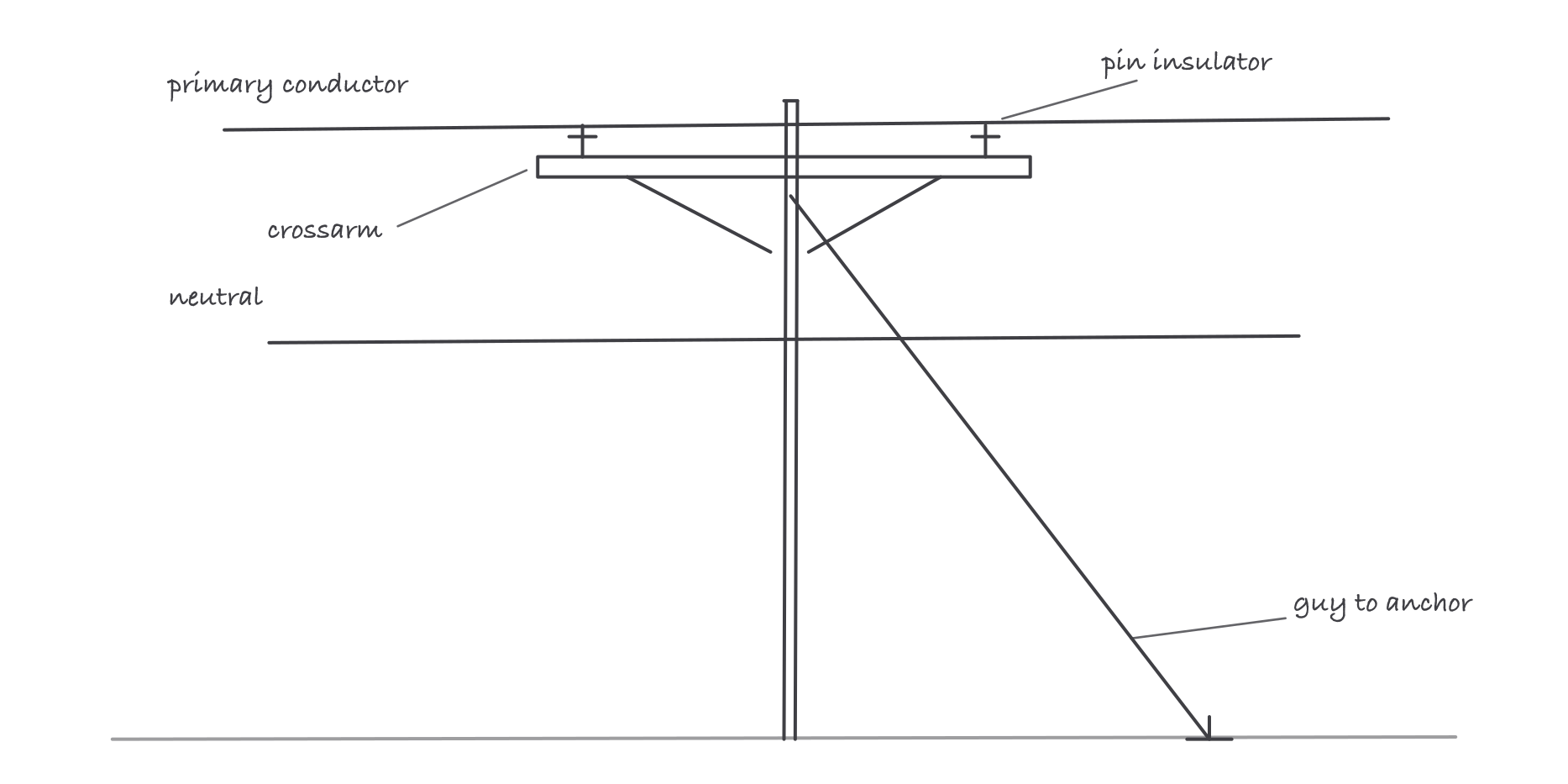
Tangent framing: the pole holds height, the arm holds spacing, the insulator holds voltage, the guy holds pull
Worked example: setting depth
The traditional rule of thumb for embedding a wood pole: bury 10 percent of the pole’s length plus 2 ft.
For a 40 ft pole: 40 × 0.10 = 4 ft; 4 + 2 = 6 ft deep, leaving 34 ft above grade.
For a 55 ft pole: 55 × 0.10 = 5.5 ft; 5.5 + 2 = 7.5 ft deep, leaving 47.5 ft above grade.
The rule of thumb is a starting point, not an answer: your utility’s construction standards and the soil class govern the real number. But it explains why the crew orders a 45 ft pole to replace a 40 ft pole “at the same height”: the extra length is partly eaten underground.
Where it bites
- Tangent and deadend structures are not interchangeable. A tangent pole holds conductors up; a deadend pole holds the line’s full tension. Framing, insulators and guying all change when the load changes direction.
- The neutral is not a communications wire. The multi-grounded neutral is part of the power system and carries current in normal operation. Everything below it in the joint-use space belongs to other companies, with its own clearance rules.
- Covered wire is not insulated wire. Tree wire’s jacket protects against abrasion and momentary brush contact, not against you. Treat covered conductor exactly like bare conductor.