Learn · Linework
Switching and Tagging
Part of Groundman to Journeyman Lineworker · step 16 of 23 · next: Storm Response Work
In learning paths: Groundman to Journeyman Lineworker
Assumes you know: Personal Protective Grounding
Switching and tagging is the formal procedure that takes a line or piece of equipment out of service for work and guarantees it stays out until the work is done. Under OSHA 1910.269(m), deenergizing for employee protection is not “somebody turned it off”: it is a system of requests, switching orders, tags, tests and releases with the system operator holding the keys.
Why it matters on the job
Crews get hurt in the gap between what they believe about a circuit and what the system is actually doing. Switching and tagging closes that gap with procedure. Journeymen run clearances constantly (every deenergized job starts and ends with one), and the discipline is absolute because the failure mode is a crew touching a conductor that someone else re-energized moments earlier.
The teaching
The system operator is the authority. On systems with centralized control, deenergizing starts with a request to the operator, who directs the switching, records the configuration and controls everything that could re-energize the line. No one energizes or deenergizes independently while a clearance is out.
Open, then make it stay open. Breakers and switches are opened per the switching order, and devices that could restore power automatically (reclosing schemes) are disabled. Where the standard requires it, disconnecting means establishing a visible or verified open point, not trusting a remote indication alone.
Tags mark protection, not information. A tag on a switch says: this device is protecting workers; do not operate. Tags are placed and removed under the clearance procedure, and operating a tagged device is among the most serious violations in the industry.
Test, then ground. A clearance gets you a deenergized line on paper. The crew still tests for voltage and installs protective grounds before the line is treated as dead (the grounding lesson covers why).
Release is as formal as the request. When work ends, the employee in charge confirms all workers are clear, grounds are removed, and then releases the clearance to the operator. Multiple crews on one line each hold their own protection: one crew’s release must never strip protection from another.
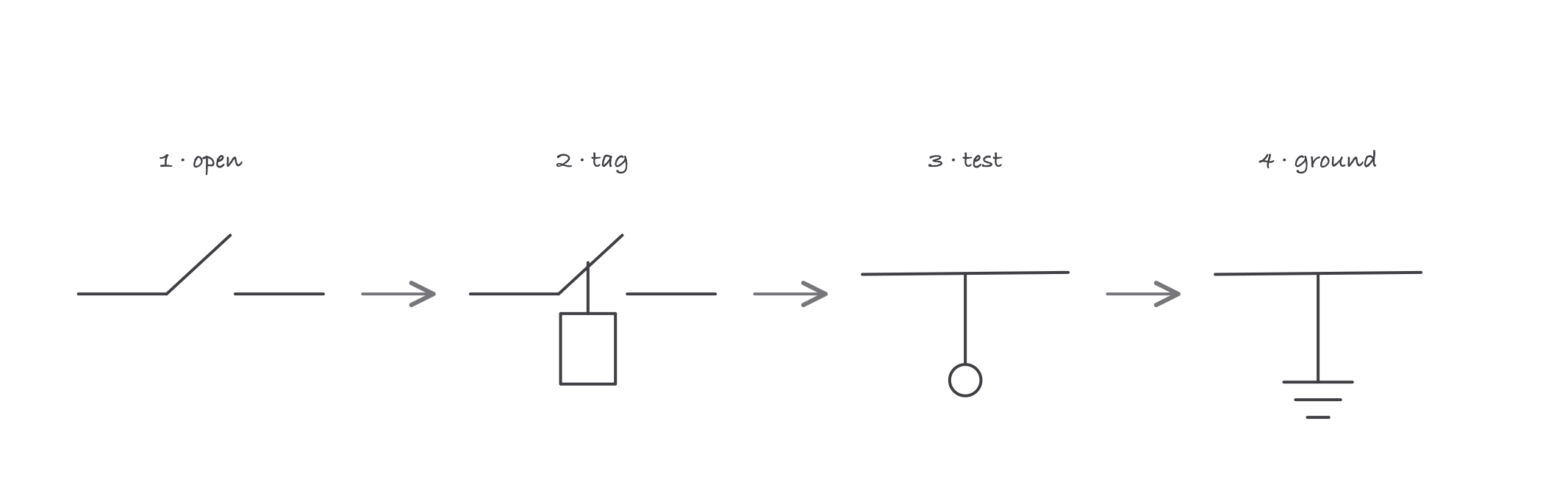
Open, tag, test, ground: paper protection first, then physical proof
Worked example: a clearance from request to release
A crew needs a distribution tap dead to replace a pole:
- The employee in charge requests a clearance from the system operator on the tap between two named devices.
- The operator directs switching: the tap’s source device is opened, reclosing upstream is addressed per the order, and tags go on. The operator records the clearance in the crew’s name.
- The employee in charge confirms the points and tags in the field match the order (a wrong-switch error is exactly what this step exists to catch).
- The crew tests the conductors, installs worksite grounds, and works.
- Pole set, conductors transferred, the employee in charge polls the crew clear, grounds come off, and the clearance is released back to the operator, who then directs re-energization.
Every handoff is person-to-person and read back. Radio discipline is part of the procedure, not a courtesy.
Where it bites
- “It’s open at the cutout” is not a clearance. A visible open you made yourself, with no tag, no operator record and no reclosing addressed, protects you only from devices you can see, and only until anyone else touches the system.
- Independent crews need independent protection. A clearance held by another foreman does nothing for your crew. Each crew establishes its own protection under the procedure.
- The paperwork is the protection. Shortcutting the readbacks and confirmations because “we do this every day” removes the exact redundancy that catches the wrong-feeder, wrong-switch, wrong-tap errors experienced crews still make.