Learn · Linework
Underground Distribution (URD)
Part of Groundman to Journeyman Lineworker · step 4 of 23 · next: Distribution Transformers and Connections
In learning paths: Groundman to Journeyman Lineworker
Assumes you know: Transmission vs Distribution
Underground residential distribution (URD) puts the feeder under the lawn: insulated primary cable in conduit or direct-buried, pad-mounted transformers at grade, and separable insulated connectors (elbows) instead of open-air taps. Nothing to see overhead, which is exactly what makes the work different: you cannot patrol a buried fault with your eyes.
Why it matters on the job
New subdivisions have been built underground for decades, so URD work is a core journeyman skill at most utilities. The habits transfer imperfectly from overhead: the cable is insulated but never assumed dead, the “structures” are green boxes and enclosures the public leans bicycles against, and troubleshooting means locating an invisible fault instead of spotting a burned jumper from the truck.
The system
Cable. URD primary cable is a medium-voltage insulated conductor with a concentric neutral (wires wound around the outside of the insulation) that carries neutral current and grounds the cable system. Damaged or corroded concentric neutrals are a classic hidden hazard on older direct-buried cable.
Pad-mounted transformers. The pole-top transformer’s ground-level cousin, in a locked steel cabinet on a concrete pad. Primary cable enters one compartment, secondary services leave another.
Elbows. Separable insulated connectors join cable to transformer bushings. Loadbreak elbows can be opened and closed on energized circuits with a shotgun stick (a hot stick with a clamping tool made for elbow work); deadbreak elbows must never be separated energized. Knowing which is in your hand is not optional.
Loop feed. Most URD subdivisions are fed as a loop: primary cable runs from the source through each transformer and back toward a second source, with one point left open in normal operation. The loop exists for restoration: any single cable section can be isolated and everyone still gets fed.
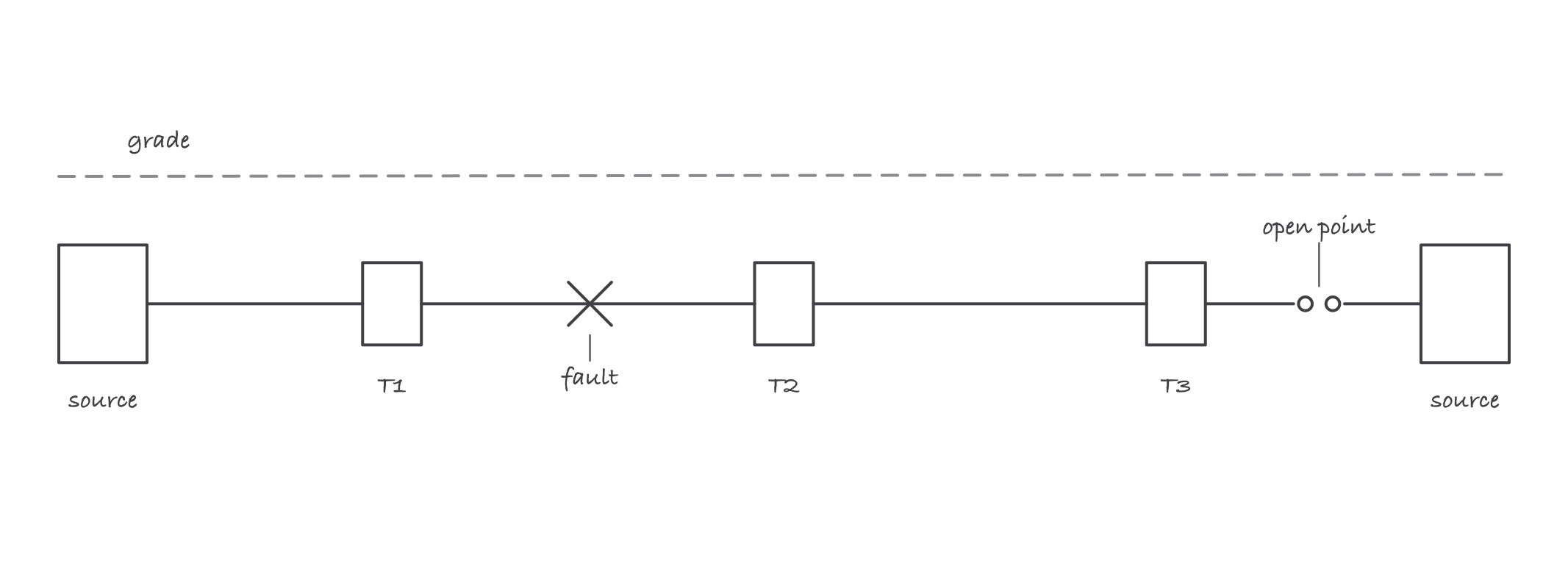
Loop feed: one buried section can fail and every transformer can still be fed from one end or the other
Worked example: restore around a cable fault
A loop feeds transformers T1, T2 and T3 between two sources, with the normal open point past T3. The cable section between T1 and T2 faults and the source breaker locks out.
- Confirm with the system operator which section relayed out, and take the clearances the switching plan requires.
- At T1, separate the loadbreak elbow feeding the faulted section and park it on an insulated parking stand. At T2, separate the other end. The faulted section is now isolated at both ends.
- Close the normal open point. T2 and T3 now feed from the far source; T1 feeds from the near source. Every customer is back on before the cable is even repaired.
- Test, ground and repair the faulted section on its own schedule, then restore normal configuration.
The fault localization itself uses test equipment (fault locators, thumpers) rather than patrol, which is a discipline of its own.
Where it bites
- Insulated is not dead. You cannot see an energized URD cable’s condition, and elbows and cabinets conceal everything. Cable is treated as energized until it is tested and grounded, same as overhead.
- Backfeed lives in loops. Any loop or dual-source design means either end can energize a section. Isolating one end of a cable proves nothing about the other.
- The public is on the other side of the cabinet. Pad-mounts sit in yards and playgrounds. A left-open or damaged cabinet is an immediate public hazard, not a punch-list item.