Learn · Linework
Personal Protective Grounding
Part of Groundman to Journeyman Lineworker · step 15 of 23 · next: Switching and Tagging
In learning paths: Groundman to Journeyman Lineworker
Assumes you know: Transmission vs Distribution
Personal protective grounding is the practice that makes a deenergized line safe to touch: test it dead, then connect it to ground and bond it around the worksite so that if it becomes energized again, the worker is inside a zone where everything sits at nearly the same potential. Under OSHA 1910.269(n), a deenergized line is not a safe line; it is a line waiting to be tested and grounded.
Why it matters on the job
Lines that are “off” get re-energized by switching errors, automatic reclosing, lightning, induction from parallel circuits, and backfeed from customer generators. Grounding is the layer of protection that does not depend on every human upstream doing everything right. It is also widely misunderstood, because the words sound passive and the physics is not.
The teaching
Treat as energized until tested and grounded. The standard’s logic is a sequence: deenergize and take a clearance (the switching and tagging lesson), then test the conductor to confirm it is actually dead, then install grounds. Until the grounds are on, you work it like it is hot, because as far as your body is concerned it might be.
Grounds are fault-current equipment. Protective grounds are sized to carry the maximum fault current the location could deliver, for as long as the protection takes to clear it. A ground set is not symbolic: during an accidental re-energization it may carry thousands of amps, and an undersized or poorly connected set fails exactly when it is needed.
The equipotential zone is the point. Current through the earth creates voltage differences across distance. Connecting a line to earth somewhere does not by itself protect a worker who bridges two points at different potentials (hands on conductor, feet on a pole ground, boots on soil). Worksite grounding bonds the conductors, the structure ground and the worker’s position together, so the worker’s whole environment rises and falls as one. Little difference in potential across the body means little current through the body.
Order of connection. Ground end first, then conductor end with a live-line tool; removal is the reverse. The rule exists so the last connection made (and the first broken) is the one at the possibly-energized conductor, handled at tool’s length.
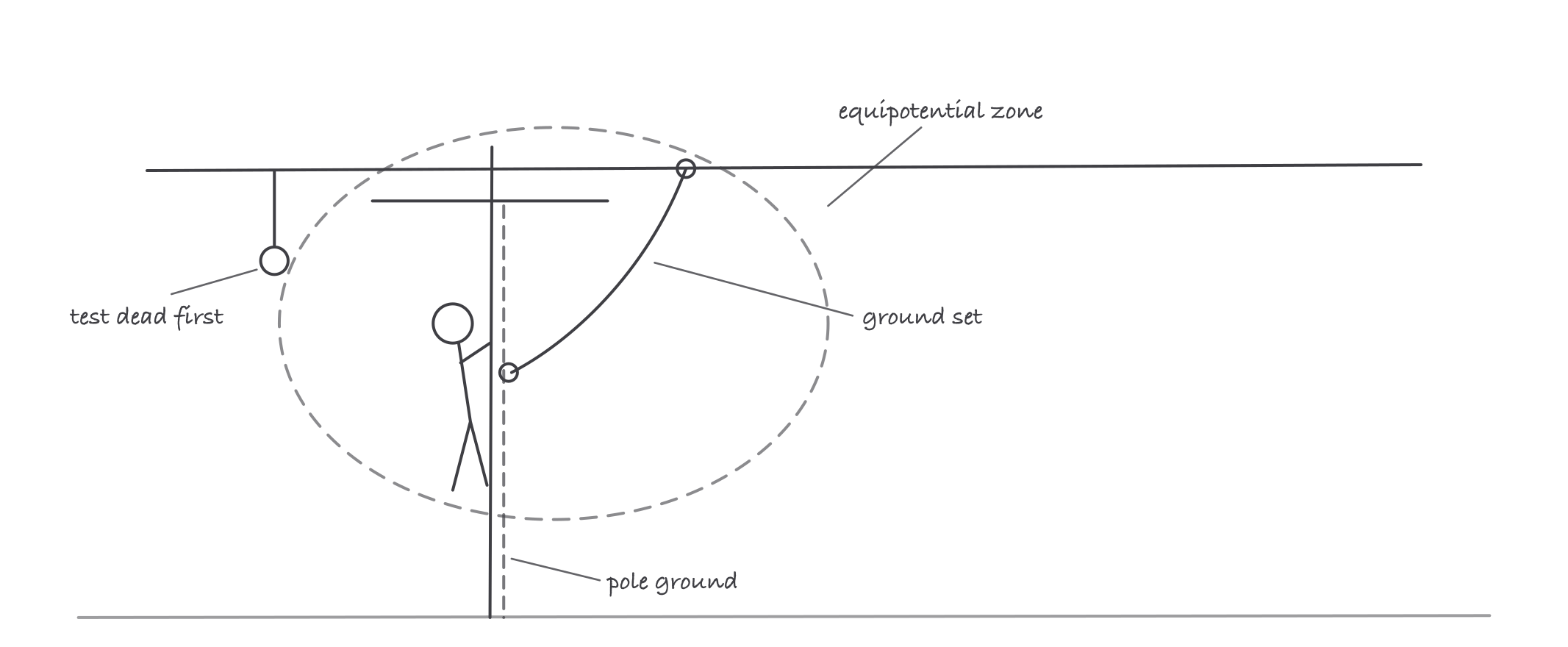
Grounding does not make the line safe by touching earth; it makes the worksite one potential so your body never bridges two
Worked example: grounding a deenergized span
A crew has a clearance to replace a broken crossarm:
- Confirm the clearance with the system operator and verify tags and open points per the switching order.
- From a position respecting minimum approach distance, test each conductor with a tested voltage detector. Dead readings on all three.
- Connect the ground set’s ground-end clamp to the system neutral or structure ground at the worksite.
- With a live-line tool, land the first phase clamp, then bond phase to phase until all conductors and the structure ground are connected into one zone at the worksite.
- Work the crossarm inside the zone. When finished, remove conductor-end clamps first with the live-line tool, ground end last, then release the clearance.
Every step exists to answer one question: if this line goes hot right now, where does the current go, and is any of it routed through a person?
Where it bites
- A groundman is not “grounding.” The entry-level crew member and the 1910.269(n) practice share a word and nothing else. Do not let the vocabulary blur in your head or your writing.
- Grounds at the substation do not protect you at the pole. Distance means potential difference. Protection comes from bonding at the worksite, where your body is.
- Induction is real power. A deenergized line running parallel to an energized one carries induced voltage and current. Grounds manage it, but opening a ground set carelessly on an induced line can draw an arc. The line does not need a switching error to bite.