Business · Linework
Getting Selected: Line Apprenticeship Entry Requirements
Part of Groundman to Journeyman Lineworker · step 23 of 23
In learning paths: Groundman to Journeyman Lineworker
Outside line apprenticeships are selective programs with concrete, published entry gates, and most applicants who fail do so on paperwork and preparation rather than potential. The gates cluster into the same categories everywhere: age, education, driving credential, aptitude testing, physical readiness and screening, and then the program’s own early filters, with climbing school the famous one.
Why it matters on the job
Programs publish their requirements precisely so applicants can arrive complete. The California-Nevada JATC’s application notice is a clean example of the pattern: at least 18 years old, high school diploma or GED, a valid unrestricted commercial driver’s license, an aptitude test followed by an interview, then a five-day orientation and climbing class, with apprentices traveling away from home at their own expense once indentured. Treat every requirement as a task list you can start today.
The gates, one by one
Age and education. 18 or older with a high school diploma or GED is the standard floor. Programs commonly look for math readiness (algebra shows up in program prerequisites and aptitude tests), because the trade’s coursework runs on it.
The driving credential. Many outside line programs require a CDL, some at application (Cal-Nev requires a valid unrestricted commercial license), others early in the program. The CDL lesson covers classes and the training rule; for entry purposes the message is shorter: find out what your target program requires and when, and get ahead of it.
Aptitude test and interview. Union programs typically screen with a standardized aptitude test (math and reading focused) and rank candidates through structured interviews. Interview pools decide who gets indentured; showing up with line-adjacent experience (groundman work, utility labor, military service, pole-climbing exposure) is how applicants separate themselves.
Physical readiness and screening. The work is heavy, at height, outdoors, in weather. Programs and employers screen with physical evaluations and drug testing, and the screening does not end at entry: safety-sensitive work keeps testing throughout a career.
The climbing gate. Early climbing instruction (Cal-Nev’s five-day orientation and climbing class is representative) is both training and filter. Programs put climbing first deliberately: it is inexpensive to discover early that pole-top work is not for you, and expensive to discover it in year two.
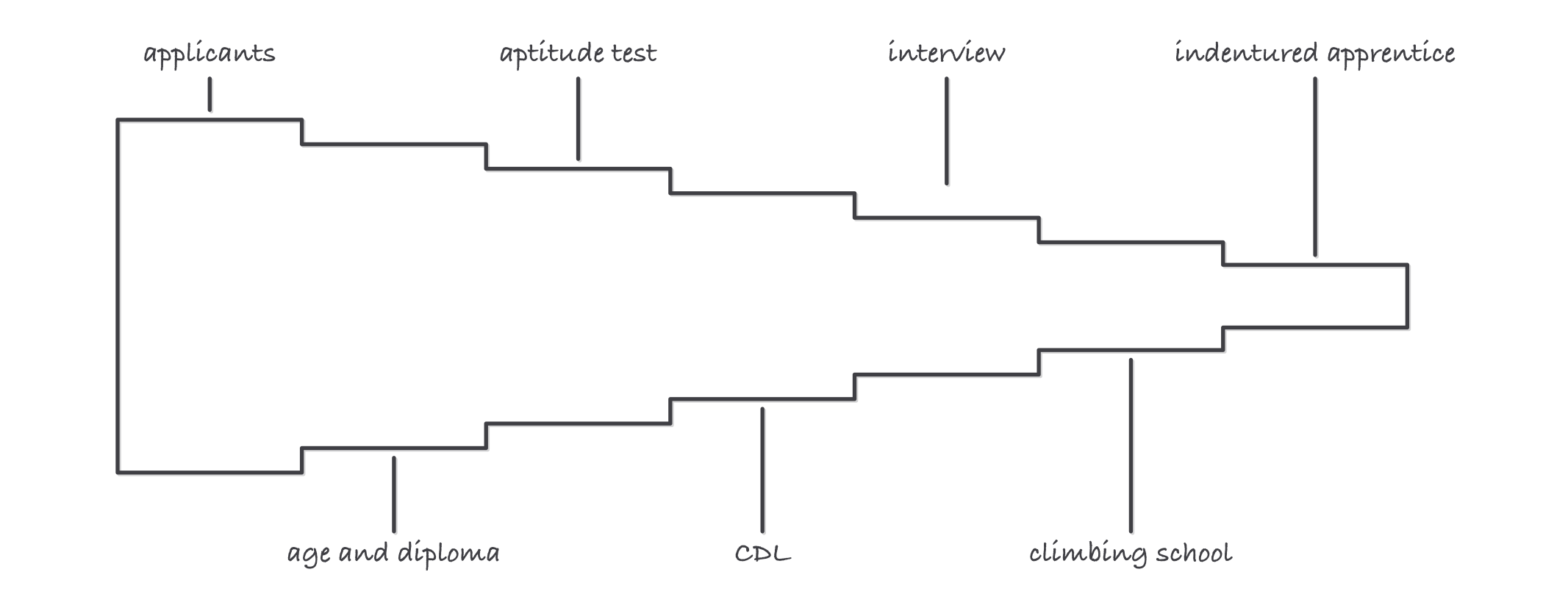
Selection is a funnel of published gates: every one of them can be prepared for before you apply
A concrete exemplar: preparing against Cal-Nev’s list
An applicant eight months out, working the list backward: GED already in hand; CDL Class A started now (training, permit, skills test) because it is the longest-lead item; algebra refreshed against aptitude-test practice material; a groundman job application in with a local contractor for experience and references; savings building, because the notice is explicit that travel away from home is at the apprentice’s expense. By application day, every published gate is pre-cleared and the interview has real material to work with.
Where it bites
- Rankings expire and pools reopen. Selection is competitive and periodic: missing a window or sitting low on a ranked list can mean months of waiting. Apply broadly across programs and regions if you can travel.
- “Unrestricted” is a word with teeth. A CDL with an automatic or air-brake restriction may not satisfy a program that asks for an unrestricted license. Verify before test day, not after.
- The travel requirement is not fine print. Outside line work moves. Programs say so up front (at your own expense, in Cal-Nev’s wording) because apprentices who cannot travel cannot complete the rotations. Plan the life logistics as seriously as the test prep.