Learn · Linework
Minimum Approach Distance
Part of Groundman to Journeyman Lineworker · step 9 of 23 · next: Downed Conductors and Backfeed
In learning paths: Groundman to Journeyman Lineworker
Assumes you know: Transmission vs Distribution, Qualified Employee: What OSHA Requires You to Know
A minimum approach distance (MAD) is the closest any part of a qualified worker’s body, or any uninsulated object they hold or ride, may come to an exposed energized part. The distances are not folklore or round numbers: OSHA 1910.269 sets them through tables and equations (Table R-3 for AC systems, Table R-8 for DC), and they grow with voltage because the physics they encode grows with voltage.
Why it matters on the job
MAD is the boundary that makes energized work survivable. Every method lesson (rubber gloving, hot sticking, bucket positioning) is ultimately a technique for doing useful work while never letting an uninsulated part of you or the machine cross the distance for the voltage in play. Knowing the MADs for the voltages you work is one of the named competencies a qualified employee must hold.
Where the numbers come from
A MAD is built from two components, and understanding them is more durable than memorizing any one table row:
The electrical component. Air is an insulator until enough voltage stresses a gap into flashing over. The distance air needs depends on the worst-case voltage the gap might see, which is not the nominal voltage: switching operations and faults create transient overvoltages that momentarily exceed nominal by design-dependent factors. The standard’s tables and equations size the air gap for that maximum transient, which is why employers with engineering studies of their system’s transient overvoltage levels can, per the standard, apply the corresponding distances rather than worst-case defaults.
The inadvertent-movement component. People are not statues. On top of the electrical distance, the standard adds an allowance for the unplanned few inches: a slip, a settle of the bucket, a tool swing. The total is the number in the table.
Voltage in, distance out: higher voltage means a larger electrical component (steeply, at transmission levels) plus the movement allowance.
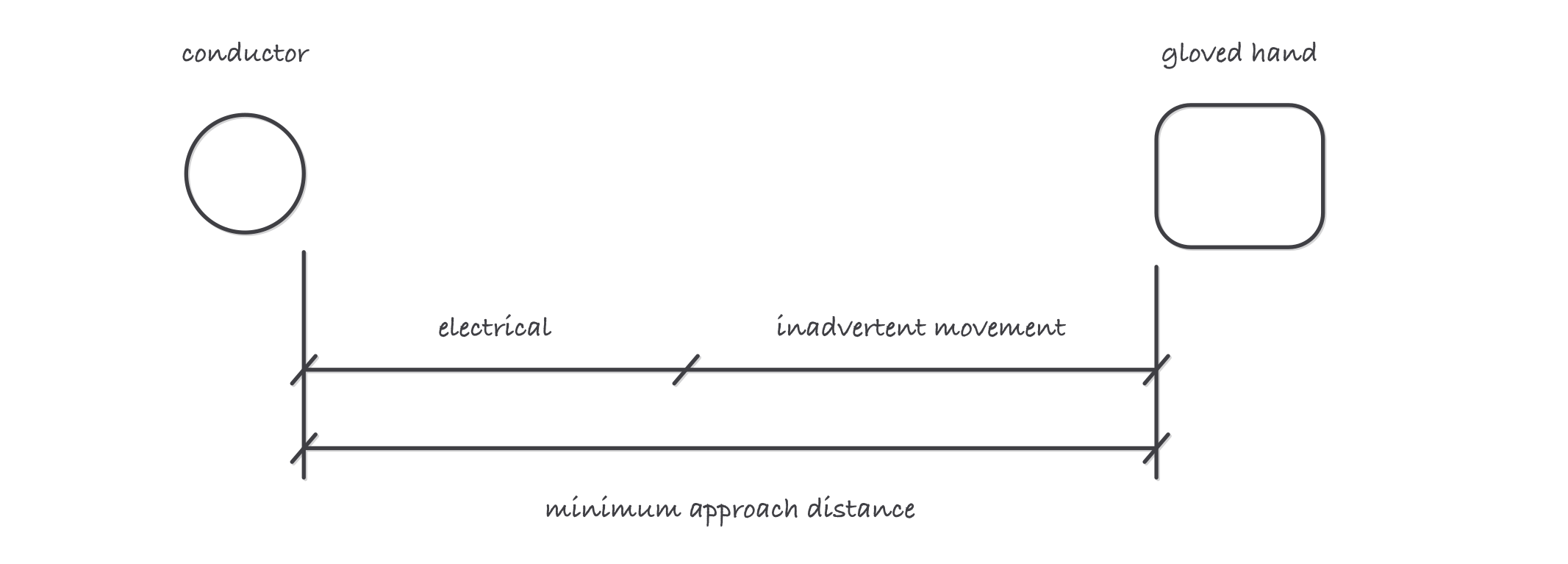
A MAD is an engineered air gap plus a human-sized margin, computed per voltage from the standard’s tables
Worked example: applying the rule without a number
You are sent to a circuit section you have not worked before. The procedure that produces the right distance, every time:
- Establish nominal voltage from the operating map and the operator, never from the look of the construction.
- Identify the exposure: phase-to-ground for a worker referenced to ground, phase-to-phase where two conductors are in play, because the tables list them separately.
- Look up or compute the MAD from the employer’s tables for that voltage (the employer’s numbers implement Table R-3, including any engineering-based transient values).
- Plan the work so the distance is never challenged: position the bucket, apply cover-up, or choose live-line tools rated so that the insulated tool, not your body, crosses the gap.
The deliberately absent piece here is a distance in feet and inches. The tables exist precisely so nobody works from memory of a number someone once said; you work from the current table for your system, and this lesson’s job is to make the table make sense.
Where it bites
- These are not NFPA 70E boundaries. Inside electrical work uses NFPA 70E’s limited and restricted approach boundaries; line work uses 1910.269’s MAD tables. The vocabularies do not mix, and importing one into the other produces wrong distances in both directions.
- The MAD applies to conductive things you control. Handlines, tools, the uninsulated boom sections and the truck all carry your obligation. A worker at proper distance holding a wet rope across the gap has crossed it.
- Cover-up changes exposure, not the rule. Insulating cover lets you work closer to covered parts per your method’s rules, but every uncovered energized part in reach still commands its full distance. The rubber gloving lesson builds the working picture.