Learn · Linework
Transmission vs Distribution
Part of Groundman to Journeyman Lineworker · step 2 of 23 · next: Overhead Construction: Poles, Crossarms, Hardware
In learning paths: Groundman to Journeyman Lineworker
Assumes you know: How Power Gets Delivered: Generation to Meter
Transmission moves bulk power at high voltage between substations; distribution delivers medium- and low-voltage power from a substation to customers. They share physics and one OSHA standard, and almost nothing else: the structures, conductors, tools, crews and approach distances are different worlds.
Why it matters on the job
“Lineman” covers both, but a career usually leans one way. Transmission means big steel, long spans, helicopters and barehand or hot-stick methods on lines that can run at hundreds of kilovolts. Distribution means wood poles and pad-mounts, rubber gloves, transformers, and customers at the end of every span. The distinction drives your training, your minimum approach distances, and what your local crews actually do all day.
Reading the two systems
Voltage. Transmission runs roughly 69 kV and up (many utilities call the 34.5 kV to 138 kV middle ground subtransmission). Distribution primaries commonly run 4 kV to 35 kV, and secondaries deliver under 600 V to the customer.
Structures. Transmission uses lattice towers and tall steel, concrete or laminated wood structures, with conductors hung from long insulator strings, often two or more conductors bundled per phase. Distribution uses the familiar wood pole with crossarms or armless brackets, pin or post insulators, and a transformer hanging where the customers are.
Purpose. A transmission line has two ends and a job: move bulk power from one substation to another. A distribution feeder is a tree: it leaves the substation, branches into taps and laterals, and serves every meter along the way.
Protection and switching. Transmission lines are managed as regional grid assets, switched by system operators and protected by relays at each end. Distribution feeders carry reclosers, fuses and sectionalizers strung through neighborhoods.
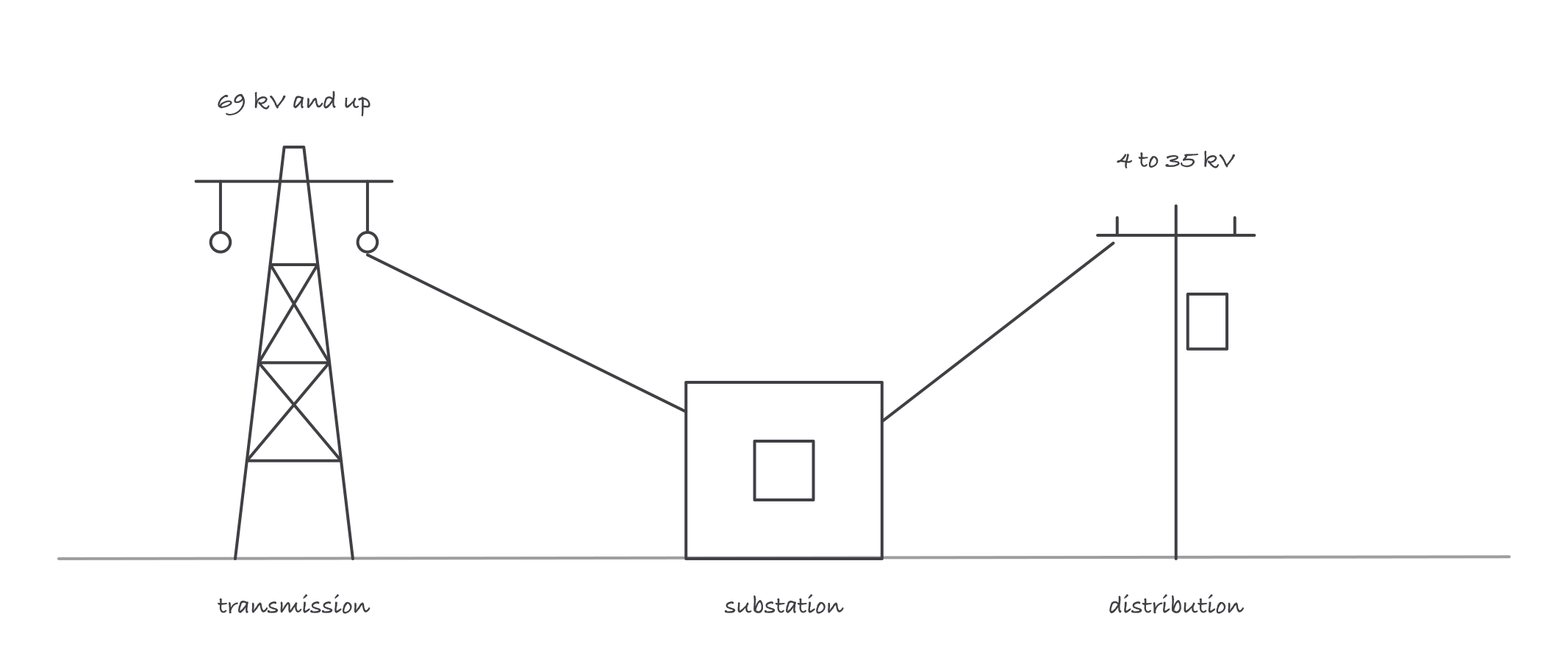
Two systems meet at the substation fence: bulk movers on the left, the delivery tree on the right
Worked example: classify what you are looking at
You stop at an unfamiliar line. Run the checks in order.
- Insulators. Long strings of many suspension discs mean transmission; a single pin or post insulator on a crossarm means distribution primary.
- Structure. Lattice steel or tall single-pole steel in a cleared corridor points to transmission. A wood pole shared with cable and telephone attachments points to distribution.
- Equipment. Transformers, fused cutouts and service drops only live on distribution. A line that touches no customer between substations is transmission.
- Conductor count. Bundled conductors per phase (two, three or four wires held apart by spacers) are a transmission signature.
No single check is proof; the pattern is. And classification never substitutes for the operating map and your foreman’s briefing: you verify nominal voltage before anyone works, because approach distances are set by voltage, not by appearance.
Where it bites
- “High line” experience does not transfer sideways. A transmission hand is not thereby competent on energized distribution rubber-glove work, and a distribution hand is not ready for barehand work at 345 kV. Methods qualify separately.
- Subtransmission blurs the picture. A 69 kV line on wood poles looks deceptively like big distribution. Voltage, not structure material, sets the rules.
- Same standard, different numbers. OSHA 1910.269 covers both systems, but the minimum approach distances it requires scale steeply with voltage. The lesson on minimum approach distance covers how those numbers are set.