Learn · Linework
Bucket Truck Work
Part of Groundman to Journeyman Lineworker · step 13 of 23 · next: Rubber Gloving and Live-Line Work
In learning paths: Groundman to Journeyman Lineworker
An insulated bucket truck (aerial device) puts a lineworker at conductor height on a boom whose insulating section is itself a piece of protective equipment. The machine makes elevated work faster and steadier than climbing, and it brings its own discipline: setup, inspection, testing and positioning rules that exist because the truck is part of the electrical circuit story, not outside it.
Why it matters on the job
Most distribution work today happens out of a bucket. Apprentices run trucks early and often, and the habits formed around setup and positioning follow you for a career. OSHA’s line-work standard (1910.269) treats aerial devices used for energized work as tested equipment with defined requirements, and utilities layer their own inspection and dielectric-test programs on top.
The machine
The insulating boom section. On an insulated aerial device, a fiberglass boom section between the worker and the grounded truck provides insulation rated for the work. That insulation is only real if it is clean, dry, uncontaminated and periodically dielectric tested; a scratched, dirty or wet boom is a conductor with a paint job.
The bucket and liner. Workers position from inside the bucket, often with an insulating liner as an additional layer for rubber-glove work. Body belt or harness and lanyard attach to the boom or bucket anchorage, per your employer’s fall-protection rule, so an ejection (a struck truck, a boom whip) does not become a fall.
Outriggers and the base. The truck becomes a crane the moment the boom leaves the cradle. Outriggers on solid footing (with pads or cribbing on soft ground) carry the tipping load. Grades, soft shoulders and trenches are planned around before the first control is touched.
The daily rhythm
Before the boom goes up: walk-around inspection, controls function-tested from the ground, leaks and cracks checked, and the day’s setup chosen so the boom reaches the work without passing through conductors or violating approach distances on the way. Lower controls stay usable as the rescue path: someone on the ground must be able to bring the bucket down.
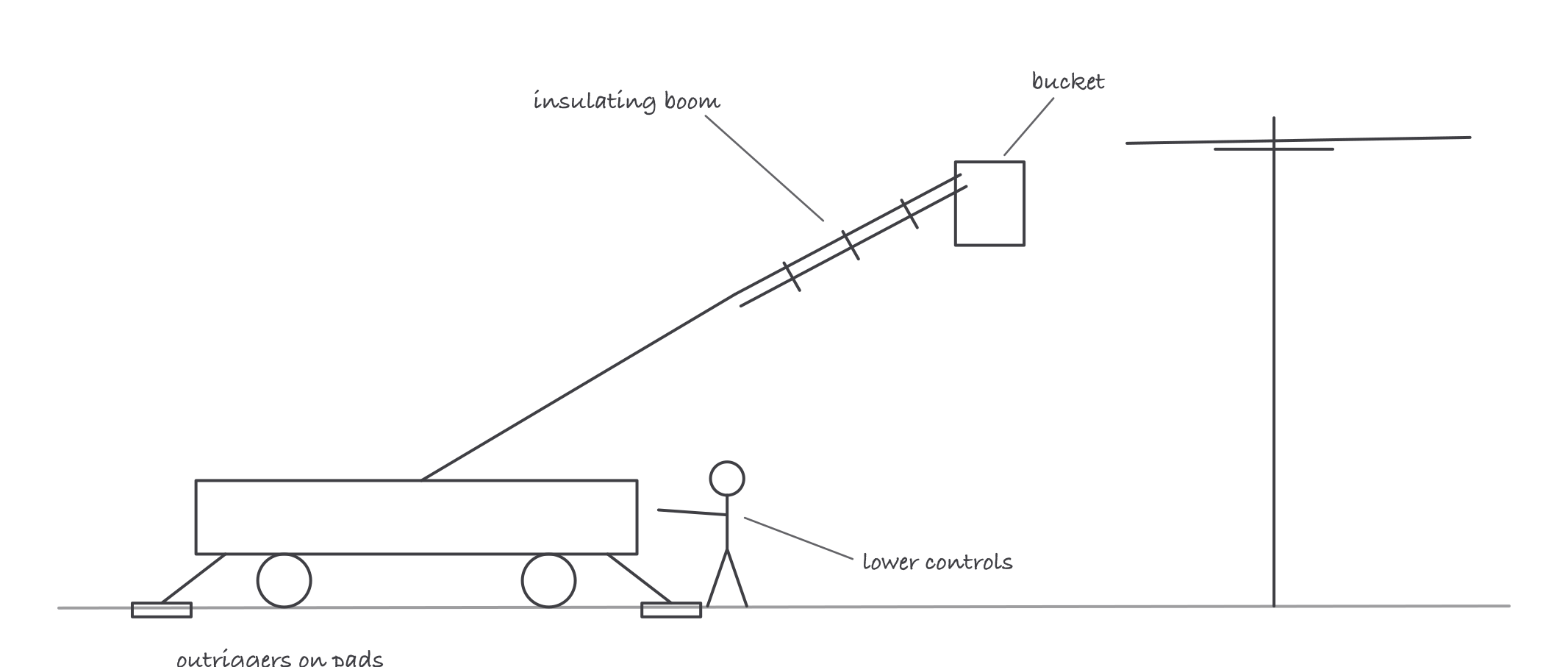
The setup is the safety system: solid footing, an inspected insulating boom, and a rescue path through the lower controls
Worked example: setting up on a service call
A transformer change-out on a suburban street:
- Position the truck so the boom’s working arc reaches the pole top without swinging through the primary or over the neutral on the way up. Repositioning a truck beats threading a needle.
- Set the brake, chock the wheels, deploy outriggers onto pads. Confirm the truck is level within the manufacturer’s limits.
- Function-test the boom from the lower controls, then the upper.
- Plan the lift path aloud with the crew: where the bucket travels, where cover-up goes, where the new transformer swings.
- Only then does anyone leave the ground.
Notice that everything on the list happens with the line untouched.
Where it bites
- The boom’s insulation has a rating and a history. It is insulation only for the voltage class it is rated and tested for, and only below the boom’s insulating section. Anything conductive that bridges it (a wet rope, a handline, a wire dragged over the boom) erases it.
- Approach distances apply to the machine. The bucket, boom and truck must respect minimum approach distances the same way your body does. An uninsulated portion of the boom near an energized conductor is a contact waiting for a ground path.
- The truck can become energized. Contact anywhere on the circuit can put the chassis at line potential. Ground crews learn to treat a working truck like an energized appliance: stay clear or use the trained procedures for approaching it.