Learn · Linework
Distribution Transformers and Connections
Part of Groundman to Journeyman Lineworker · step 5 of 23 · next: Substation Basics
In learning paths: Groundman to Journeyman Lineworker
Assumes you know: Overhead Construction: Poles, Crossarms, Hardware
A distribution transformer trades voltage for current through its turns ratio: the primary winding takes medium voltage at small current, the secondary delivers service voltage at large current, and the power passing through is the same on both sides minus small losses. Hanging, connecting and banking these units is core journeyman work.
Why it matters on the job
The transformer is where the utility’s system finally touches the customer’s. You will size replacements, land primary and secondary connections, parallel units into banks, and troubleshoot the low-voltage complaints that always trace back to a connection or an overloaded can. Getting polarity or phasing wrong on a bank is not a callback: it is an explosion of current at close range.
The teaching
Turns ratio sets the voltages. A transformer with 30 times as many primary turns as secondary turns divides the primary voltage by 30. Current does the opposite: the secondary carries roughly 30 times the primary current. Power in equals power out, so a transformer is rated in kVA (kilovolt-amperes), not in amps: the amps depend on which side you stand on.
The center tap makes 120/240 V. A standard US residential secondary winding is center-tapped, and the tap is grounded as the neutral. Line to line gives 240 V for large loads; either line to neutral gives 120 V. One winding, two service voltages.
Polarity and phasing. Bushing markings (H for primary, X for secondary) and additive or subtractive polarity tell you how windings relate. Connect a unit backward across another and you create a dead short through two transformers.
Banking. Three single-phase units connected wye or delta serve three-phase customers. The connection pattern decides available voltages and how the bank behaves when one unit fails, which is why banking is taught as its own discipline.
Worked example: one 25 kVA pole transformer
A 25 kVA transformer feeds a house group from a 7,200 V primary phase, delivering 240 V.
Turns ratio: 7,200 ÷ 240 = 30:1.
Full-load secondary current: 25,000 VA ÷ 240 V = 104.2 A.
Full-load primary current: 25,000 VA ÷ 7,200 V = 3.47 A.
Check the ratio with the currents: 104.2 ÷ 3.47 = 30.0, matching the turns ratio. This is why the primary side connects through a small fused cutout while the secondary side runs heavy triplex: same power, 30 times the current downstairs.
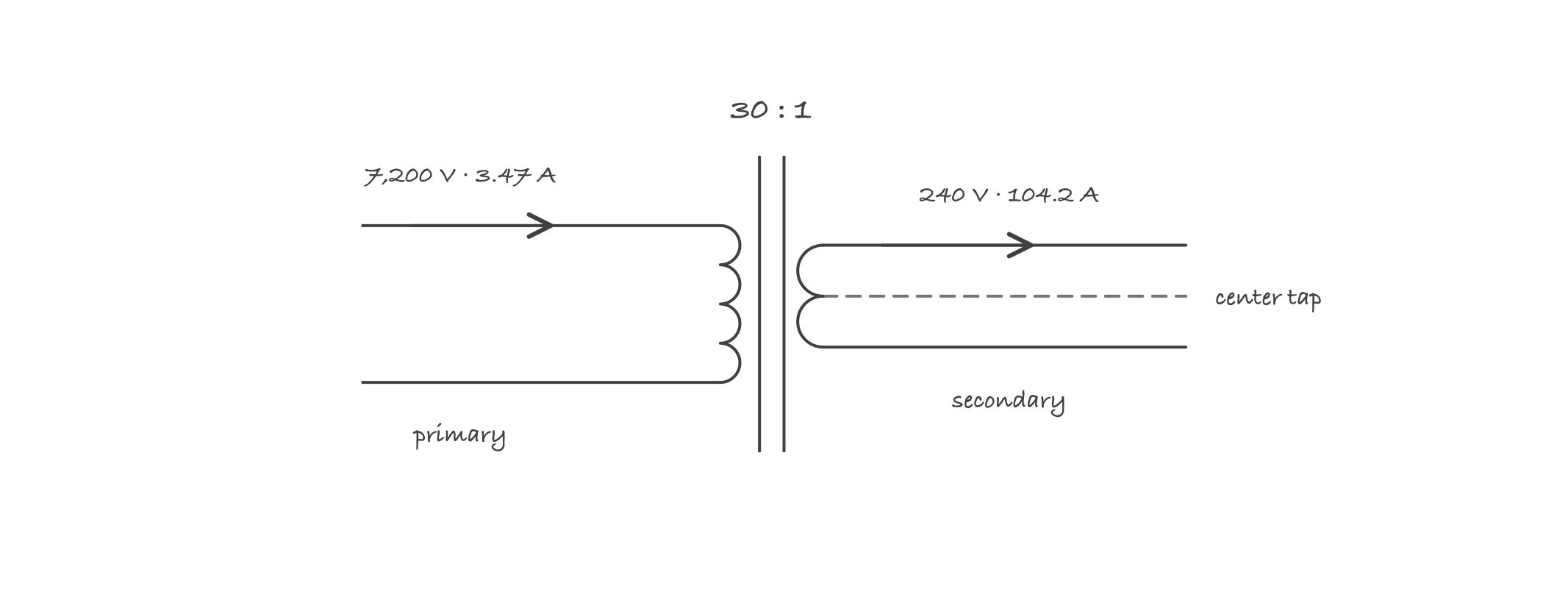
The ratio works both directions: divide voltage by 30, multiply current by 30
Where it bites
- The ratio runs backward too. Energize the secondary (a portable generator, a paralleled service) and the primary side rises to full medium voltage. Every transformer is a step-up transformer to whatever is behind it.
- kVA is not kW at the meter. Transformer nameplates rate apparent power. Real household loading is diverse and intermittent, so utilities deliberately size units smaller than the connected load’s total. Follow your utility’s loading guide, not the sum of nameplates.
- A “low voltage” complaint is a measurement job. Voltage at the transformer, at the weatherhead and at the panel tell three different stories (overload, bad connection, or customer-side trouble). Measure before you swap equipment.