Learn · Linework
Climbing: Gaffs, Belts and Technique
Part of Groundman to Journeyman Lineworker · step 12 of 23 · next: Bucket Truck Work
In learning paths: Groundman to Journeyman Lineworker
Climbing wood poles on steel gaffs is the founding skill of the trade, and it is still where apprenticeships start: a climbing school, often in the first weeks, where you learn to trust sharpened steel and a leather-and-nylon belt with your life. The California-Nevada line JATC, for example, begins with a five-day orientation and climbing class before an apprentice ever charges time on a crew.
Why it matters on the job
Buckets do most elevated work now, but buckets cannot reach every pole: backyards, easements, storm-blocked streets, and structures a truck cannot be set on. A lineworker who cannot climb is a lineworker whose crew has a hole in it, and programs test climbing early precisely because it washes people out.
The equipment
Climbers (hooks). Steel shanks strapped to your legs, each with a sharpened gaff (spike) that penetrates the pole face. Gaff length, profile and sharpness are inspected and maintained like the cutting tools they are.
Body belt and positioning strap. The belt carries D-rings at your hips; the positioning strap loops around the pole and back to the D-rings, letting you lean back and plant both gaffs while keeping both hands free for work.
Fall protection. Modern practice adds a secondary means of pole attachment designed to arrest a fall (wood-pole fall-restriction devices), and employer rules define exactly what must be attached when. Learn your employer’s rule as law.
The technique
Climbing is geometry, not strength. You keep your body away from the pole (arms extended, weight back) so the gaff drives into the wood at a penetrating angle. Hug the pole and the geometry reverses: the gaff angle flattens, the point slides along the grain instead of biting, and you cut out (the gaff tears free and you drop until something stops you).
Each step is deliberate: lift a hook, plant the gaff with a firm knee-driven stab, weight it, then move the other. At the top, the positioning strap goes around the pole, you settle back against it, and your legs and the strap form the stable triangle you work from.
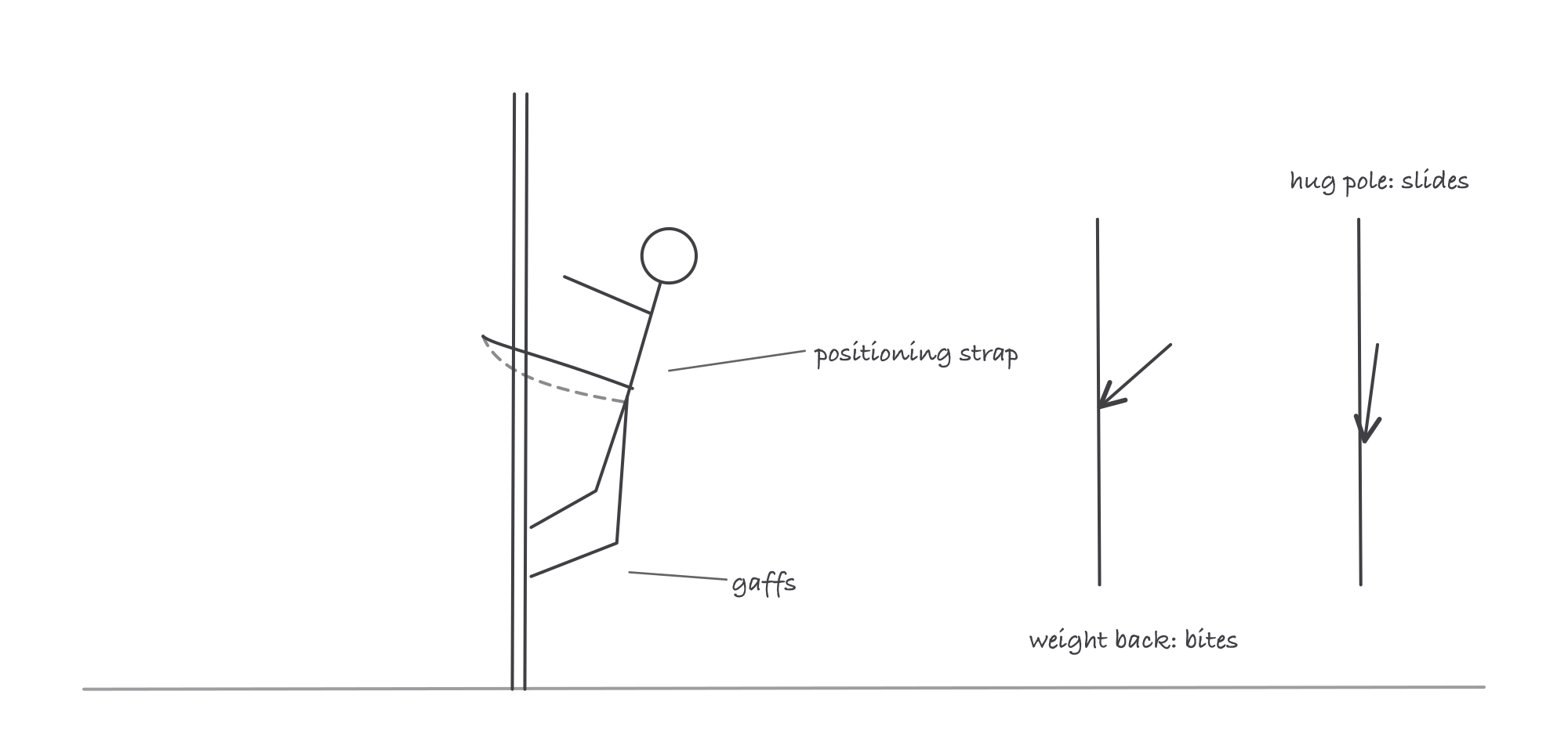
Lean back to bite: keeping your weight away from the pole steepens the gaff angle and drives the point into wood
Worked example: a controlled ascent
Walking through one climb of a sound 40 ft pole:
- Inspect the pole (sound it with a hammer, check for rot, cracks, hardware and attachments) and inspect your gaffs, straps, belt and snaps.
- Face the pole, plant the first gaff about knee height, weight it fully before trusting it.
- Climb in short, rhythmic steps, hands on the pole surface for balance, never in a grip that pulls your body in.
- At working height, throw the positioning strap, seat it above something that will stop it from sliding (or per your training on smooth pole faces), clip both D-rings, lean back, and test it with your weight before releasing your hands.
- Descend the same way you came up: deliberate, weight back, one gaff at a time.
Where it bites
- Cut-outs come from comfort. The instinct under fatigue or fear is to pull in close to the pole. That instinct is exactly what flattens the gaff angle and causes the fall. Training exists to overwrite it.
- The pole is part of your equipment. A shell-rotted or woodpecker-riddled pole will not hold a gaff no matter how good your form is. The inspection before the climb is part of the climb.
- Dull gaffs are a hazard you carry. Gaff sharpness and profile are maintenance items with gauges and procedures, not something you eyeball the morning of.