Learn · Linework
Downed Conductors and Backfeed
Part of Groundman to Journeyman Lineworker · step 10 of 23 · next: The ET&D Partnership and Its 10-Hour Course
In learning paths: Groundman to Journeyman Lineworker
Assumes you know: Transmission vs Distribution
A wire on the ground gives no visible or audible warning of whether it is energized, and OSHA’s downed-wires guidance is built on that fact. The rule for crews and public alike: treat every downed line, and everything it touches, as energized until the utility confirms otherwise and it is tested and grounded.
Why it matters on the job
Storm scenes, car-hit poles and failed spans put lineworkers next to conductors whose state is unknown, with the public close by. The three mechanisms in this lesson (reclosing, ground gradients, and backfeed) explain why “it looks dead” means nothing, and they are the technical spine of every downed-wire response you will run.
The three mechanisms
Reclosing: dead lines that retry. Distribution protection is built to restore service automatically after momentary faults, so breakers and reclosers test a faulted line by re-energizing it, more than once, on a programmed schedule. A conductor lying silent in the road can return to full voltage seconds after it tripped. This is also why crews have reclosing disabled before working on a line, and why the interval after a line goes dead is the most dangerous time to touch it.
Step and touch potential: the ground becomes the circuit. An energized conductor on the ground drives current into the earth, and the earth has resistance, so voltage falls off across distance from the contact point. Two points a stride apart can differ by hundreds of volts: stand with feet apart in that gradient (step potential) or bridge your hand from a truck or fence to the ground you stand on (touch potential) and your body is in the divider. The hazard zone around a downed wire is a region, not a point, and it extends through everything conductive the wire touches: fences, guardrails, vehicles, wet soil.
Backfeed: energy from the wrong direction. A customer’s portable generator connected without a transfer switch pushes power into the house wiring and out through the service, and the service transformer works in reverse.
Worked example: the backfeed arithmetic
The distribution transformer lesson showed a 7,200 V to 240 V transformer as a 30:1 ratio. Run it backward.
A homeowner two spans away wires a generator into a dead house without a transfer switch. The generator holds the secondary at 240 V. The transformer does what its ratio says, in the direction the energy happens to flow: 240 V × 30 = 7,200 V on the primary.
The “dead” tap the crew is walking toward now sits at full primary voltage, fed by a machine the crew cannot hear from the road, with no upstream breaker between the generator and the conductor to clear anything.
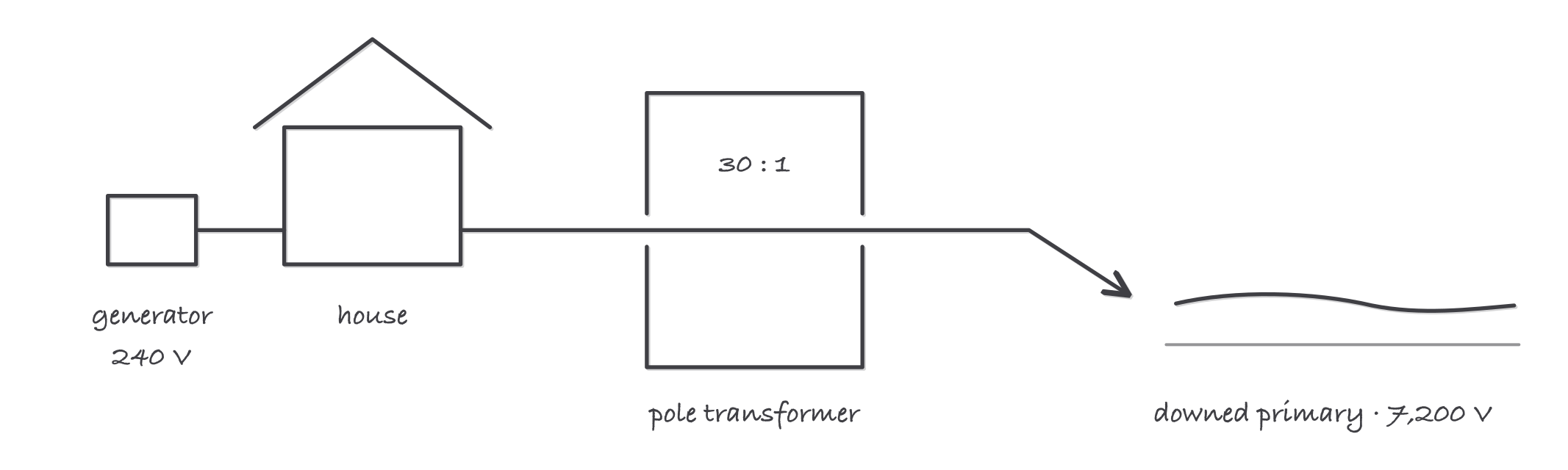
The transformer has no idea which way it is supposed to work: 240 volts in the wrong direction is 7,200 volts on a dead line
Where it bites
- Confirmation is a test, not a report. “The whole neighborhood is out” and “dispatch says it tripped” are starting points. The conductor’s status is established at the worksite with a voltage detector, followed by grounds, before it is handled as dead.
- The public will not believe the wire is dangerous. A silent wire draped over a fence looks like rope, and people cut fences, move wires off cars and walk into gradients. Scene control (keeping people out of the region, not off the wire) is line work, and it starts the moment you arrive.
- Everything the wire touches inherits the hazard. Vehicles, tree limbs, chain link, telephone and cable strands: a downed primary recruits conductors. Clearing a scene means mapping what is electrically connected, not eyeballing where the wire ends.