Learn · Linework
Rubber Gloving and Live-Line Work
Part of Groundman to Journeyman Lineworker · step 14 of 23 · next: Personal Protective Grounding
In learning paths: Groundman to Journeyman Lineworker
Assumes you know: Bucket Truck Work
Rubber gloving is the energized-work method where the barrier between you and the primary is worn on your hands: rated rubber gloves with leather protectors, rated rubber sleeves, and a wall of rubber and plastic cover-up over everything else in reach. The line stays hot, the customers stay lit, and the method’s whole logic is insulate and isolate.
Why it matters on the job
Distribution cannot be turned off every time it needs work. Energized methods let crews change insulators, transfer conductors and replace equipment with the feeder live, and rubber gloving is the everyday energized method on distribution voltages. It is journeyman work with a journeyman’s training burden: OSHA’s line-work standard permits energized work only by qualified employees using the tools, equipment and techniques the method requires.
The teaching
Gloves are rated equipment, not workwear. Insulating rubber gloves come in classes, each with a maximum use voltage marked on the glove, and the class on your hands must cover the voltage you are working. Leather protectors go over the rubber to take the mechanical abuse. Gloves are air-tested before use each day and electrically retested on a schedule; a pinhole is a full failure.
Sleeves extend the barrier. Rubber sleeves cover the forearms and upper arms, because reaching through a maze of conductors exposes far more than hands.
Cover-up builds the room you work in. Line hoses, blankets, hoods and covers go over every conductor and grounded surface within reach, applied nearest-first as you build the covered zone and removed in reverse as you leave it. The goal is that a slip, a dropped tool or an inch of drift meets rubber, not metal.
Second point of contact is the enemy. Current needs a path through you: one contact at line potential and another at a different potential. Rubber gloving attacks both ends: insulation on you, isolation (cover) on everything else that could be the second point.
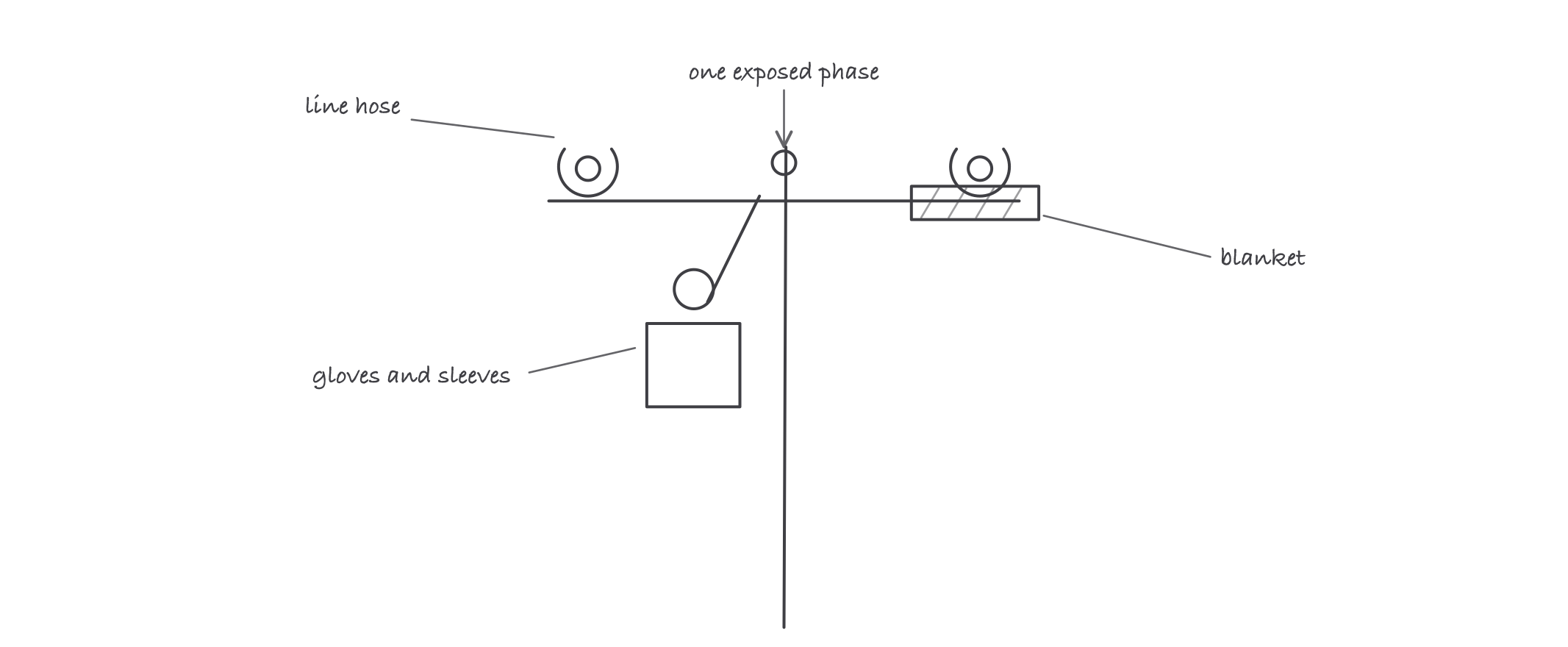
Insulate and isolate: rubber on the worker, cover on everything else, one exposed point at a time
Worked example: covering up for an insulator change
A cracked pin insulator on the center phase of a three-phase crossarm:
- From below the conductor level, test and inspect gloves and sleeves, then glove up before entering the working zone around the primary.
- Cover the nearest exposed conductor first, then the next: line hose on the outside phases, blankets over the crossarm end fittings, cover on the pole ground and neutral if they are within reach.
- With the center phase now the only uncovered component, lift it from the damaged insulator using the method your utility specifies (gloved hands or an auxiliary arm on the boom), swap the insulator, and land the conductor back.
- Remove cover in reverse order, last piece nearest you, and leave the zone the way you entered it.
The sequence is the safety. Cover applied in the wrong order means reaching past uncovered energized parts to place rubber, which is the exposure the method exists to prevent.
Where it bites
- Rubber gloving and hot sticking are different methods. Above the voltages where glove work is permitted, crews work with live-line tools (hot sticks) or barehand methods, each with its own envelope, training and equipment. “Working it hot” is not one technique, and qualification in one is not qualification in another.
- Minimum approach distance still applies. Cover-up and gloves manage the parts you must contact; the distances from the tables still govern every uninsulated part of you and the machine relative to everything not covered. The minimum approach distance lesson covers where those numbers come from.
- Cover-up degrades in silence. Sun-rotted line hose and a blanket with a cut do their failing quietly. Inspection before use is part of the method, and so is treating cover with storage care instead of throwing it loose in a bin.