Learn · Linework
Storm Response Work
Part of Groundman to Journeyman Lineworker · step 17 of 23 · next: Storm Deployment: Restoration Work Away From Home
In learning paths: Groundman to Journeyman Lineworker
Assumes you know: Switching and Tagging
Storm response is line work with the system broken: conductors down, poles snapped, protective schemes half-functional, and pressure from every direction to get the lights back on. The methods do not change (test, ground, clearance, cover-up), but the environment that makes them easy to follow is gone, which is exactly when they matter most.
Why it matters on the job
Restoration is where the trade’s safety culture gets stress-tested. OSHA’s guidance for storm and downed-wire work is blunt on the core point: treat all downed or damaged lines, and everything they touch, as energized until the utility confirms otherwise and the lines are tested and grounded. Storm casualties among responders and the public cluster around the assumption that a broken system is a dead system.
The teaching
Assess before you touch. The first job on a damaged section is patrol and assessment: what is down, what is hanging, what is energized or could become energized, and what hazards (trees under tension, damaged poles, water, gas, traffic) surround the electrical work. Damage assessment feeds the operator’s restoration plan; freelancing repairs outside that plan puts crews against each other on the same conductors.
The system fights back. Reclosing schemes retry faulted lines. Circuits get switched in unfamiliar configurations to pick up load around damage. Customer generators backfeed dead circuits through service transformers. Every one of these can re-energize a conductor that was dead a minute ago, which is why testing and grounding at the worksite remain non-negotiable even with the whole feeder visibly wrecked.
Restoration has an order. Utilities restore in a priority sequence: transmission lines and substations first (nothing downstream works without them), then main feeders that pick up the most customers and critical facilities (hospitals, water systems, emergency services), then taps and laterals, then individual services. Crews feel this as triage: a tap serving six houses waits while the feeder serving six thousand gets rebuilt.
Emergency conditions bend rules narrowly, not broadly. The line-work standard’s requirements are written with tight, specific exceptions (the two-employee requirement, for example, has a narrow emergency provision). Storm mode does not suspend the standard; it raises the stakes on following it.
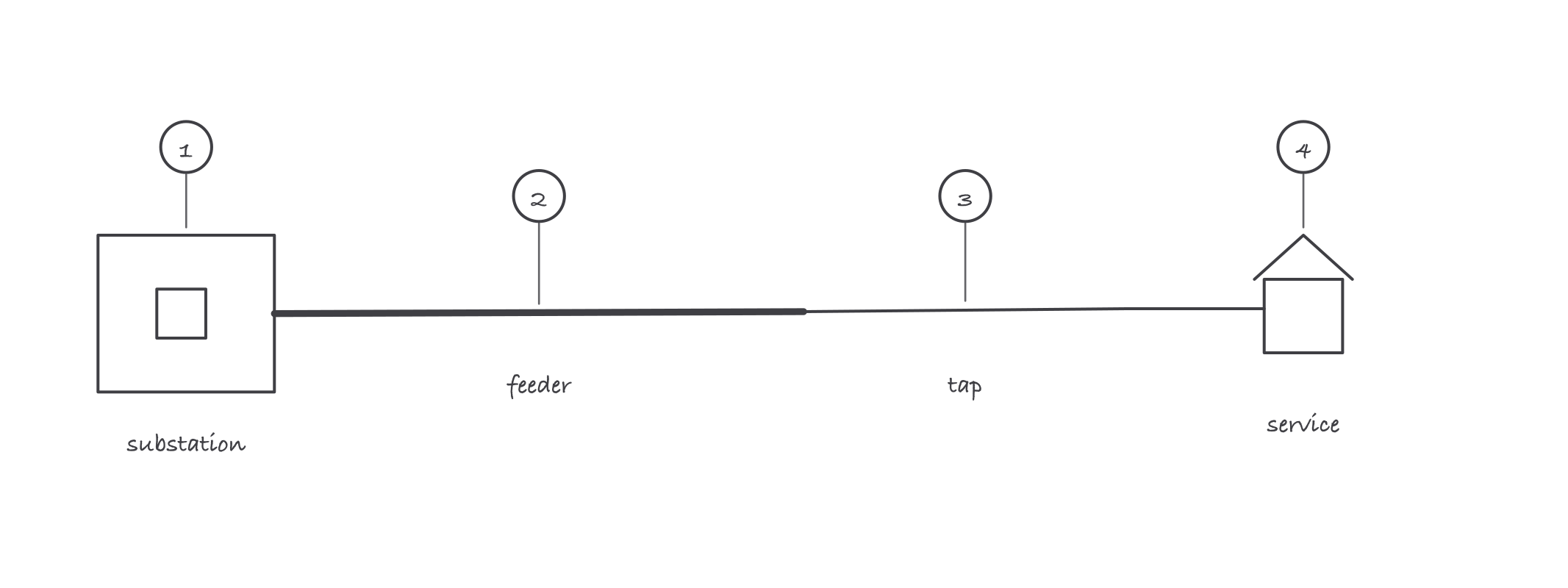
Triage by count: the backbone comes back before the branches, the branches before single services
Worked example: working one broken span
A patrol finds a span on the ground across a driveway, pole intact:
- Secure the scene: the conductor and everything it touches (fence, vehicle, puddles) is treated as energized. Keep the public out; the hazard zone is bigger than the wire.
- Report to the operator with location and damage; get the section’s status and a clearance before contact. “The whole area is out” is a rumor, not a test result.
- With the clearance confirmed, test the conductor at the worksite. Then ground it, bracketing the work.
- Make the repair (splice or re-string the span), remove grounds, release the clearance, and the operator restores per the plan.
The steps are the same as a bluebird-day job. The discipline is doing them at 3 a.m., in the rain, with a homeowner watching from the porch.
Where it bites
- Downed wires recruit new conductors. A fence wire, a guardrail, a wet rope, a tracked-up vehicle chassis: anything in contact with a downed conductor extends the hazard far from the visible wire.
- Fatigue is a system hazard, not a personal one. Long restoration shifts degrade the judgment that safe energized work depends on. Crew rotation and rest limits are part of restoration planning, and the storm deployment lesson goes deeper.
- Backfeed does not announce itself. A humming generator two houses away can hold a “dead” tap at full primary voltage. The downed conductors lesson shows the arithmetic.