Learn · Linework
Storm Deployment: Restoration Work Away From Home
Part of Groundman to Journeyman Lineworker · step 18 of 23 · next: The Lineworker Apprenticeship
In learning paths: Groundman to Journeyman Lineworker
Assumes you know: Storm Response Work
Storm deployment is the trade’s expeditionary mode: crews leave home territory, travel long distances, and work extended restoration hours on a system they have never seen, under the direction of a host utility. The storm response lesson covered how broken systems are worked safely; this one covers the deployment itself, because the distance, the hours and the unfamiliarity are hazards of their own.
Why it matters on the job
Almost every lineworker rolls on storms: contractor hands as the core business, utility and co-op crews through mutual assistance between utilities. Restoration work after hurricanes concentrates the trade’s worst exposures (downed conductors, damaged structures, energized-status unknowns) into long shifts in wrecked terrain, and OSHA’s hurricane restoration guidance for electrical workers exists because that combination keeps producing casualties.
The teaching
You work under the host’s system, not your own. Clearances, switching authority, grounding practices and circuit knowledge belong to the host utility. Crews arriving on a storm are briefed into the host’s procedures, and the discipline is to run the host’s rules even where home rules differ. The most dangerous phrase on a storm is “back home we do it this way.”
The hazard list is longer than the electrical one. OSHA’s guidance for hurricane electrical restoration reads like a site survey of everything wrong at once: downed and unstable lines, damaged poles and trees under load, flooded and debris-choked work areas, traffic, generators backfeeding, and the heat, insects and footing hazards of the wrecked environment itself. Assessment before work is not a formality on a storm; it is most of the job.
Fatigue management is a control, not a virtue. Restoration runs on extended shifts across many days. Fatigue degrades exactly the faculties energized work depends on (attention, judgment, fine motor control), so rotation, rest periods and honest self-report are treated as part of the safety system, on par with grounds and cover-up.
Logistics are part of readiness. Deployment means living out of staging areas and hotels or camps for one, two or more weeks: packing for weather, managing money and per diem, communicating with home on a schedule. Crews that arrive logistically squared away do better work because the storm days are spent on the system, not on scrambling.
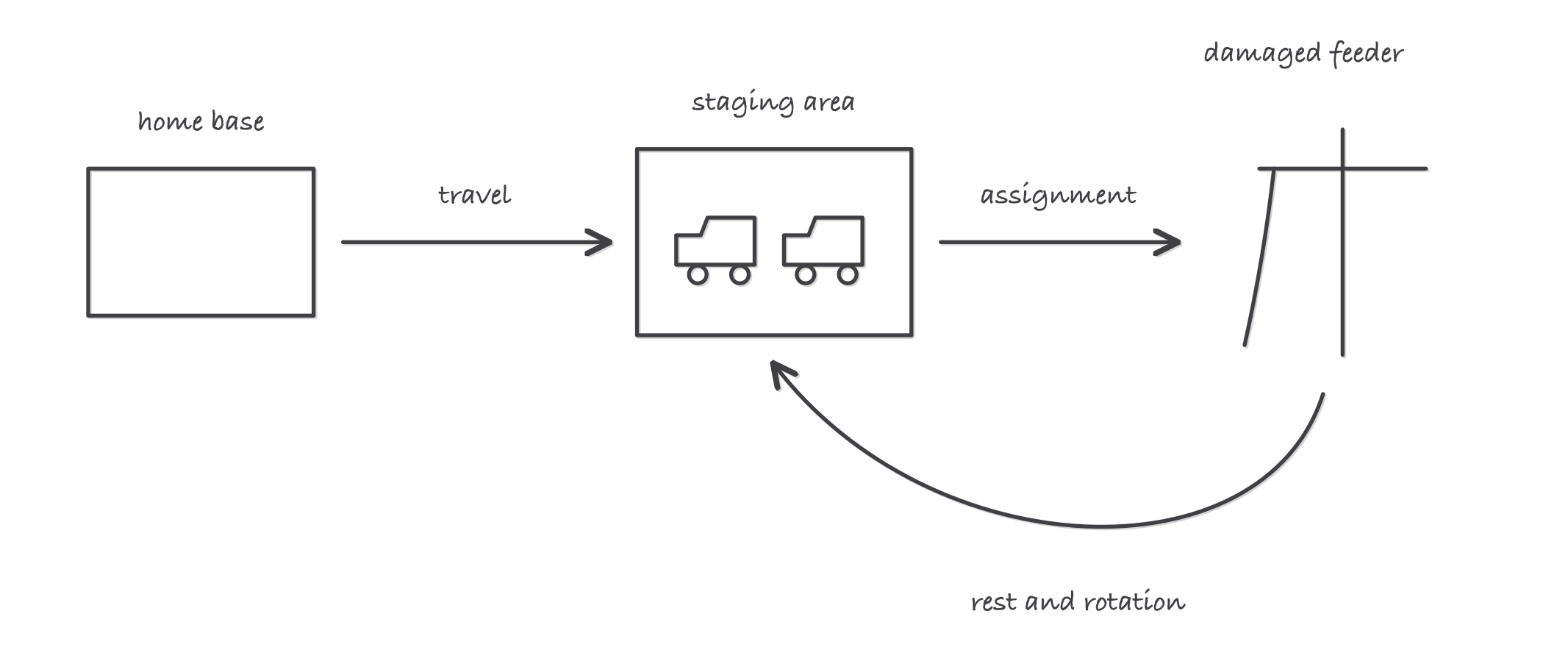
Deployment is a cycle: travel, stage, brief into the host system, work, rotate, and only then home
Worked example: the first 24 hours on a roll
A contractor crew is released to a hurricane restoration 400 miles away:
- Travel and check-in. Convoy to the host’s staging area; trucks fueled, inventoried and staged; crew housed and rested before the first work shift, because arriving exhausted and starting immediately is how week one goes wrong.
- The host briefing. Circuit maps, switching and clearance procedures, grounding requirements, the reporting chain, and the day’s assignments. Names and radio channels written down, not memorized.
- First assignment assessment. Patrol the assigned section and report damage before repairs: what is down, what is energized or could be, what the host’s plan needs first.
- Work the plan. Test and ground per the host’s procedure on every conductor handled, treat every downed line as energized until proven otherwise, and end the shift at the rotation time, not at the crew’s pride threshold.
Where it bites
- Unfamiliar systems break assumptions silently. Construction standards, voltages, grounding practices and even hardware differ between utilities. The habits that make you fast at home can make you wrong on a host system; the briefing exists to recalibrate them.
- The public is part of the work site. Restoration crews work in neighborhoods full of residents, generators, chainsaws and frustration. Scene control and public contact are continuous, not occasional.
- Money distorts judgment. Storm hours are lucrative, and the incentive runs straight against fatigue limits. Crews that last in this trade treat rest rules as non-negotiable precisely because the paycheck argues otherwise.