Learn · Fire Protection
Waterflow Switches and the Fire Alarm Boundary
Part of Sprinkler Fitter to NICET · step 9 of 21 · next: Special Hazards Suppression Systems
In learning paths: Sprinkler Fitter to NICET
Assumes you know: Sprinkler System Types: Wet, Dry, Preaction, Deluge
Water flowing in the sprinkler system trips the waterflow switch, and the waterflow switch tells the fire alarm. That single sentence carries the whole relationship between the two systems, and it runs in the direction most people get backwards: on a standard wet or dry system, the alarm does not set off the sprinklers. The sprinklers set off the alarm.
Why it matters on the job
You install the hardware that sits on this boundary: waterflow switches on the riser and branch mains, tamper switches on every control valve. The circuits those switches connect to belong to the fire alarm system, NFPA 72, and the low-voltage trade. Knowing exactly where your work ends and theirs begins keeps you legal, keeps the acceptance test clean, and keeps two crews from wiring over each other.
The two switches
The waterflow switch detects that water is moving in the pipe. On wet systems this is typically a vane-type device: a paddle sits in the waterway, and sustained flow, like a single open head, deflects it and closes a contact. Its signal means fire: it initiates an alarm.
The tamper switch (valve supervisory switch) detects that someone is closing a control valve. A sprinkler system dies silently when a valve is shut, so every valve that can cut off water is supervised. Its signal is not an alarm: it is a supervisory signal, a “come look at this” to whoever monitors the system.
That signal distinction, alarm versus supervisory, is the vocabulary of the boundary. The sprinkler side generates conditions; the alarm side classifies and reports them under NFPA 72 (the 2025 edition is current).
Where NFPA 13 hands off to NFPA 72
Recent editions of NFPA 13 tell you where the devices go: which valves are supervised, where flow detection sits. NFPA 72 governs everything the devices connect to: the circuits, the panel, the monitoring, the signal types, and the timing the alarm side must meet. The switch bodies are sprinkler-side hardware you mount and pipe around; the wiring to the panel is fire alarm work, and in most jurisdictions it rides on a different license and a different NICET track (Fire Alarm Systems, a low-voltage credential).
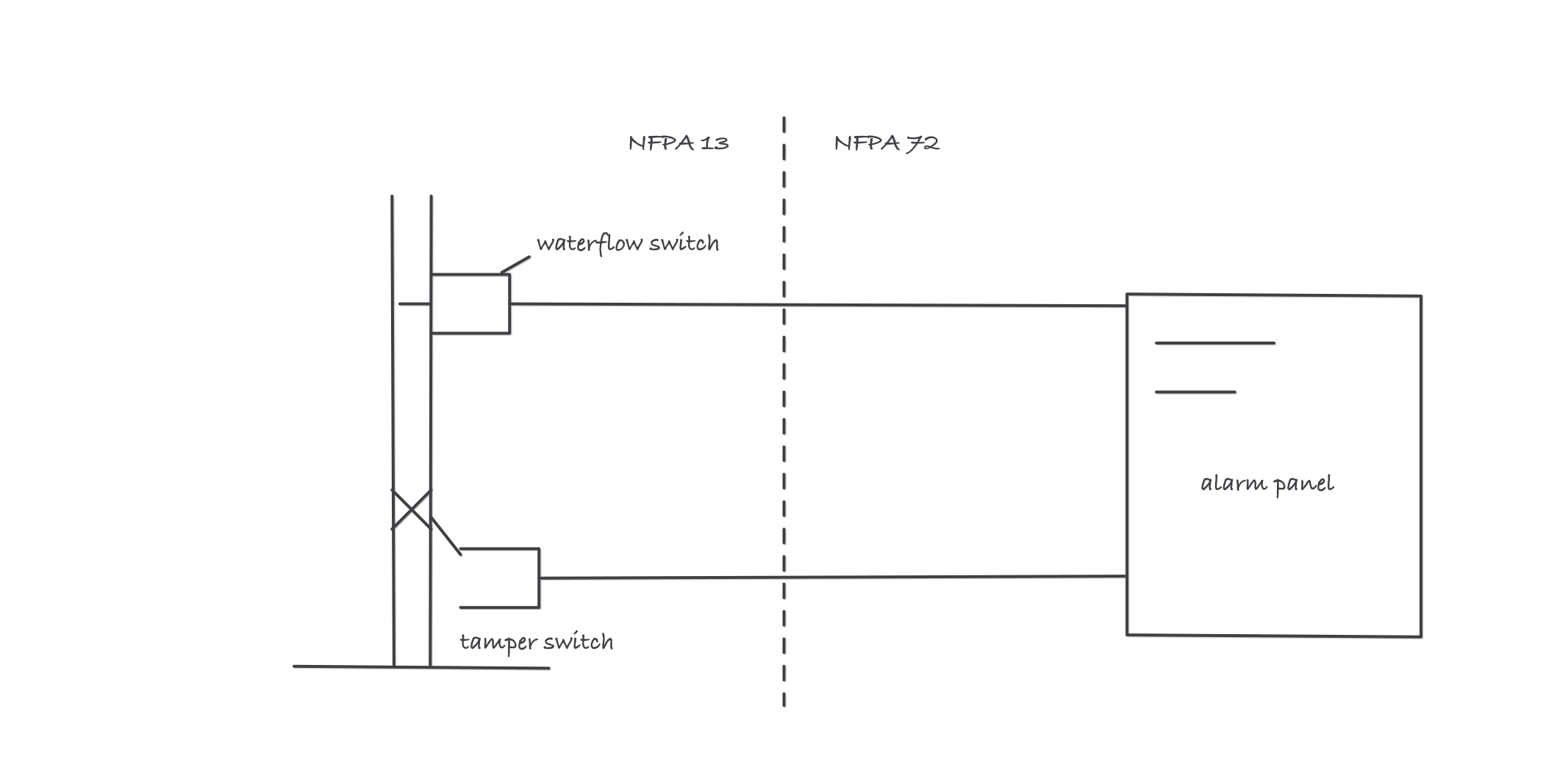
You mount the switches; the alarm trade wires them: the dashed line is NFPA 13 handing off to NFPA 72
Worked example: two signals, two meanings
Walk both events through the boundary on a wet system.
- A head opens. Heat, never smoke, operates one sprinkler over the fire. Water moves through the riser, the vane deflects, and the waterflow switch closes. The alarm panel receives an initiating signal, classifies it as an alarm, and drives notification and monitoring. Everything after the switch contact belongs to NFPA 72.
- A valve starts to close. A maintenance tech shuts the main control valve two turns. The tamper switch operates within those first turns, and the panel reports a supervisory condition, not an alarm. Nobody evacuates; somebody investigates. The system has told on the person about to disable it.
Same boundary, opposite meanings: flow means fire, tamper means the water supply is being taken away.
Where it bites
- “The alarm activates the sprinklers.” Backwards for wet and dry systems. Only preaction and deluge systems let detection open a valve, and that inversion is the entire point of those system types.
- Alarm versus supervisory. Reporting a closed valve as an alarm, or a waterflow as a supervisory, fails acceptance testing and confuses every responder afterward. The signal classes exist so the response can differ.
- Wiring past the boundary. Mounting the switch is your work; landing its circuit at the panel generally is not. Crossing that line can put you outside your license and inside the alarm contractor’s scope.
- Unsupervised valves. A valve nobody watches is the classic reason systems fail to perform: closed water supplies do not announce themselves without a tamper switch.