Learn · Fire Protection
Sprinkler Piping Installation
Part of Sprinkler Fitter to NICET · step 3 of 21 · next: Hydraulic Calculations
In learning paths: Sprinkler Fitter to NICET
Assumes you know: Sprinkler System Types: Wet, Dry, Preaction, Deluge
Sprinkler piping is hung from the structure, braced against earthquakes, and joined by methods you can make reliably a hundred times a day at height. Hangers, seismic bracing, grooved couplings and threaded joints are the four skills this lesson covers, plus the machine most of the work happens from: the lift.
Why it matters on the job
A sprinkler system is a water-filled steel network overhead, above people, stock and equipment. Water is heavy: every foot of filled pipe is load the building has to carry through your hangers. Installation quality is invisible on day one and decisive in year twenty, or in minute one of an earthquake.
Hangers: carrying the filled weight
Every hanger carries a share of pipe, fittings and, critically, the water inside. A common assembly is a threaded rod from the structure down to a clevis or ring around the pipe. Three rules organize hanger work in recent editions of NFPA 13:
- Attachment must be to structure, not to ceilings, other trades’ supports, or whatever is handy.
- Spacing is a table lookup, set by pipe material and size. Steel pipe allows longer spans than CPVC; bigger pipe allows longer spans than small.
- Ends and heads get extra rules: distance from the last hanger to the end sprinkler is limited so an operating head cannot lever the pipe.
Worked example. A 60 ft steel branch line where the applicable table permits a maximum 12 ft between hangers: 60 / 12 = 5 spans, so the line needs at least 5 hangers, before the end-of-line and armover rules add their own. Space them evenly and you also spread the filled weight evenly into the structure.
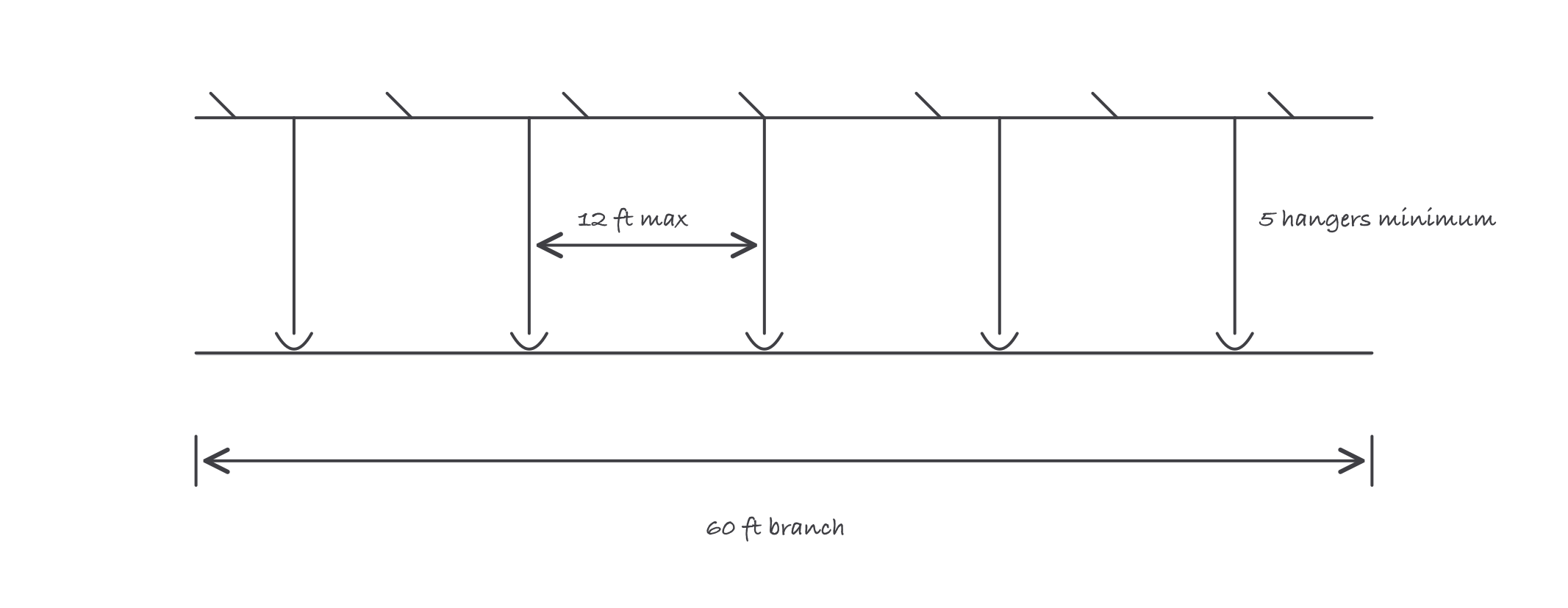
Spacing is a table value: 60 ft at a 12 ft maximum means five spans, five hangers minimum
Seismic bracing: stopping the sway
Hangers carry weight straight down; they do nothing to stop pipe swinging sideways in an earthquake. Where the adopted code requires it, sway braces lock the piping to the structure against horizontal movement: lateral braces stop side-to-side swing, longitudinal braces stop movement along the pipe run, and flexible couplings at seismic joints let the building move without tearing the pipe apart. Brace type, spacing and load ratings all come from the seismic provisions and the manufacturer’s listings, never from habit.
Joining: grooved and threaded
Grooved couplings dominate modern sprinkler work. A groove is rolled (or cut) near each pipe end, a rubber gasket seals across the joint, and a two-piece housing engages both grooves and bolts tight. Fast, strong, and slightly flexible, and the gasket only seals if the groove is clean, the gasket is lubricated per the manufacturer, and the housing bolts are drawn evenly.
Threaded joints remain standard for smaller pipe and for armovers to heads. Cut threads remove metal, which is why minimum wall thickness rules exist for threaded pipe, and why a poorly cut or overdoped thread is a slow leak hiding above a ceiling tile.
Working from lifts
Most hanging and joining happens from a scissor lift. OSHA regulates scissor lifts as scaffolds (29 CFR 1926.451), and the protection logic is: guardrails in place, or personal fall protection where guardrails are not. Keep both feet on the platform, never climb the rails to gain reach, and check overhead clearances: the steel you are hanging pipe from is also what a rising platform crushes against.
Where it bites
- The water is the load. Pipe that felt manageable dry doubles down when the system fills. Hanger spacing tables already assume water-filled pipe; improvised supports do not.
- Grooved is not threaded. A grooved joint’s strength lives in the groove-to-housing engagement. A shallow, dirty or eccentric groove looks fine assembled and lets go under pressure surge.
- Seismic bracing is not extra hangers. Hangers and braces solve perpendicular problems: gravity versus shaking. Passing inspection needs both, in seismic territory.
- Never trade fall protection for reach. The minutes saved standing on a midrail are the minutes that end careers. Lift work is scaffold work in OSHA’s eyes, with scaffold rules.