Qualifications · Fire Protection
Fire Protection Licensing by State
Part of Sprinkler Fitter to NICET · step 17 of 21 · next: Becoming a Sprinkler Contractor
In learning paths: Sprinkler Fitter to NICET
There is no national sprinkler license. Fire protection licensing is state-fragmented, and the fragmentation is not only in the rules but in who writes them: in some states the state fire marshal licenses the trade, in others the contractor licensing board does, and in a few places the city itself is the authority. Learn the three patterns and you can find your own jurisdiction’s answer quickly; memorize any single state’s rules and you know one state.
*Learn the Trades is a free study resource. We are not a licensing body, an authorized training provider, or an exam administrator. Reading this page does not award any card, license, or certification. Always verify requirements with the issuing authority linked in the sources.*Why it matters on the job
Working outside your jurisdiction’s licensing rules is illegal, and the rules change shape at every border. The practical skill is not knowing every state: it is recognizing which pattern your state runs, finding the issuing authority, and reading its actual requirements. The three anchors below are real, verified examples of each pattern.
Pattern 1: the state fire marshal (Texas)
Texas licenses fire sprinkler work through the State Fire Marshal’s Office, which sits inside the Texas Department of Insurance. The structure is two-layered: the firm holds a Sprinkler Certificate of Registration (SCR), and a designated individual at the firm holds a Responsible Managing Employee license, in three flavors (RME-G general, RME-I inspection only, RME-D one- and two-family dwellings). Fire-marshal states tie licensing directly to the fire authority rather than to a general contractor board. Texas gets its own lesson next.
Pattern 2: the contractor licensing board (California)
California treats fire protection as a contractor classification: C-16 Fire Protection, issued by the Contractors State License Board (CSLB). C-16 covers the layout, fabrication and installation of fire protection systems, including underground fire mains, trenching, fire pumps and tanks, and it explicitly excludes electrical alarm systems, which belong to a different classification. The exclusion cuts both ways: a general building contractor cannot take fire protection work without C-16 or a C-16 subcontractor.
Pattern 3: the city (New York City)
New York City licenses the trade municipally: the Department of Buildings issues the Master Fire Suppression Piping Contractor license, in Classes A, B and C. The experience pathway is seven years within the ten years before application (with degree and professional-engineer alternatives), plus a written exam. Note what is absent: there is no New York State sprinkler license behind it. In municipal-pattern jurisdictions, the city’s rules are the rules.
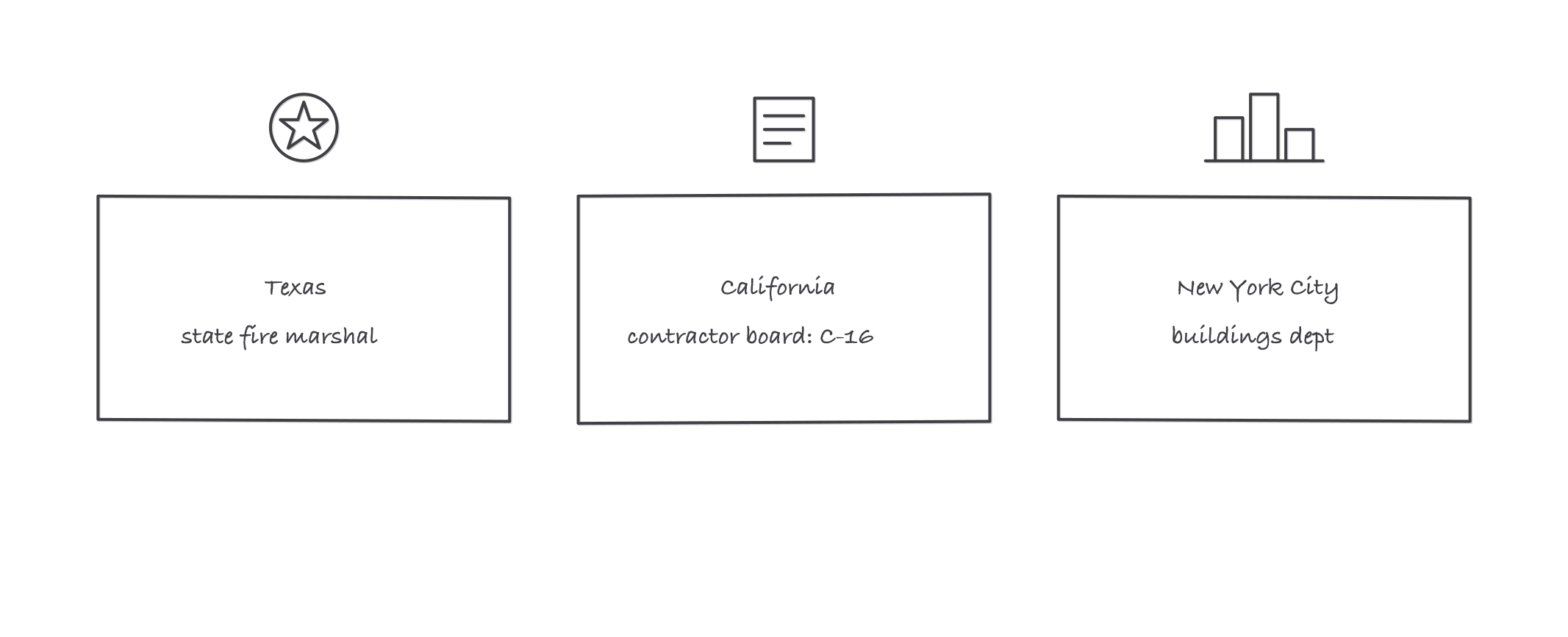
Three authorities, three patterns: fire marshal, contractor board, city hall
Worked example: locating your authority
You take a job in a state you have never worked in. The search runs in pattern order. Does the state fire marshal’s office license sprinkler contractors or RMEs? If yes, you are in a Texas-shaped system: look for a firm registration layer and an individual license layer. If not, does the state contractor board have a fire protection classification? That is a California-shaped system: read the classification’s scope and exclusions carefully, especially around alarms. If neither turns up, check the major cities where you will actually work: a New York-shaped system puts the license at the buildings department. In every case, the issuing authority’s own pages are the source; anything else is commentary.
Where it bites
- The state’s default licensing agency may not be the right one. In Texas, most trades license through one state agency, but sprinkler licensing lives with the fire marshal inside the Department of Insurance. Search for the credential, not the agency you expect.
- Firm versus individual licensing. Some layers attach to the company, some to a person. “Get licensed” is two different projects depending on which layer is missing.
- Scope exclusions are boundaries, not fine print. California’s C-16 excluding alarm systems is the licensing mirror of the NFPA 13/NFPA 72 boundary you learned on the tools.
- No state license does not mean no license. NYC proves it: silence at the state level can mean the requirement lives downstairs, at the city.