Learn · Fire Protection
Special Hazards Suppression Systems
Part of Sprinkler Fitter to NICET · step 10 of 21 · next: NFPA 25: Inspection, Testing and Maintenance
In learning paths: Sprinkler Fitter to NICET
Assumes you know: Sprinkler System Types: Wet, Dry, Preaction, Deluge
Some rooms cannot take water. A data hall full of running servers, a turbine enclosure, a tank farm of flammable liquid: dousing any of them with a sprinkler discharge either destroys what you were protecting or fails to put the fire out. Special hazards suppression systems exist for exactly these spaces, and they replace water with an agent chosen for the hazard: clean agents, carbon dioxide, or foam.
Why it matters on the job
Special hazards is a distinct specialty inside fire protection, with its own design logic, its own servicing discipline, and its own NICET certification track (Special Hazards Systems, four levels). Even if you stay on the water side your whole career, you will share buildings with these systems, and knowing what each one is doing, and what it can do to you, is part of working around them safely.
The three families
Clean agents suppress fire with a gas that is electrically nonconductive and leaves no residue. That combination is the whole pitch: discharge one into a room of energized electronics and there is nothing to mop up, dry out, or replace afterward. The room is typically flooded to a design concentration and held there while the hazard cools.
Carbon dioxide suppresses by displacing oxygen. It is effective and cheap, and it is dangerous for the same reason it works: a CO2 discharge into an enclosed space makes that space unsurvivable. CO2 systems belong to normally unoccupied enclosures, and every discharge is engineered around keeping people out of the agent.
Foam attacks flammable-liquid fires by blanketing the fuel surface, separating fuel from flame and sealing off the vapor that feeds it. Plain water sinks straight through a burning liquid; foam floats on it. Fuel storage, loading racks, and similar hazards are foam territory.
How the discipline differs from sprinklers
A sprinkler system is one design idea applied everywhere: water on the fire, head by head. Special hazards work inverts that. The agent is matched to the hazard, the enclosure is part of the system (a flooding agent only works if the room holds it), and the discharge is engineered as a single event: agent quantity, the hydraulic flow of the agent through its piping and nozzles, and the condition of the enclosure all have to be right on the day of the fire. That is why NICET’s Special Hazards program tests suppression agents, agent flow, installation, and servicing as its core content.
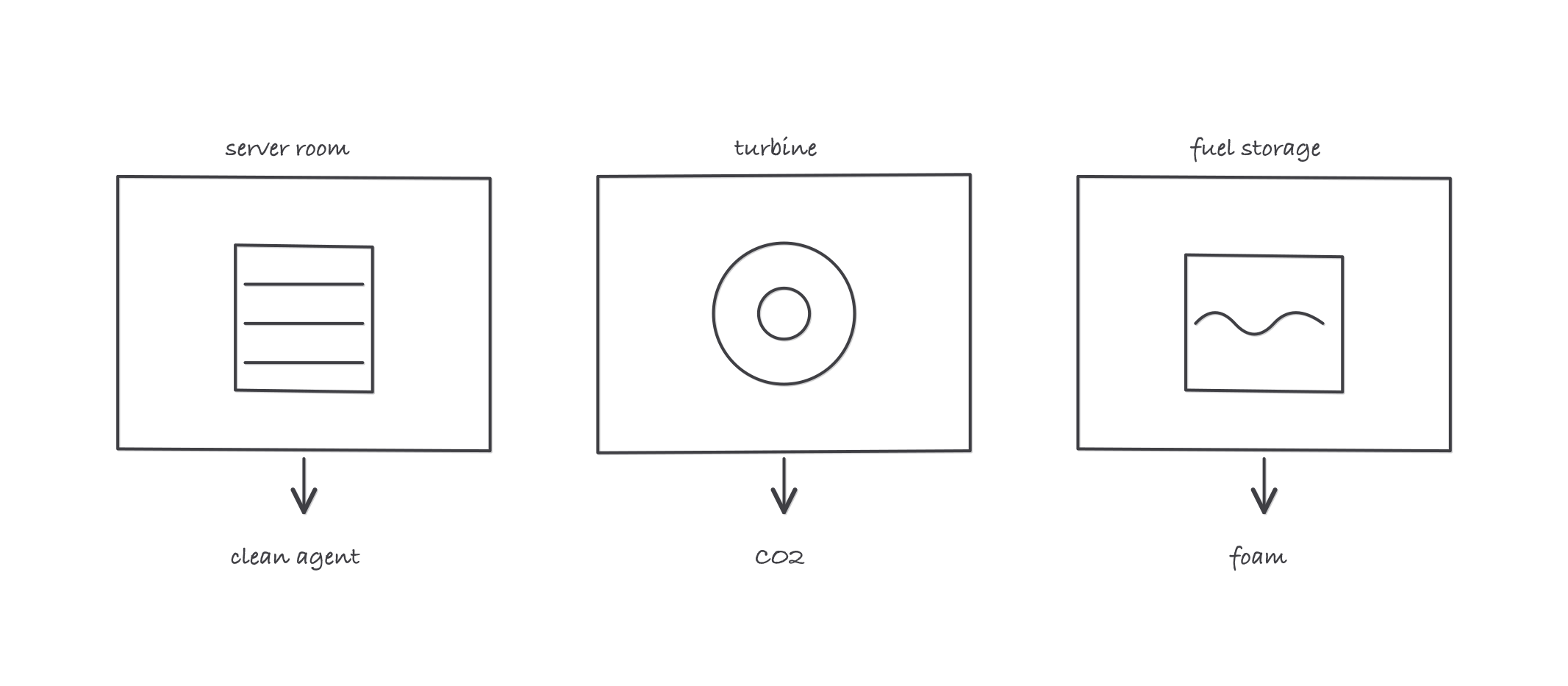
The agent follows the hazard: electronics, enclosed machinery, flammable liquid
Worked example: match the agent
Three spaces in one industrial building. Reason through each.
- The server room. Energized electronics, high value, continuously occupied by technicians. Water ruins the equipment; CO2 endangers the occupants. Clean agent: nonconductive, residue-free, and designed for occupied spaces.
- The turbine enclosure. Enclosed machinery, normally unoccupied, lubricating oil under pressure. CO2 fits: the enclosure holds the agent, and there is nobody inside to displace oxygen from. The discharge interlocks and warnings exist to keep it that way.
- The fuel storage area. Flammable liquid in bulk. A gaseous agent disperses outdoors and water spreads the fuel. Foam blankets the liquid surface and holds the vapor down.
One building, three fires that behave differently, three systems.
Where it bites
- CO2 is a life safety hazard, not only a suppression agent. Treat every enclosure protected by CO2 as a space that can kill during and after a discharge. Lockout and time-delay provisions are there for the servicing tech: you.
- “Clean agent” is not a brand. It is a family of gases sharing two properties: nonconductive, no residue. Systems differ in agent, concentration, and hardware; the servicing manual for the installed system governs.
- The enclosure is part of the system. Propping a door, cutting a cable penetration, or removing a damper on a flooded room quietly breaks the design without touching a single system component.
- Special hazards is not sprinkler work with different pipe. Different agents, different physics, different certification track. NICET certifies it separately for a reason.
Exam relevance
This is the knowledge base NICET’s Special Hazards Systems certification examines: which agent family fits which hazard, how agents flow and discharge, and how systems are installed and serviced. The next lesson covers the certification itself, its four levels and what each one means.
Verified requirements
| Where | Expires | Renewal | Continuing education |
|---|---|---|---|
| United States (federal) | Yes | 3 years | CPD required each 3-year certification period |
Information comes from issuing-authority sources. Confirm current rules, fees and eligibility with the authority before acting.