Learn · Low Voltage and Telecom
Fire Alarm System Fundamentals
Part of Fire Alarm Technician, NICET Track · step 1 of 11 · next: Initiating Devices and Notification Appliances
In learning paths: Fire Alarm Technician, NICET Track
A fire alarm system is a supervised detection-and-warning machine with three parts: initiating devices that sense trouble (smoke detectors, heat detectors, pull stations), a fire alarm control unit (the panel) that decides what the signals mean, and notification appliances (horns, strobes, speakers) that tell occupants to move. Around that core sit power supplies and, in most commercial systems, a connection to a supervising station that summons the fire department.
Why it matters on the job
Fire alarm is the life-safety end of low-voltage work, and everything about it is stricter: the code is enforced, the wiring is supervised, the documentation is legal record, and the licensing is frequently separate from ordinary low-voltage work. It is also the specialty where certifications and pay climb fastest for technicians who master it.
The governing document is NFPA 72, the National Fire Alarm and Signaling Code (2025 is the current edition). It gets its own lessons later in this group; for now, know that nearly every requirement mentioned here traces to it.
The signal model
The panel lives in one of four states, and keeping them straight is the foundation of the trade:
- Normal: all circuits supervised and quiet.
- Alarm: an initiating device reports fire (smoke, heat, waterflow, a pulled station). Notification fires, and the supervising station is told to dispatch.
- Supervisory: something that protects the building needs attention but is not a fire, for example a closed sprinkler valve.
- Trouble: the system itself is impaired: a broken wire, a ground fault, lost power. Supervision exists to force this state instead of silent failure.
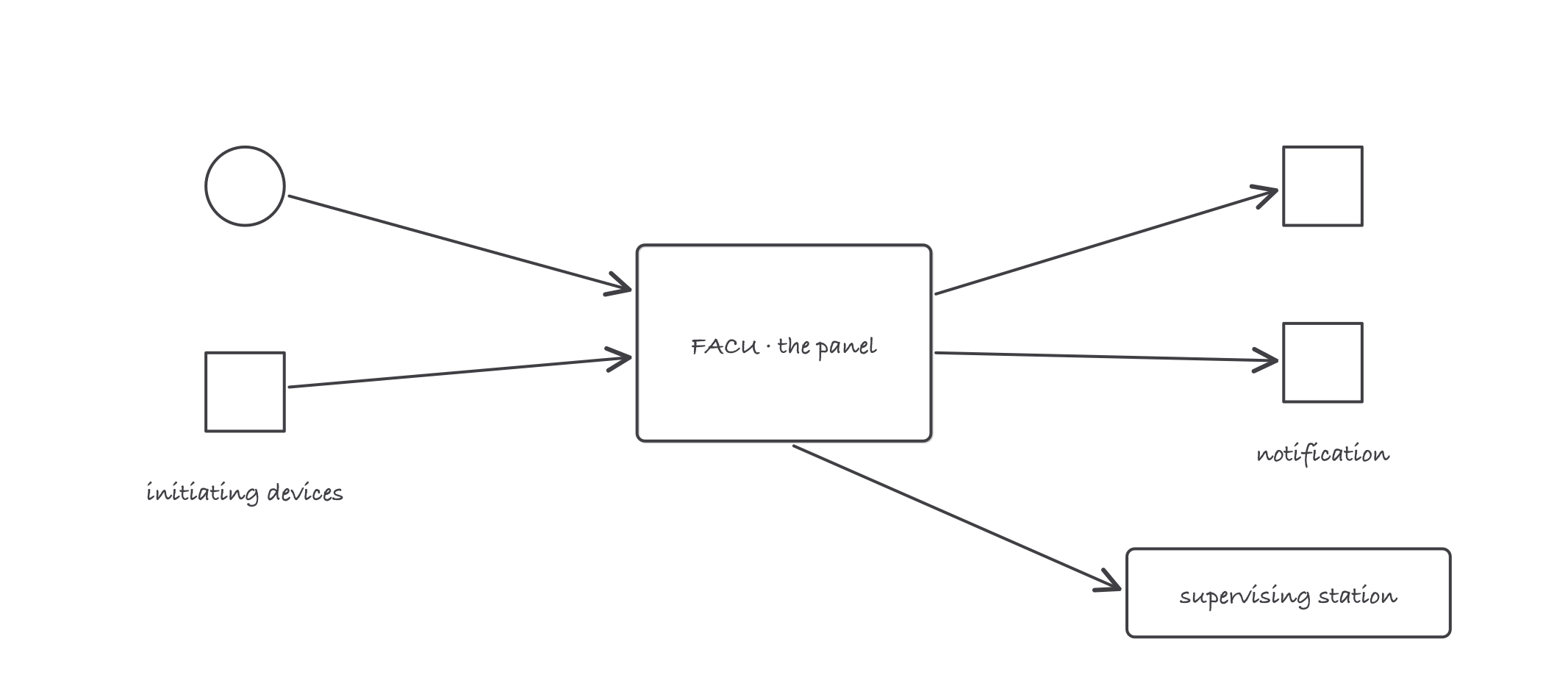
Inputs on one side, outputs on the other: the panel decides which of its four states the building is in
Power
A fire alarm system runs on primary power from the building supply and carries its own secondary power, normally batteries, sized so the system keeps protecting through an outage. Battery sizing is a calculation you will do on every install.
Worked example: sizing batteries
The design brief for a small panel requires 24 hours of standby followed by 5 minutes of full alarm. The panel and devices draw 0.150 A in standby and 1.8 A in alarm.
- Standby demand: 0.150 A × 24 h = 3.600 Ah
- Alarm demand: 5 min = 5 ÷ 60 = 0.0833 h; 1.8 A × 0.0833 h = 0.150 Ah
- Total: 3.600 + 0.150 = 3.750 Ah
- Apply the 20% derating factor the design uses for battery aging: 3.750 × 1.2 = 4.50 Ah
- Next standard battery size up: 7 Ah. Two 12 V, 7 Ah batteries in series give the 24 V panel its secondary supply.
Where it bites
- Trouble is not alarm. A trouble signal means the safety net has a hole, and it deserves urgency, but resetting it without finding the broken conductor is malpractice. The system was telling you it could no longer see a device.
- Your low-voltage license may not cover this. Several big states carve fire alarm out: California’s C-7 low voltage classification explicitly excludes fire alarm systems, Florida splits alarm contracting into a class that includes fire and one that does not, and Oregon’s Class B limited energy license excludes protective signaling. Check the state board before you bid.
- The code’s name matters. NFPA 72 is the National Fire Alarm and Signaling Code: signaling, including emergency communications systems, is inside its scope, and inside the exams built on it.