Learn · Fire Protection
NFPA 25: Inspection, Testing and Maintenance
Part of Sprinkler Fitter to NICET · step 11 of 21 · next: ITM Frequencies and Documentation
In learning paths: Sprinkler Fitter to NICET
Assumes you know: Sprinkler System Types: Wet, Dry, Preaction, Deluge
NFPA 25 is the standard that keeps existing water-based fire protection systems working: sprinklers, standpipes, fire pumps, tanks and their valves. Its whole discipline rests on one three-way distinction. Inspection is looking. Testing is making the equipment operate. Maintenance is fixing and replacing. Three defined activities, with different frequencies, different skills and different paperwork.
Why it matters on the job
Installation is a few months of a system’s life; NFPA 25 governs the following fifty years. For the trade this is an entire career track: ITM work is steady, recession-resistant and inspection-heavy, with its own NICET certification (Inspection and Testing of Water-Based Systems). For buildings it is the difference between a system that works at 3 a.m. and sculpture that looks like one.
The owner owns it
NFPA 25’s responsibility structure starts with the building owner. The owner is responsible for keeping the system in working order, for having the ITM activities performed, for keeping records, and for acting on what the reports say. Contractors and inspectors perform the work; they do not absorb the owner’s responsibility by showing up. This matters in the field: your report tells the owner what the standard requires; what happens next is on them, and your documentation proves what they were told.
Inspection: looking
An inspection is a visual examination: is the control valve open and locked, is the gauge showing pressure, are heads free of paint, corrosion and loading, is nothing stored within the clearance below heads. Inspections are the most frequent activity, deliberately cheap to perform, and they catch the failure mode that dwarfs all others: somebody closed a valve and nobody knew.
Testing: making it operate
A test makes equipment do its job on demand: flow water through a main drain and watch the pressure behave, trip a dry valve, run the fire pump, operate a waterflow switch until the alarm sounds. Tests are scheduled less often than inspections because they cost time and disturbance, and they answer the question inspection cannot: not “does it look right” but “does it work.”
Maintenance: fixing
Maintenance keeps or restores function: replacing a worn gasket, rebuilding a dry pipe valve, replacing damaged heads, greasing pump bearings. Some maintenance is scheduled; much is corrective, triggered by what inspection and testing find. Maintenance closes the loop the other two activities open.
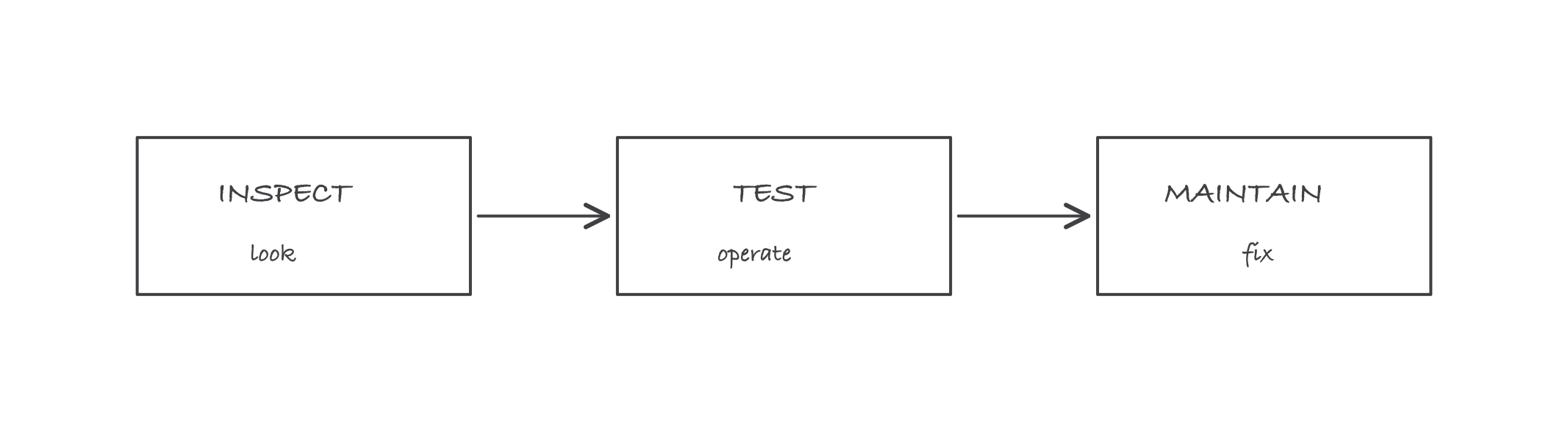
The NFPA 25 triad: inspection looks, testing operates, maintenance fixes, and each feeds the next
Worked example: classify a morning’s findings
Sort a real task list into the three bins:
- Walking the riser room and confirming both control valves are open and supervised: inspection.
- Opening the main drain and reading residual pressure: test.
- Reading the air pressure gauge on the dry system: inspection.
- Tripping that dry valve and timing water delivery: test.
- Rebuilding the tripped valve’s seat and resetting it afterward: maintenance.
The words are not interchangeable on a report. Writing “inspected the main drain” when you flowed it understates what you did; writing “tested” when you only looked overstates it, and both can surface in litigation after a loss.
Where it bites
- “Inspection” is the word people misuse most. In NFPA 25 an inspection never makes water move. If equipment operated, it was a test. Precision here is a professional tell.
- NFPA 25 is not NFPA 13 enforcement. An NFPA 25 inspection checks that the existing system is maintained, not that it was designed right. Citing design deficiencies during routine ITM exceeds the standard’s scope; note genuine hazards separately and say which standard you are invoking.
- The owner’s responsibility does not transfer. A signed contract for quarterly ITM does not make the contractor responsible for the system’s condition between visits, for closed valves, or for deferred repairs the owner declined.
- Editions matter here too. NFPA 25 revises on the same rough three-year cycle (2026 edition current), and requirements do move between editions. The adopted edition in your jurisdiction governs.
Exam relevance
NICET’s Inspection and Testing of Water-Based Systems certification is built directly on NFPA 25, and the three-activity vocabulary is its native language: expect questions that hinge on whether a task is inspection, testing or maintenance, who is responsible for what, and what scope a routine inspection actually has. If you can classify findings the way the worked example does, without hesitation, you are studying correctly.
Verified requirements
| Where | Expires | Renewal | Continuing education |
|---|---|---|---|
| United States (federal) | Yes | 3 years | CPD required each 3-year certification period |
Information comes from issuing-authority sources. Confirm current rules, fees and eligibility with the authority before acting.