Learn · Low Voltage and Telecom
NFPA 72 Basics
Part of Fire Alarm Technician, NICET Track · step 4 of 11 · next: Navigating NFPA 72: Finding Answers Fast
In learning paths: Fire Alarm Technician, NICET Track
Assumes you know: Fire Alarm System Fundamentals
NFPA 72 is the National Fire Alarm and Signaling Code, the document that governs how fire alarm and signaling systems are designed, installed, tested, and maintained in the United States. The current edition is 2025. Note what the title does and does not say: it is not only a “fire alarm code”. The signaling half, emergency communications systems, is fully in scope, and it shows up in real projects and certification exams alike.
*Learn the Trades is a free study resource. We are not a licensing body, an authorized training provider, or an exam administrator. Reading this page does not award any card, license, or certification. Always verify requirements with the issuing authority linked in the sources.*Why it matters on the job
Every fire alarm argument on a jobsite ends the same way: someone opens the code. Technicians who can navigate NFPA 72 answer inspectors with a chapter and section instead of a shrug, and the NICET fire alarm exams are, to a large degree, a test of how fast and accurately you can find things in this book.
What NFPA 72 is, and is not
NFPA 72 tells you how: how systems must perform, how devices are installed and spaced, how circuits are classed and supervised, how systems are tested and maintained.
It does not tell you when a building needs a fire alarm system. That decision belongs to the adopted building code and fire code and to the authority having jurisdiction (AHJ). The division of labor is a classic exam question and a daily reality: the building code says “this occupancy needs a system”, then hands you to NFPA 72 for everything about doing it right.
One more layer: your state or city adopts a specific edition, sometimes with amendments. The adopted edition governs your work, even when NFPA has published a newer one. Always confirm which edition your jurisdiction runs.
How the code is organized
The chapters group into blocks, and knowing the blocks is what makes the book navigable:
- Administration and definitions open the code: scope, referenced publications, definitions, and documentation requirements.
- Support chapters carry the rules every system uses: fundamentals (power supplies among them), circuits and pathways (the Class A/B/N/X designations), and inspection, testing, and maintenance.
- Device chapters cover initiating devices and their spacing, and notification appliances and their coverage.
- Systems chapters cover the system types themselves: protected premises (in-building) fire alarm systems, emergency communications systems, supervising station systems, and household alarm systems.
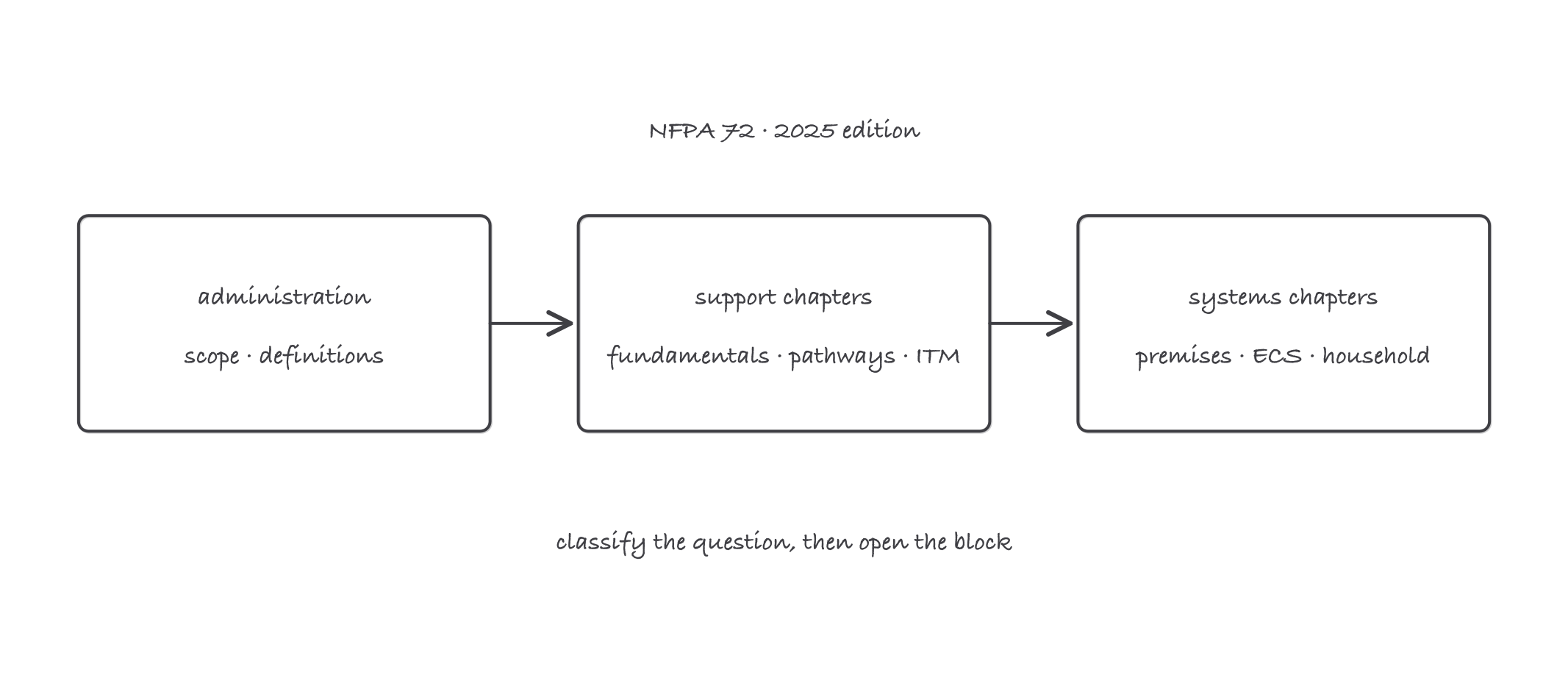
Navigate by block first: is my question about rules every system shares, about a device, or about one system type
Worked example: three lookups
Practice the routing decision, because that is the skill:
- “How often does this smoke detector need testing?” That is inspection, testing, and maintenance: a support chapter, and the heart of the ITM tables.
- “How far apart can spot heat detectors be on this smooth ceiling?” That is a device question: the initiating devices chapter and the detector’s listed spacing.
- “Does the fire alarm have to take over the elevator recall?” That is an interface between the system and building functions: the emergency control functions material in the systems block, alongside the protected premises chapter.
Wrong-block searches are where beginners burn exam minutes. Classify the question first, then open the book.
Where it bites
- The name and scope trap. Calling it “the fire alarm code” invites forgetting that emergency communications systems live here too, and NICET content does not forget.
- Edition lag is normal. Jurisdictions commonly enforce an edition several years old. Quoting the newest edition at an AHJ enforcing an older one is a losing argument.
- NFPA 72 does not order systems into existence. Occupancy requirements come from the building and fire codes. Keep the division of labor straight.
- Read the code, not summaries. NFPA provides free read-only access to the code on nfpa.org with a login. For any claim that matters, open the adopted edition itself.
Exam relevance
Expect NICET questions that test navigation itself: which chapter owns a topic, what the pathway class designations mean, and how ITM requirements are found. Time spent learning the block structure pays directly in exam minutes.