Learn · Fire Protection
ITM Frequencies and Documentation
Part of Sprinkler Fitter to NICET · step 12 of 21 · next: Impairment Procedures
In learning paths: Sprinkler Fitter to NICET
Assumes you know: NFPA 25: Inspection, Testing and Maintenance
NFPA 25 schedules every inspection, test and maintenance task on a frequency ladder that runs from weekly to every five years, and it demands records that prove each rung was climbed on time. The two halves are inseparable: an undocumented test never happened, as far as the standard, the AHJ and the insurer are concerned.
Why it matters on the job
ITM work is calendar work. A service company lives or dies by tracking hundreds of buildings’ overlapping frequencies without missing one, and an inspector’s report is a legal document that outlives everyone’s memory of the visit. Frequency questions are also bread-and-butter material on the NICET Inspection and Testing exams.
The frequency ladder
The exact assignments live in NFPA 25’s tables and shift somewhat between editions, so the working skill is knowing the ladder’s shape and looking up the rung:
- Weekly and monthly: the cheap visual checks with the biggest payoff, gauges and control valve positions chief among them. Some frequencies relax when equipment is electronically supervised, because the supervision is doing the daily watching.
- Quarterly and semiannual: operational checks of alarm-adjacent devices, waterflow alarm tests and similar.
- Annual: the big service visit. The main drain test, physical checks of heads and pipe from the floor, fire pump flow testing and a general going-over of each system.
- Multi-year: the deep work. Internal pipe assessments, gauge replacement or recalibration, and component-specific service intervals, with five years as the classic long rung.
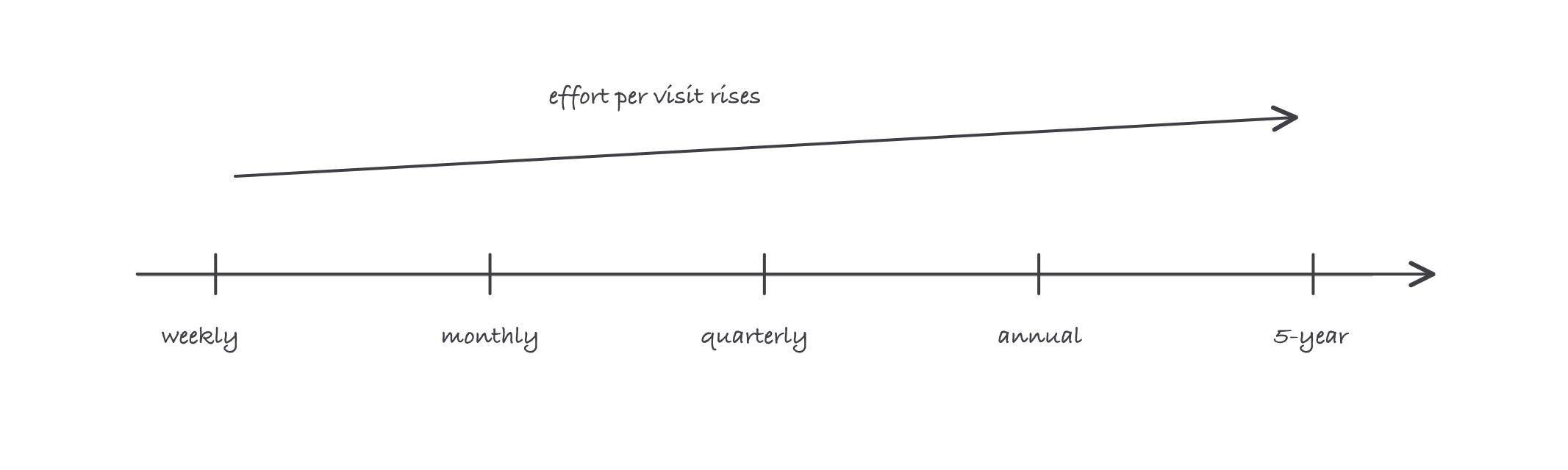
The shape to memorize: frequent cheap looks, annual operation, deep work on multi-year cycles
Records: the system’s second life
Every activity generates a record: what was inspected or tested, on which system, when, by whom, with what results and what deficiencies. Records stay with the building and pass to new owners; the current owner must retain them and produce them for the AHJ. A good report is written so a stranger can reconstruct the visit years later: which valve, which gauge reading, which head replaced and why.
Deficiency handling is part of the paper trail. The report tells the owner what was found and what NFPA 25 requires; the owner decides and acts. Your protection, and the building’s, is that the notification is in writing and dated.
Worked example: how many activities in five years
A wet system’s program assigns: monthly gauge inspections, quarterly waterflow alarm tests, one annual service visit, and a five-year internal pipe assessment. Over one five-year cycle:
- Monthly inspections: 12 × 5 = 60
- Quarterly tests: 4 × 5 = 20
- Annual visits: 1 × 5 = 5
- Five-year assessment: 1
Total: 60 + 20 + 5 + 1 = 86 documented activities, for one simple system in one building. Smart scheduling folds them: the quarterly visit absorbs that month’s inspection, the annual absorbs a quarterly, the five-year rides with an annual. The count of records stays 86; the count of truck rolls drops to 60. That folding, done across a whole portfolio without dropping a record, is the actual skill of running ITM work.
Where it bites
- Supervision changes frequencies. Electronically supervised valves and monitored systems earn relaxed inspection intervals in the tables. Two identical risers can carry different schedules for this one reason.
- The record is the compliance. Crews reliably do the work and unreliably write it down. Missing paper reads as missing protection in every audit and every post-loss investigation.
- Editions move rungs. A frequency memorized from an old edition can be wrong under the adopted one (NFPA 25 is on a roughly three-year cycle, 2026 edition current). Confirm against the edition your jurisdiction enforces.
- Frequency is a minimum, not a target. Harsh environments, repeat deficiencies or an AHJ’s local rules can all tighten the schedule. Nothing stops an owner doing better than the table.
Exam relevance
NICET’s Inspection and Testing of Water-Based Systems exams lean on exactly two skills from this lesson: matching activities to frequencies the way the tables do, and knowing what complete documentation contains. Practice by building five-year counts like the worked example: it forces both the ladder and the folding logic into memory.
Verified requirements
| Where | Expires | Renewal | Continuing education |
|---|---|---|---|
| United States (federal) | Yes | 3 years | CPD required each 3-year certification period |
Information comes from issuing-authority sources. Confirm current rules, fees and eligibility with the authority before acting.