Learn · Fire Protection
Sprinkler System Types: Wet, Dry, Preaction, Deluge
Part of Sprinkler Fitter to NICET · step 1 of 21 · next: Sprinkler Heads and Response
In learning paths: Sprinkler Fitter to NICET
A sprinkler system’s type comes down to two questions: what fills the pipe before a fire, and what has to happen before water reaches the fire. Wet, dry, preaction and deluge are the four answers recent editions of NFPA 13 build on, and each exists because some building makes the simpler answer impossible.
Why it matters on the job
Most of the systems you will fit are wet systems, and then a freezer warehouse, a data hall or an aircraft hangar lands on the schedule and the rules change: different valves, different trim, different testing, different failure modes. Knowing which type belongs where is also knowing why the work exists at all: BLS attributes much of the growth in sprinklerfitting work to state building codes that require suppression systems in more and more buildings.
First, kill the movie myth
In films, one flame sets off every head on the floor. Real systems do not work that way. Each standard sprinkler head is an individual heat-operated valve, and in most fires only the one or two heads directly over the fire get hot enough to open. Smoke never activates a standard sprinkler head: heat does, always. The one system type where every head really does flow at once is deluge, and that is exactly why deluge gets its own category.
Wet pipe: water at every head
Pipes are full of water under pressure all the way to each head. A head opens and water discharges that instant. Fewest parts, fastest response, least to go wrong: this is the default whenever every part of the piping stays reliably above freezing.
Dry pipe: air holds the water back
In a dry system the pipes hold pressurized air or nitrogen, not water. The air pressure holds a dry pipe valve closed against the water supply. When heat opens a head, air escapes and pressure drops; the valve trips, and water travels through the formerly dry piping to the open head. That travel takes time, which is the price you pay for putting piping in a freezer aisle or an unheated parking garage.
Note what “dry” means and what it does not. Dry does not mean no water: the water is waiting behind the valve. And dry is the answer to freezing, not to water-sensitive contents. That second job belongs to preaction.
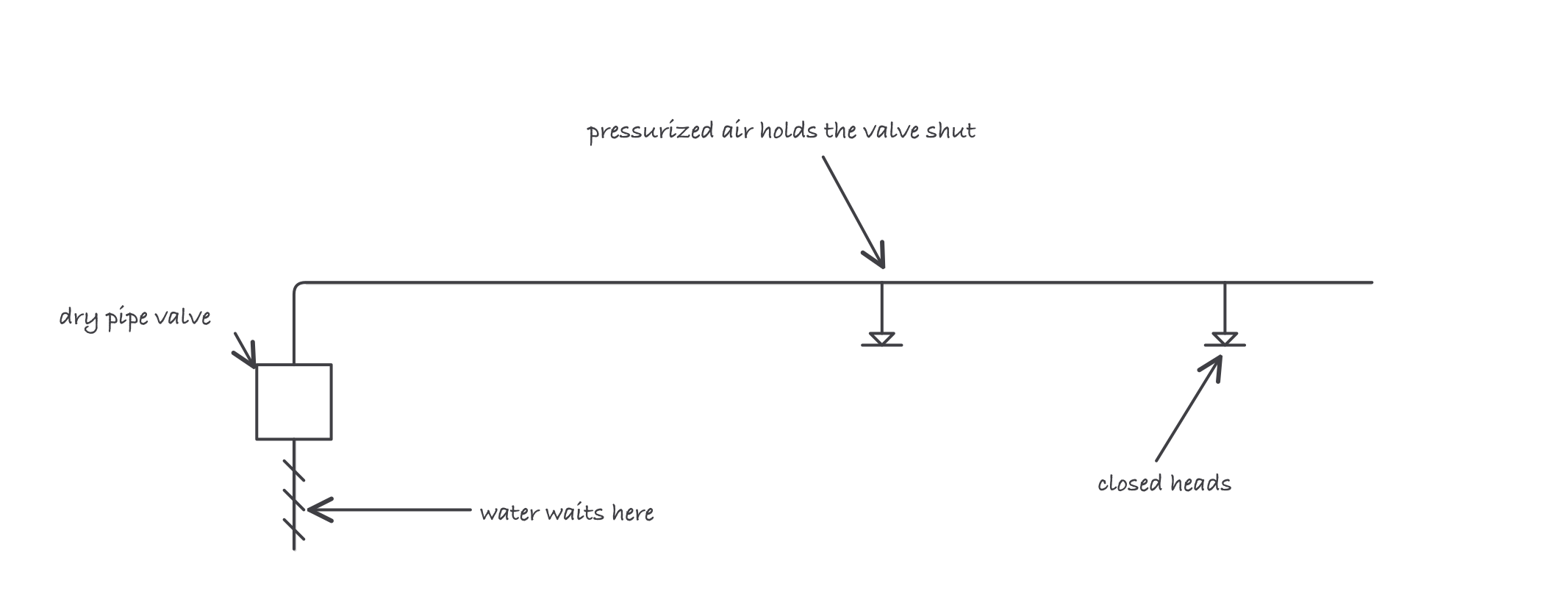
In a dry system the air in the pipe is doing a job: holding the valve shut against the water
Preaction: two events before water
A preaction system uses closed heads like a wet system, but the pipe holds no water until a separate detection system (heat or smoke detectors) operates a preaction valve. Water only discharges when both things happen: detection lets water into the piping, and a head still has to open over the fire. One accidental knock to a head, or one damaged pipe, and nothing flows. That double demand is why preaction protects data halls, museums and archives.
Deluge: every head flows
A deluge system uses open heads: no heat elements at all. The piping stands empty until detection opens the deluge valve, and then every head on the system discharges at once. Deluge is for fires that grow too fast to wait for heads to open one by one: aircraft hangars, flammable liquid handling, and similar high-challenge hazards.
Worked example: pick the system
Three spaces, one decision each:
- Heated office floor. Nothing freezes, contents are ordinary. Wet system: fastest, simplest, cheapest to maintain.
- A minus 10 °F freezer aisle. Water in the pipe would freeze and burst it. Dry system: air in the pipe, water held back at the valve in a heated space.
- Data hall. Freezing is not the issue; an accidental discharge over live servers is. Preaction: closed heads plus a detection-released valve, so no single failure puts water in the pipe.
And the aircraft hangar takes deluge, because a fuel fire spreads faster than closed heads can open in sequence.
Where it bites
- Dry protects piping from freezing, nothing else. Learners reach for a dry system to protect water-sensitive contents; that is preaction’s job. A tripped dry valve floods the piping exactly like a wet system.
- Preaction and deluge blur together because both use a detection-released valve. Keep them apart by the heads: preaction heads are closed (two events before discharge), deluge heads are open (one event, everything flows).
- The fire alarm does not set off the sprinklers. For wet and dry systems the causation runs the other way: water flowing in the pipe trips the waterflow switch, which notifies the alarm system. Only preaction and deluge let detection open a valve, and even then, detection opens a valve, not a head.