Learn · Fire Protection
Sprinkler Heads and Response
Part of Sprinkler Fitter to NICET · step 2 of 21 · next: Sprinkler Piping Installation
In learning paths: Sprinkler Fitter to NICET
Assumes you know: Sprinkler System Types: Wet, Dry, Preaction, Deluge
A sprinkler head is a valve held shut by a heat-sensitive element, plus a deflector that shapes the discharge into a spray pattern. Everything about head selection (temperature rating, orifice size, response speed, orientation) is a property of those few parts.
Why it matters on the job
You hang thousands of these, and each one is chosen, not generic. Install a head with the wrong temperature rating near a unit heater and it discharges on a cold morning with no fire anywhere. Swap a head with the wrong K-factor into a calculated system and the design no longer delivers its water. Heads are where the hydraulic design and the physical building meet.
The parts and what they do
The heat-responsive element holds the cap on the waterway. Most modern heads use a glass bulb filled with liquid that expands with heat: at the head’s rated temperature the bulb shatters and the cap falls away. Older and special-service heads use a fusible link, a metal element that melts apart at its rated temperature. Either way, each head operates alone. That is the whole reason only the heads over the fire open.
Temperature rating is stamped on the head, and glass-bulb heads signal it with the color of the bulb liquid. Ratings step up from ordinary (for most occupied spaces) through intermediate and high toward very-high classes used near heat sources. The working rule: the rating must sit comfortably above the hottest normal temperature at the head’s location, per the tables in recent editions of NFPA 13.
The orifice and its K-factor set how much water flows. K is the head’s flow coefficient: flow in gpm equals K times the square root of pressure in psi.
The deflector breaks the solid stream into the spray pattern, and its design fixes the head’s orientation: pendent (hangs below the pipe), upright (sits on top), or sidewall (throws sideways from a wall). Install a head in the wrong orientation and the pattern collapses.
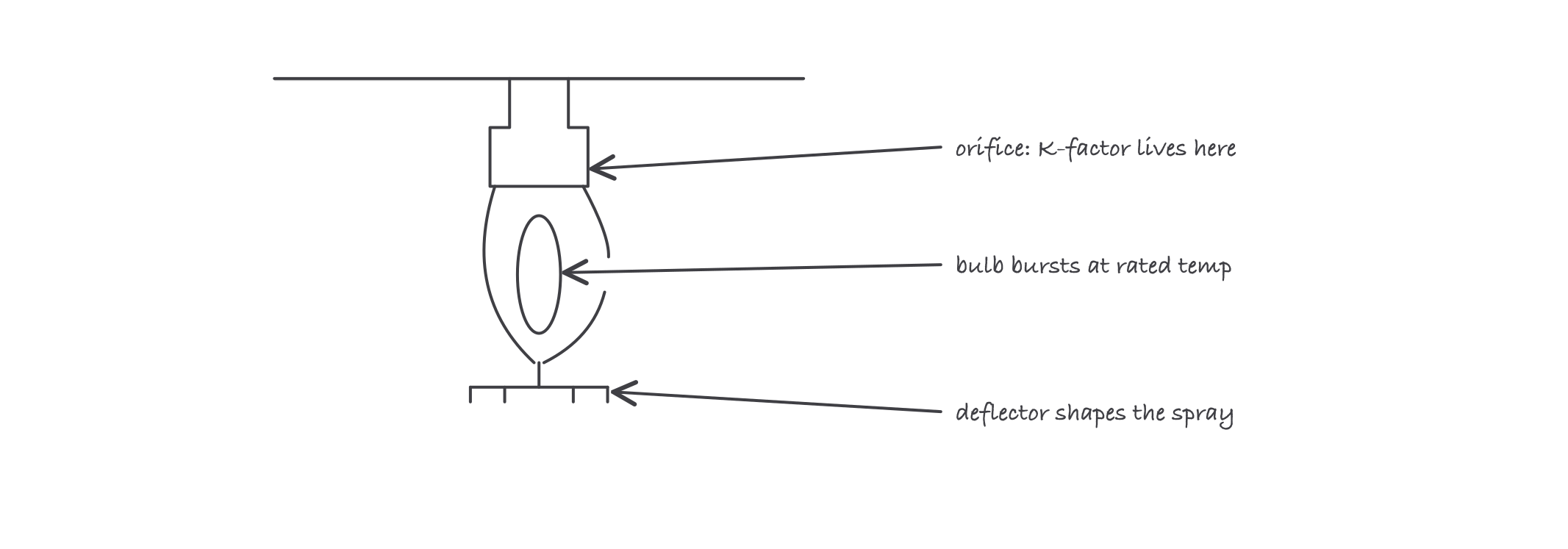
Three parts to know: the bulb that bursts at rated temperature, the orifice that meters flow, the deflector that shapes the spray
Worked example: what K-factor means
Flow follows Q = K × √P, with Q in gpm and P in psi at the head.
A traditional standard-orifice head, K = 5.6, flowing at 15 psi:
Q = 5.6 × √15 = 5.6 × 3.873 = 21.7 gpm
A larger-orifice K = 8.0 head at the same 15 psi:
Q = 8.0 × 3.873 = 31.0 gpm
Same pressure, 43 percent more water, purely because of the orifice. This is why you can never substitute heads by thread size alone: the K-factor is part of the hydraulic design. It is also why a single flowing head causes far less water damage than people fear: compare those tens of gpm with the hundreds a fire department hose stream delivers.
Response: how fast the element operates
Two heads with the same temperature rating can open at very different speeds. Response describes how quickly the element absorbs heat from the ceiling jet: quick-response heads use thinner bulbs or lighter elements that heat up faster than standard-response heads. Faster response means operating earlier in fire growth, which is why quick-response heads dominate in light-hazard occupied spaces. Response speed and temperature rating are independent choices: one is how fast, the other is how hot.
Where it bites
- Rating and response get conflated. A 155 °F quick-response head and a 155 °F standard-response head open at the same temperature; the quick-response head reaches it sooner. Different properties, different table lookups.
- “Sprinklers detect smoke” is wrong every time. The element responds to heat only. A smoldering, smoky fire can run a long time before any head opens; smoke detection is a separate system’s job.
- Painted or loaded heads are ruined heads. Paint, corrosion or dust insulation changes the element’s response. Field rule: a painted head gets replaced, never cleaned.
- Orientation is not cosmetic. An upright head installed pendent puts its deflector on the wrong side of the flow, and the floor-level pattern it was listed for never forms.