Learn · Fire Protection
Impairment Procedures
Part of Sprinkler Fitter to NICET · step 13 of 21 · next: Main Drain and Waterflow Tests
In learning paths: Sprinkler Fitter to NICET
Assumes you know: NFPA 25: Inspection, Testing and Maintenance
An impairment is any period when a water-based fire protection system, or part of one, is out of service. NFPA 25 treats that period as a managed emergency: the building is standing without the protection it was designed around, so the standard prescribes who is told, what compensates, and how protection is verified back into service.
Why it matters on the job
Every ITM career includes hundreds of impairments, because you cannot rebuild a dry valve or replace a section of main with the system live. Fire history’s grimmest entries feature closed valves nobody tracked: the system survived the fire planning, the construction and the decades of service, and failed because it was off and forgotten. Impairment procedure is the checklist that makes forgetting impossible.
Planned versus emergency
A preplanned impairment is scheduled: valve rebuild, tie-in for a tenant fit-out, pump service. You control the timing, so the standard expects the full procedure arranged before the water stops.
An emergency impairment is discovered: a broken main, a frozen and split pipe, a failed valve. The sequence compresses but the elements do not change: the same people get told, the same compensations go in, the same restoration proof is required. The only thing an emergency excuses is advance notice.
The procedure
Assign one person. An impairment coordinator owns the impairment from shutdown to restoration: one name, not a committee.
Tag it. A visible impairment tag goes at the affected control valve and at the fire department connection, so an arriving crew knows at a glance the system is dark and where. The tag is a message to strangers: it must say what is off and who to contact.
Notify everyone who counts on the system. The fire department, the alarm monitoring service, the insurance carrier, the AHJ where required, and the people in the building. Notification happens at shutdown and again at restoration.
Compensate while the water is off. Typical measures, scaled to the risk: a fire watch walking the affected area, temporary protection such as hose lines or extinguishers staged, shutting down hot work and other hazardous operations in the unprotected area, and keeping the impairment short: work continuously until the system is back.
Restore and prove it. Reopen valves, verify the system is actually functional (a drain test confirms water really reaches the reopened riser), remove the tags, notify everyone again, and record the whole episode.
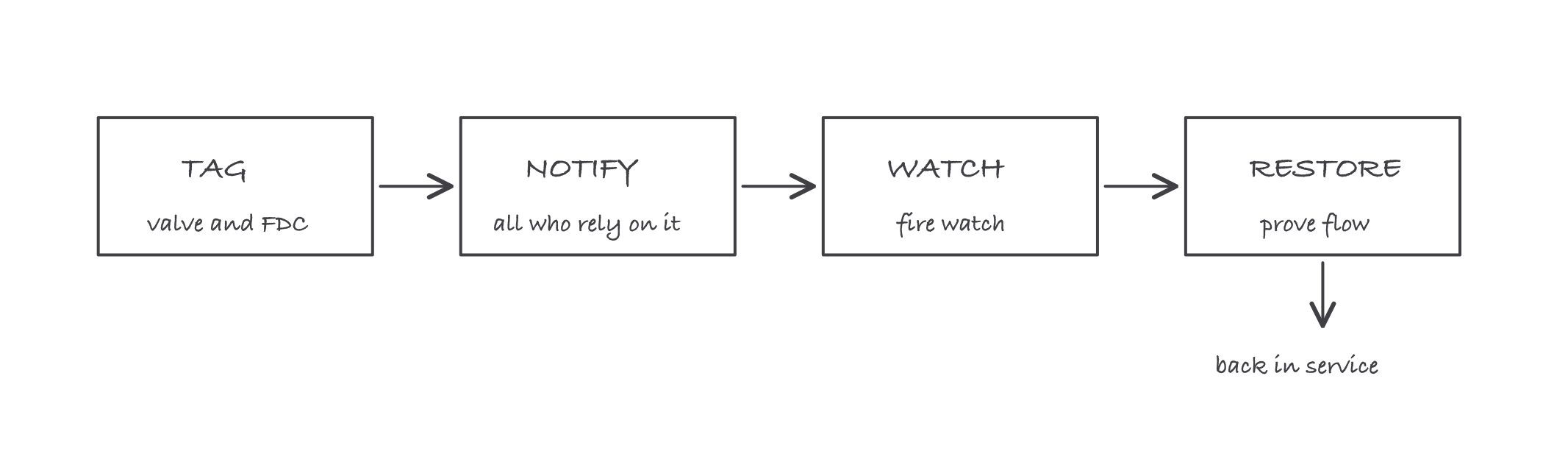
The loop that keeps a dark system from being a forgotten system: tag, notify, watch, restore
Worked example: a dry valve rebuild, run properly
A warehouse dry system needs its valve rebuilt, a half-day job.
- Before touching anything: coordinator named; rebuild scheduled for the morning so restoration lands inside the workday; fire department, monitoring service, insurer and warehouse manager notified with start time and expected duration.
- At shutdown: control valve closed and tagged, FDC tagged, monitoring service confirms it has logged the system out of service. Forklift battery charging and all hot work in the affected bays stopped; a fire watch begins hourly rounds of the unprotected area.
- During: crew works the rebuild straight through, no lunchtime gap with the system down and nobody on it.
- At restoration: valve reset, control valve reopened, drain test confirms supply pressure at the riser, air restored to the dry system. Tags come off, every party from step 1 is notified the system is back, and the report records times, parties notified, compensations used and the test result.
The fire-watch rounds and the stopped hot work are not bureaucracy: statistically, the rebuild morning was the most dangerous four hours that warehouse has had all year.
Where it bites
- The tag is not the procedure. A tagged valve with no notifications and no fire watch is a documented failure, not a managed impairment. The tag is one element of five.
- Restoration needs proof, not optimism. “I reopened the valve” is not “water reaches the system.” Valves reopened partway, or against a closed valve elsewhere, have left buildings dark for years. Flow water and watch the gauge.
- Emergency impairments skip the notice, not the steps. Crews treat a burst main as exempt from procedure. It is exempt from scheduling; the notifications, compensation and restoration proof all still apply, starting the moment the impairment is found.
- Partial impairments mislead. Isolating one floor’s zone still strips protection from that floor while the rest of the building looks normal on the riser gauges. Tag and manage the affected area as seriously as a full shutdown.
Exam relevance
NICET’s Inspection and Testing track tests impairment procedure as sequence and as roles: who is notified and when, what a coordinator does, which compensating measures fit which risk, and what restoration requires before tags come off. Scenario questions read like the worked example above; practice by asking, at each step, “who knows the system is off, and what is standing in for it.”
Verified requirements
| Where | Expires | Renewal | Continuing education |
|---|---|---|---|
| United States (federal) | Yes | 3 years | CPD required each 3-year certification period |
Information comes from issuing-authority sources. Confirm current rules, fees and eligibility with the authority before acting.