Business · Fire Protection
Becoming a Sprinkler Contractor
Part of Sprinkler Fitter to NICET · step 18 of 21 · next: NICET Inspection and Testing Certification (Levels I-III)
In learning paths: Sprinkler Fitter to NICET
Assumes you know: Fire Protection Licensing by State
A sprinkler contractor is a company, and companies are what jurisdictions license to sell fire protection work. Becoming one is less about a bigger toolbox and more about standing up the legal structure your state requires: registering the firm, and keeping a licensed responsible individual on staff whose credential the firm’s authority to work hangs on. That two-layer shape, firm registration plus designated license-holder, repeats across the country even though the names change at every border.
Why it matters on the job
The contractor step is where the trade’s ceiling lifts: you bid the work, carry the contracts, and keep the margin. It is also where the licensing system starts watching the company rather than the person. Understanding the structure before you file paperwork keeps you from discovering, mid-bid, that the firm is registered but has no qualifying license-holder, or the reverse.
The two-layer pattern, in two real states
Texas makes the layers explicit. The firm holds a Sprinkler Certificate of Registration (SCR) from the State Fire Marshal’s Office; a designated Responsible Managing Employee (RME) holds the individual license that defines what the firm can do: RME-G for general work, RME-I for inspection only, RME-D for dwellings. Lose your RME, and the firm’s ability to work goes with them until a replacement qualifies.
California runs the contractor-board version. The company is licensed by the Contractors State License Board under the C-16 Fire Protection classification, whose scope runs from underground fire mains and trenching through fire pumps and tanks, and explicitly excludes electrical alarm systems. The C-16 is the credential the firm must keep qualified, and general contractors without it must subcontract fire protection to someone who has it, which is precisely why a C-16 shop stays busy.
The pattern to extract: one credential attaches to the business, one attaches to a person, and the person’s departure is a business risk. Contractors plan for it the way they plan for insurance.
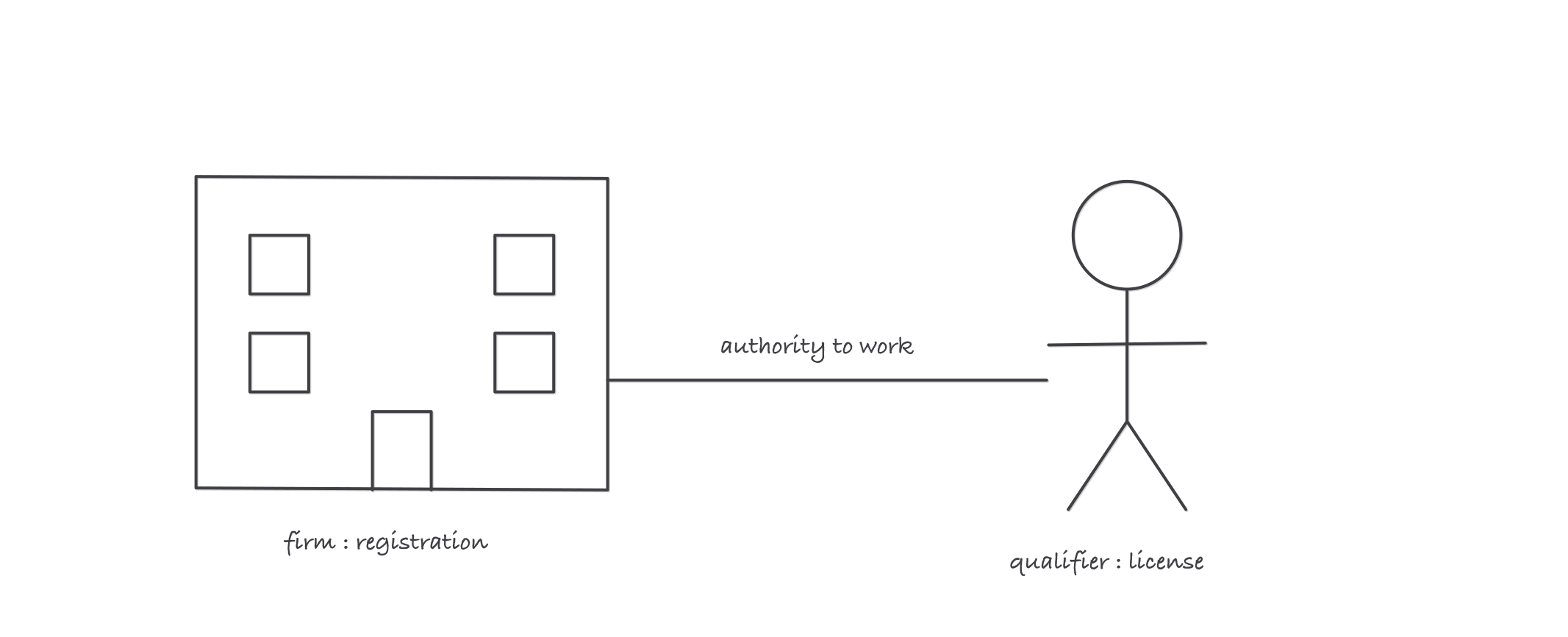
The two-layer pattern: the firm registers, a licensed person qualifies it, and the connection is the business
The market you are stepping into
The Bureau of Labor Statistics files sprinkler fitters inside its combined plumbers, pipefitters, and steamfitters occupation, so treat these as numbers for that whole group: a median wage of $62,970 (May 2024), projected growth of 4 percent from 2024 to 2034, and roughly 44,000 openings per year. Within that combined picture, BLS attributes sprinkler-side growth to state building codes increasingly requiring suppression systems: demand written directly into law, which is about as durable as construction demand gets.
Worked example: sequencing the jump in Texas
A journeyman fitter with years on the tools wants her own shop. The sequence the structure dictates: first, the personal credential, because the firm cannot operate without its RME, and she intends to be her own. Her target work is full installation and service, so that means the RME-G and its requirements (which reference NICET certification levels, giving her existing certification a direct role). Second, the company: formation, insurance, and the SCR application to the State Fire Marshal’s Office. Third, the pairing: she is designated as the firm’s RME. Only then does the firm exist as a lawful sprinkler contractor, and every bid she signs from that day rides on both layers staying current.
Where it bites
- The qualifier is a single point of failure. Firms lose their RME or qualifying individual to retirement, poaching, or a falling-out, and the work stops with them. Succession planning is a licensing issue, not only an HR one.
- Scope follows the credential, not the ambition. An RME-I qualifies a firm for inspection work only; a C-16 firm cannot self-perform alarm work. Bid inside the license you actually hold.
- The BLS numbers are not sprinkler-specific. They describe the combined piping occupation. Quote them that way, and read local demand from local code adoption instead.
- Registration is per jurisdiction. The Texas SCR means nothing in California and vice versa. Expanding across a state line means standing up the two-layer structure again under that state’s pattern.