Business · Fire Protection
The Sprinklerfitter Apprenticeship
Part of Sprinkler Fitter to NICET · step 15 of 21 · next: NICET Water-Based Certification (Levels I-IV, 3-year recert)
In learning paths: Sprinkler Fitter to NICET
The standard route into the sprinkler trade is a five-year registered apprenticeship: paid work on the tools under journeyman supervision, plus classroom training, with wages that step up as your hours accumulate. The United Association (UA), the union representing sprinkler fitters alongside the other piping trades, structures its program as 2,000 on-the-job hours plus 216 classroom hours per year.
Why it matters on the job
Sprinkler fitting has no college route and no shortcut route: the skills are physical, code-bound and learned beside people who have them. The apprenticeship is simultaneously your education, your employment and your credential trail: the documented hours it produces are what licensing boards, NICET applications and employers all ask about later.
The shape of the five years
On the job, you earn while you learn: hanging pipe, cutting and grooving, setting hangers and bracing, trimming valves, and graduating from carrying material to running work. The 2,000 hours per year is full-time work; multiply by five and the program represents roughly 10,000 supervised hours.
In the classroom, 216 hours a year covers what the jobsite teaches unevenly: hydraulics, standards navigation (NFPA 13 and its siblings), drawing reading, safety credentials and the math of the trade.
Wage progression is built in: apprentices start at a fraction of journeyman scale and step up with each program year, with union programs adding benefits negotiated in the local agreement. The UA’s sprinkler fitter program sits inside one of the largest piping-trades training systems in North America (the UA reports roughly 407,000 members across the piping trades).
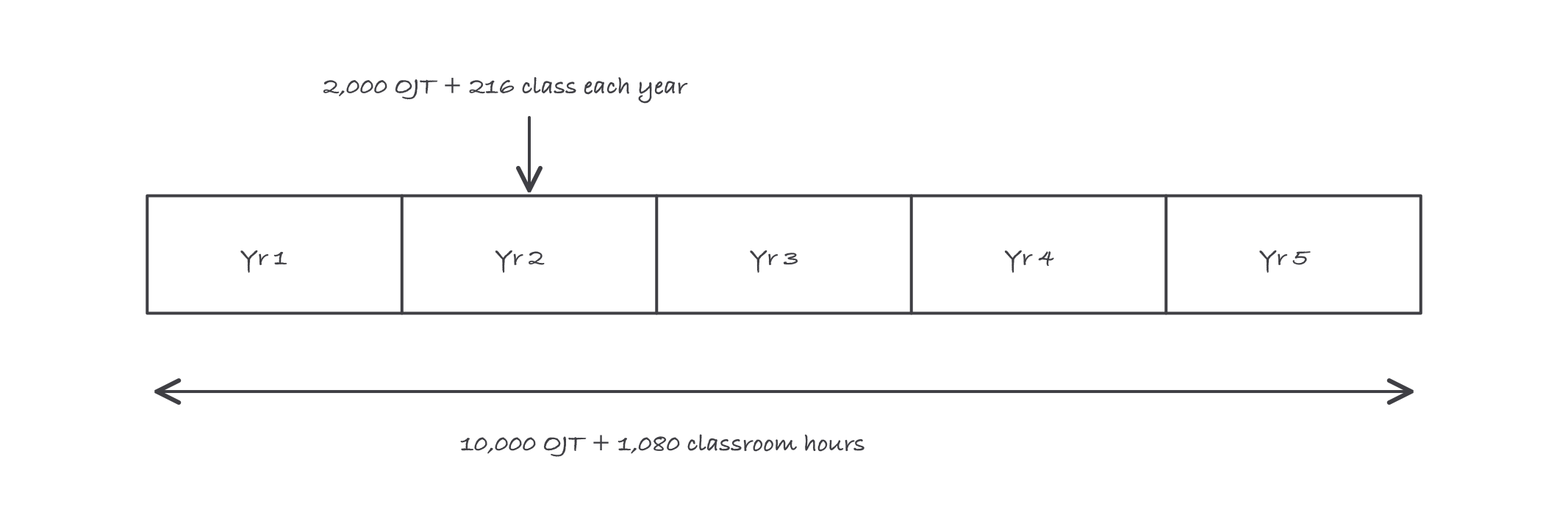
The five-year clock: every year banks 2,000 field hours and 216 classroom hours
Worked example: the hours you will bank
Using the UA program numbers:
- On-the-job: 2,000 hours × 5 years = 10,000 hours
- Classroom: 216 hours × 5 years = 1,080 hours
Total: 11,080 documented training hours. Keep every record: transcripts, signed hour logs, completion certificates. Those numbers become answers on license applications and NICET work-history verifications for the rest of your career.
What the outlook numbers really say
BLS files sprinkler fitters inside one combined occupation: plumbers, pipefitters and steamfitters, noting that “other fitters may specialize as gasfitters or sprinklerfitters.” For that combined occupation, BLS reports a median wage of $62,970 (May 2024), projected growth of 4 percent over 2024-34, and about 44,000 openings a year, driven substantially by retirements. Read those as piping-trades numbers, not sprinkler-specific ones. The sprinkler-specific signal BLS does give: growth in sprinkler work is tied to state building codes requiring suppression systems in more buildings, which is demand written into law.
Where it bites
- Union and non-union paths both exist; documentation rules both. Whichever route you take, undocumented hours are hours that never happened when a board or NICET asks. Log as you go.
- Local programs vary. The five-year, 2,000-plus-216 structure is the UA pattern; individual locals set their own application windows, entry requirements and wage scales. Verify with the local running the program, not with a national average.
- The classroom hours are not the soft part. Hydraulic calculation and standards navigation, the exact skills the classroom carries, are what separate a career that plateaus at installation from one that reaches layout, inspection or contracting.
- Quoting the BLS median as “sprinkler fitter pay” is wrong on both sides. It blends plumbers, pipefitters and steamfitters across the whole country; local union scale for sprinkler fitters can sit well away from it. Use it as an outlook signal, not a wage quote.