Learn · Fire Protection
Main Drain and Waterflow Tests
Part of Sprinkler Fitter to NICET · step 14 of 21 · next: The Sprinklerfitter Apprenticeship
In learning paths: Sprinkler Fitter to NICET
Assumes you know: NFPA 25: Inspection, Testing and Maintenance
The main drain test and the waterflow alarm test are the two tests an inspector runs most, and together they answer the two questions that decide whether a sprinkler system will perform: is the water supply still there, and will anyone find out when water moves? Both come from NFPA 25, the standard for inspection, testing and maintenance of water-based systems, and both produce numbers you write down and compare over time.
Why it matters on the job
A sprinkler system fails quietly. A valve closed somewhere upstream, a main choked with tuberculation, a dead alarm circuit: none of them show on a walk-through, and all of them show in these two tests. The value of the tests is almost entirely in the record: this year’s readings mean little alone and everything next to last year’s.
The main drain test
The main drain is the large drain connection at the base of the riser. The test is short: read the supply pressure gauge with the system static, open the main drain valve fully, let the flow stabilize, read the gauge again (the residual pressure), then close the valve slowly and confirm the system returns to static.
What you are really doing is pulling a known heavy flow through everything upstream of the riser: the underground main, the supply valves, the tap. A healthy supply carries that flow with a modest pressure drop. An obstruction or a partially closed valve upstream cannot pass the same flow, so the residual reading falls, and the size of the fall compared with previous tests is the finding.
Worked example: reading the drop
A riser has three years of main drain records, all with the same static pressure:
- Two years ago: static 80 psi, residual 65 psi. Drop: 80 − 65 = 15 psi.
- Last year: static 80 psi, residual 66 psi. Drop: 80 − 66 = 14 psi.
- This year: static 80 psi, residual 40 psi. Drop: 80 − 40 = 40 psi.
The static reading never moved, and that is the trap: static pressure only says the pipe at the gauge is pressurized. Under flow, this year’s supply lost 40 psi where it used to lose about 15. Nearly triple the historical drop means something upstream changed: the classic culprit is a supply-side valve someone closed and reopened only partway. The test result is not “fail”: it is “investigate the supply until the reading is explained”.
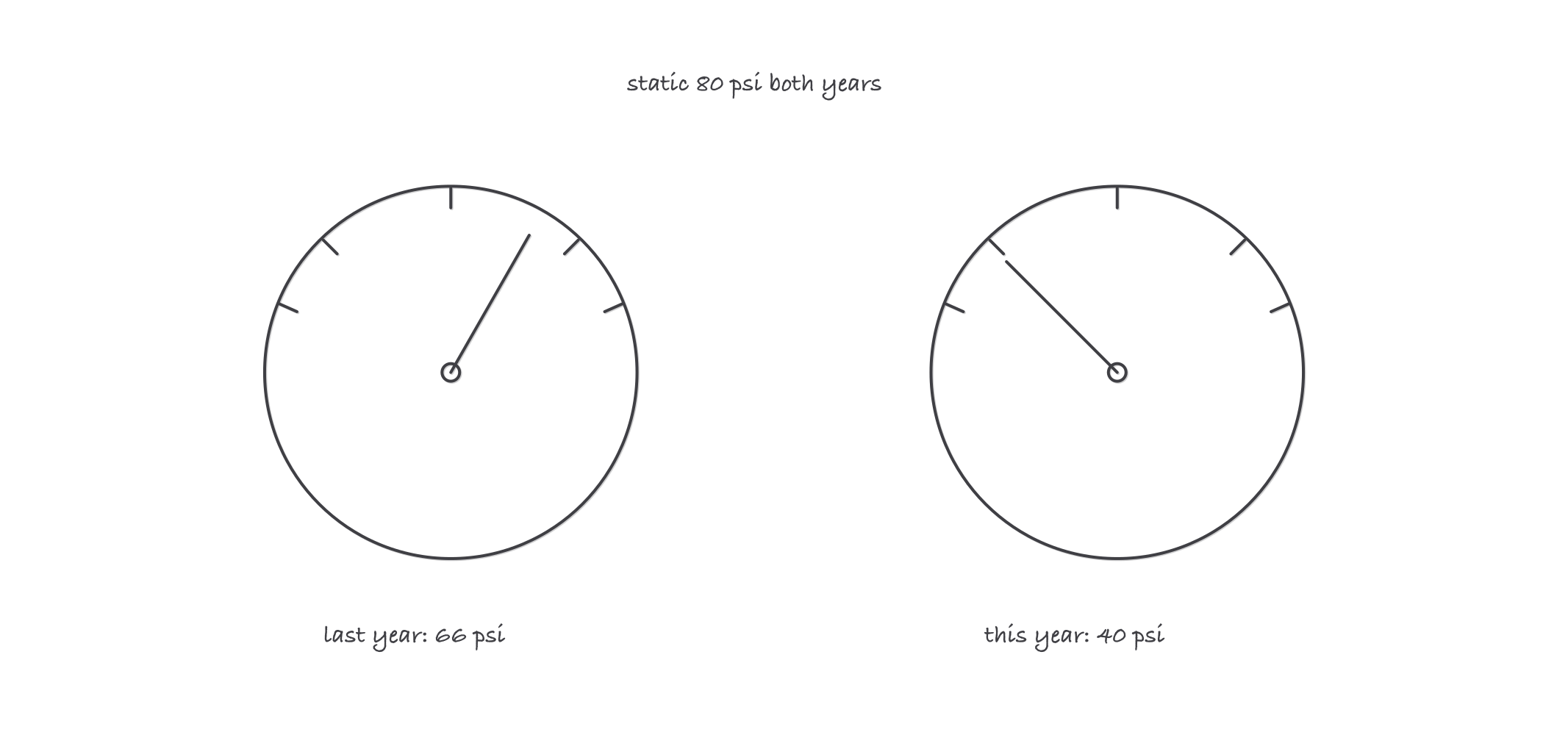
Same static, collapsing residual: the supply problem only shows when water moves
The waterflow alarm test
The waterflow test proves the alarm chain. On a wet system you open the inspector’s test connection, a small valve piped with an orifice sized to a single sprinkler head, usually at the far end of the system. Water flows as if one head had opened, the waterflow switch operates, and the alarm must follow within the time limit the standard sets. You are testing the whole chain: flow, switch, panel, notification, and the monitoring connection if there is one, not the switch in isolation.
Tell the monitoring service before and after. A test nobody logged becomes a fire department response.
Reading the gauges honestly
NFPA 25 testing is only as good as its records. Write the reading the gauge shows, not the reading the form expects: a residual copied forward from last year hides exactly the drift these tests exist to catch. If a gauge is dead, pegged, or implausible, that is a finding too: record it. The person your record protects is the next inspector, and the building between your visit and theirs.
Where it bites
- Static pressure is not supply. A fully closed upstream valve can still show perfect static pressure at the riser. Only flow reveals it, which is the whole argument for the main drain test.
- A single year proves little. The finding lives in the trend. No baseline, no comparison: keep and demand the historical records.
- Testing is not inspection. Under NFPA 25, an inspection is a visual check; a test makes the equipment work. Writing “inspected” when you flowed water, or the reverse, corrupts the record and the frequencies built on it.
- Closing the main drain fast. Slamming the valve shut hammers the system you were checking. Close slowly, watch the gauge return to static.
Exam relevance
NICET’s Inspection and Testing of Water-Based Systems certification leans directly on this material: what each test proves, how to run it, and how to interpret readings against prior results. Expect exam questions that give you static and residual numbers across years, exactly like the worked example, and ask what the change means and what to do next.
Verified requirements
| Where | Expires | Renewal | Continuing education |
|---|---|---|---|
| United States (federal) | Yes | 3 years | CPD required each 3-year certification period |
Information comes from issuing-authority sources. Confirm current rules, fees and eligibility with the authority before acting.