Qualifications · Carpentry
The Framing and Carpentry Contractor License
Part of Carpenter, Frame to Finish · step 28 of 30 · next: NCCER Credentials for Carpenters
In learning paths: Carpenter, Frame to Finish
Assumes you know: Do Carpenters Need a License
California and Oregon license framing and carpentry contractors in opposite ways, and between them they cover most of what you will meet elsewhere. California has a specific carpentry classification with a trade exam behind it. Oregon has no carpentry classification at all and still requires a license of anyone doing construction work for compensation.
*Learn the Trades is a free study resource. We are not a licensing body, an authorized training provider, or an exam administrator. Reading this page does not award any card, license, or certification. Always verify requirements with the issuing authority linked in the sources.*Why it matters on the job
This is the license that actually gates carpentry work, and it attaches to the business selling the work rather than to the carpenter doing it. Once you contract on your own account, the classification you hold defines the scope of work you may legally sell. Holding the wrong one narrows that scope without telling you.
California: the C-5
The Contractors State License Board issues Class C-5, Framing and Rough Carpentry, under the authority of Business and Professions Code sections 7008 and 7059. Its published scope is an unusually clear official statement of what a carpentry license covers, which makes it worth reading even if you never work in California.
To sit for it you document four years of journey-level or higher experience gained within the last 10 years, verified by a qualified person with direct knowledge of your work. Then you pass two exams: the trade exam for the classification, and the law and business exam every applicant takes.
The B General Building asymmetry
Class B, General Building, is authorized under B&P 7057, and its defining rule is the two-unrelated-trades test. A general building contractor takes a project only when it involves at least two unrelated building trades or crafts.
Framing and carpentry are the exception, and the exception runs one way only. A B holder may take a framing or carpentry project alone, with no second trade required. A B holder may not count framing or carpentry as one of the two unrelated trades that qualify it to take anything else. Roofing plus framing is not two unrelated trades for that purpose.
That asymmetry is widely misread, and it exists specifically because of carpentry.
Oregon: the opposite pattern
The Construction Contractors Board licenses every business doing construction work for compensation in Oregon, and carpentry appears in the covered activities. There is no carpentry classification and no carpentry trade exam. The requirements are the licensing process itself.
- 16 hours of pre-license training.
- An exam of 80 questions with a 3 hour allowance, passing at 70 percent, and a $60 fee.
- General liability insurance naming the CCB as certificate holder.
- Workers compensation coverage if you hire employees.
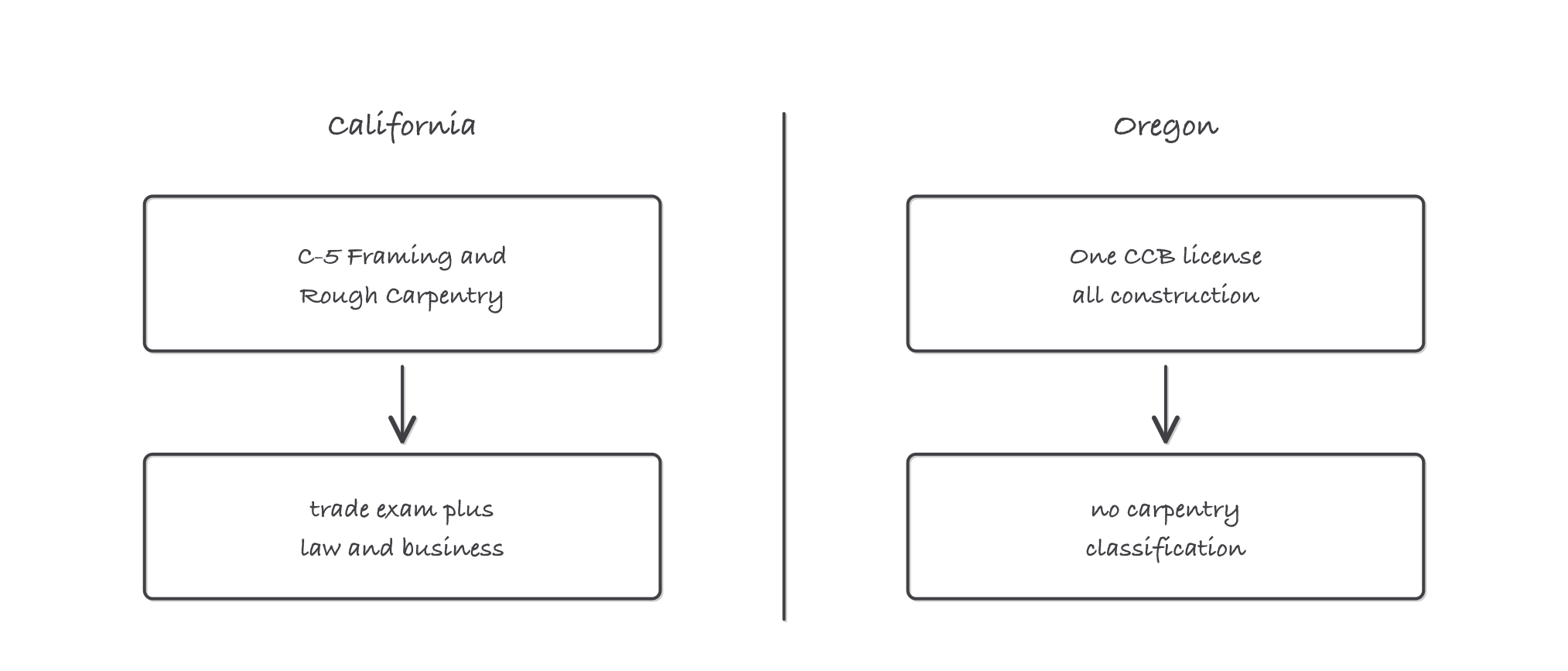
Same trade, two opposite regimes: a carpentry classification with an exam, or no classification and a blanket requirement
Worked example: the Oregon exam arithmetic
Take the published numbers apart before you book a seat.
- Passing mark. 80 questions × 0.70 = 56 correct answers.
- Margin. 80 - 56 = 24 questions you can afford to miss.
- Pace. 3 hours is 180 minutes, so 180 / 80 = 2.25 minutes per question.
That pace is comfortable as long as you are not reading each question twice, which is the argument for doing the 16 hours of pre-license training properly rather than skimming it.
Where it bites
- The license belongs to the business. It is not a personal qualification you carry between employers the way a journeyman electrician carries a state license.
- A B is not a superset of a C-5. For the two-trades test the B holder is worse off with carpentry in the mix, not better, and that catches people who assumed the broader license was strictly broader.
- Oregon has two agencies. The CCB licenses contractors. The Building Codes Division handles trade licensing and code. They answer different questions, and calling the wrong one wastes a morning.
- Nothing here transfers. California’s four-year experience window and Oregon’s 16 hours are those two states’ rules. Fees, question counts and pass marks change. Read your own board’s current page before you plan anything.
Exam relevance
The C-5 trade exam covers the classification’s scope of work. The law and business exam, which every California applicant sits regardless of classification, covers contracting law, business practice, and employment and safety obligations rather than carpentry. Oregon’s single exam sits in that second category, because Oregon has no carpentry trade exam to sit. Prepare for the business half deliberately; it is the half that is furthest from anything you learned on a wall.
Verified requirements
| Where | Expires | Renewal | Continuing education |
|---|---|---|---|
| United States (federal) | No | Confirm with issuer | Confirm with issuer |
Information comes from issuing-authority sources. Confirm current rules, fees and eligibility with the authority before acting.