Business · Carpentry
Running Crews
Part of Carpenter, Frame to Finish · step 24 of 30 · next: From Carpenter to General Contractor
In learning paths: Carpenter, Frame to Finish
The day you start running a crew, your output stops being what you build and becomes what the crew builds. The work turns into layout somebody else will cut to, a sequence that keeps four trades out of each other’s way, and a set of legal duties that used to belong to whoever was standing where you are now. One of those duties is fall protection training, and it comes with a written record requirement attached.
Why it matters on the job
A crew moves at the speed of its worst-explained task. Layout that is correct but unreadable produces the same wall as layout that is wrong. And the duties that attach to your crew’s exposure attach to the employer, which in practice lands on whoever is directing the work.
Layout for other people
Your marks are now instructions. Three habits make them readable from across a deck.
Mark the same way every time. An X on the side of the line where the stud lands, a bold V or a triangle for a king stud, a circle for a post. The convention itself matters less than the fact that the crew learns it once and then reads it at a glance from 20 feet away.
Mark once, and mark the whole run. Plate layout goes on both plates together, top and bottom, for the whole wall, before anybody cuts. Layout done wall by wall over a week is layout done four slightly different ways.
Write the reason on the odd ones. A stud at 14 1/2 in instead of on the 16 in center looks like a mistake until somebody pencils “elec” beside it. The note costs three seconds and saves a phone call from a framer who is about to move it back.
Sequencing is the product
Sequence is what a foreman actually makes. Four questions run all day.
- What has to be complete before this crew can start, and is it?
- What am I about to bury that another trade still needs access to?
- What material is on site, where is it stacked, and who is moving it?
- What is the weather about to do to the order I planned?
The answer to the second one is where most rework is born. A wall sheathed before the plumber’s stack is in is a wall somebody opens twice.
The training duty lands on you
1926.501 puts the duty to provide fall protection on the employer, and 1926.503 puts a training duty next to it. Four parts matter to a lead or a foreman.
- (a)(1) A training program. The employer provides a program that enables each employee exposed to fall hazards to recognize those hazards and know the procedures that minimize them.
- (a)(2) A competent person covers specific topics. The standard lists what has to be taught, including the nature of the fall hazards in the work area and the correct procedures for erecting, maintaining, disassembling and inspecting the systems in use.
- (b) A written certification record. It identifies the employee trained, gives the date or dates of training, and carries the signature of the trainer or of the employer. As far as an inspection is concerned, no record means no training.
- (c) Retraining. When the workplace changes, when the systems or equipment change, or when an employee’s knowledge or use shows the earlier training did not take, you train again.
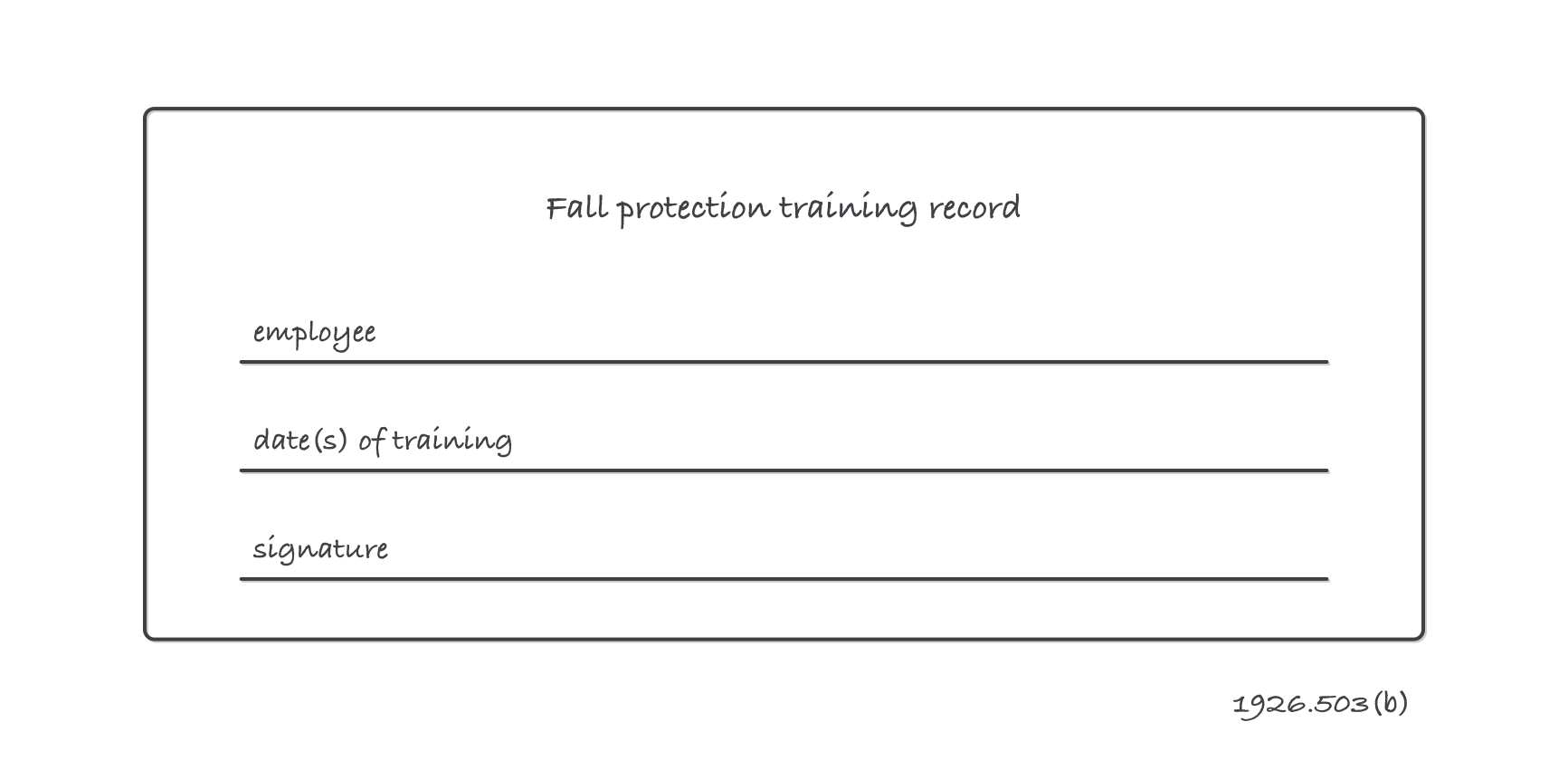
Three fields under 1926.503(b), and the record is the part inspections actually look at
Where it bites
- A toolbox talk is not the training program. Talks are useful. They are not a substitute. 1926.503(a) describes a program with defined content, delivered by a competent person, with a record behind it.
- The card is not the program either. BLS states that all carpenters must pass the OSHA 10-hour construction safety course. That card records 10 hours of general awareness training. It does not satisfy the site-specific, system-specific training 1926.503 requires for the systems on your job.
- Your best hand is not automatically your best lead. The skills barely overlap. Reading a crew, sequencing, and explaining a task are learned separately from cutting a valley rafter.
- Delegating the cutting does not delegate the layout. When the marks are wrong, the crew built exactly what you told them to.