Business · Carpentry
From Carpenter to General Contractor
Part of Carpenter, Frame to Finish · step 25 of 30 · next: Getting Into a Carpentry Apprenticeship
In learning paths: Carpenter, Frame to Finish
The state licenses the business that sells the work, not the carpenter who does it. That single sentence explains why a license finally enters your life on the day you stop working for someone else’s company and start contracting on your own account. Nothing about your skill changed overnight. What changed is who signs the contract.
*Learn the Trades is a free study resource. We are not a licensing body, an authorized training provider, or an exam administrator. Reading this page does not award any card, license, or certification. Always verify requirements with the issuing authority linked in the sources.*Why it matters on the job
A carpenter can spend twenty years at the top of the trade without ever needing a personal license. The first job you sell directly to a homeowner puts you in a different legal category. In a state that licenses contractors, selling it unlicensed is not a paperwork problem.
Three things change, and only one is the license
You become the seller. Contracts, change orders, payment terms, lien rights and warranty obligations are yours now.
You become the employer. Workers compensation, payroll, and the OSHA duties that used to belong to your foreman come with the first hire.
You become the licensee. The classification you hold defines the scope of work you may legally sell.
Most carpenters find the first two harder than the third, and the exams reflect it.
California as the worked example
California’s process is documented in detail and is a fair template for what a licensing state asks of you.
- Experience. Four years of journey-level or higher experience gained within the last 10 years, verified by a qualified person with direct knowledge of your work.
- A classification. C-5 Framing and Rough Carpentry if framing is what you sell, or Class B General Building if you intend to run whole projects.
- Two exams. The trade exam for the classification you applied for, plus the law and business exam every applicant takes.
- Bond, insurance and workers compensation as the board requires before the license issues.
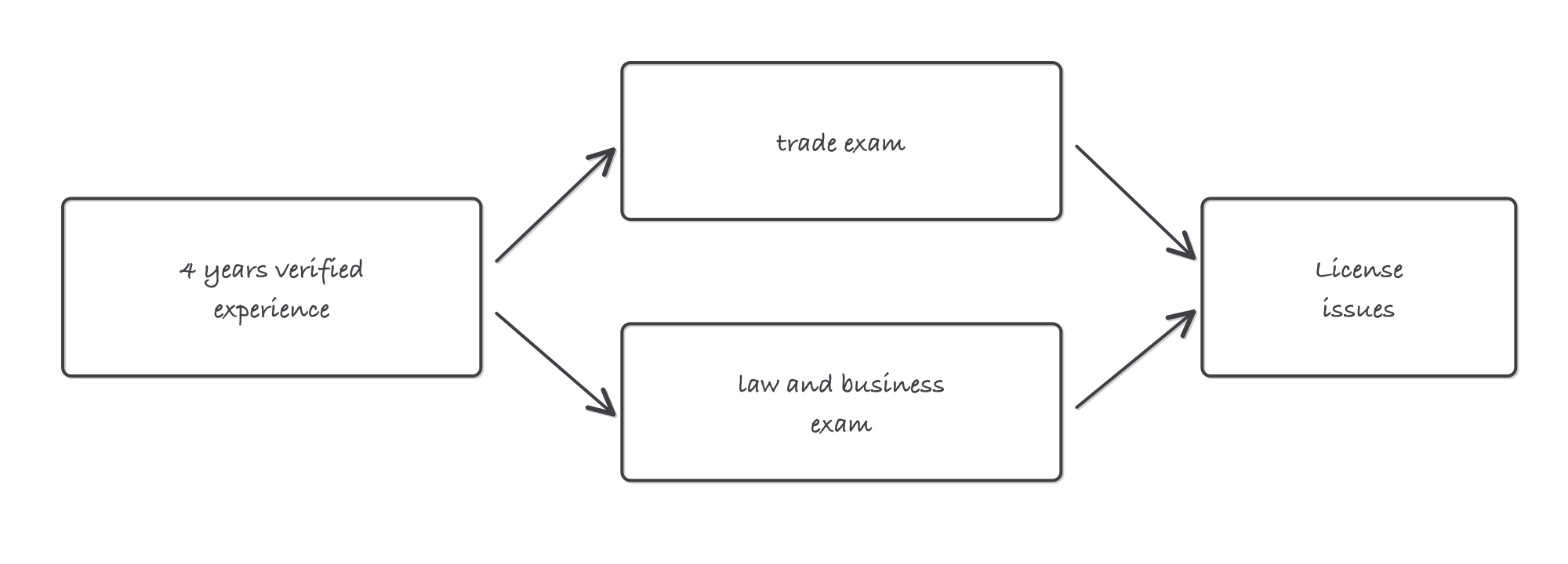
Experience first, then two exams, and only then a license
The rolling window in step 1 is worth arithmetic. Experience earned more than 10 years ago does not count, so a carpenter who framed from 2008 to 2014 and then moved into estimating has six years on the tools and zero qualifying years in 2026, because 2026 minus 10 is 2016 and all six years fall outside the window. The requirement is a rolling window, not a lifetime total, and it quietly expires.
The B classification trap
Class B, General Building, exists for projects involving at least two unrelated building trades. Framing and carpentry sit outside that count in a specific way. A B holder may take a framing or carpentry project on its own with no second trade required, but may not use framing or carpentry as one of the two unrelated trades that justify taking anything else. If your plan is to sell framing plus one other trade and call the combination general building, that combination does not qualify.
Oregon as the counter-example
Oregon does not classify contractors by trade at all. Every business doing construction work for compensation needs a Construction Contractors Board license, carpentry included, and the requirements are pre-license training, an exam, general liability insurance naming the CCB as certificate holder, and workers compensation if you hire. There is no carpentry trade exam because there is no carpentry classification to examine you on. The framing and carpentry contractor license lesson covers both states in detail.
Where it bites
- Skill is not the gate. Everything that stops carpenters at this step is business rather than craft: bidding, cash flow, contracts, insurance and payroll.
- Verified experience means somebody else signs. Start collecting supervisor contacts and dated records years before you apply, not in the month you apply.
- One state’s rules are one state’s rules. Requirements, fees and classification schemes differ everywhere, and a guide written about another state is worse than no guide.
- Hiring changes everything at once. The moment you take on an employee you inherit the fall protection duties, the training records, and the workers compensation obligations that used to be your employer’s problem.
Verified requirements
| Where | Expires | Renewal | Continuing education |
|---|---|---|---|
| United States (federal) | No | Confirm with issuer | Confirm with issuer |
| California | Yes | 2 years (standard CSLB license term; restated from existing CSLB rows, not re-verified this run) | Confirm with issuer |
| Oregon | Confirm with issuer | Confirm with issuer | Confirm with issuer |
| California | Yes | 2 years (CSLB: 'Active licenses expire every two years.' Inactive licences expire every four years.) | Confirm with issuer |
| Florida | Confirm with issuer | Confirm with issuer | Confirm with issuer |
| Arizona | Confirm with issuer | Confirm with issuer | Confirm with issuer |
Information comes from issuing-authority sources. Confirm current rules, fees and eligibility with the authority before acting.