Learn · Sheet Metal
Firm Certification vs Individual Certification
Part of Sheet Metal to TAB Certified · step 17 of 23 · next: TABB Certification: Technician and Supervisor
In learning paths: Sheet Metal to TAB Certified
Assumes you know: TAB Fundamentals
A card in a wallet and a certificate on a company wall are two different things, and the specification in front of you is asking for exactly one of them. All three TAB bodies operate at both levels: they certify people, and they separately recognize companies. A spec that calls for a certified firm is not satisfied by one employee holding a card, and a spec that calls for a certified individual is not satisfied by the company’s logo.
*Learn the Trades is a free study resource. We are not a licensing body, an authorized training provider, or an exam administrator. Reading this page does not award any card, license, or certification. Always verify requirements with the issuing authority linked in the sources.*Why it matters on the job
This point is confused constantly, and the confusion is expensive at both ends of a bid. A company that assumed its lead technician’s certification covered the firm-level requirement finds out at submittal review that it cannot perform the work it was awarded. A technician who assumed a certification is a personal, portable asset finds out that in one of the three programs it is not.
It matters to your own career too. Whether you can hold a given certification, and whether it stays with you when you change employers, is determined by which body issued it.
The two axes
Individual certification says a named person has met the eligibility criteria and passed the examinations for a discipline. It attaches to a person.
Firm-level recognition says a company has the methods, the procedures, the equipment and the qualified staff to perform work in that discipline. It attaches to a company.
The two are linked in one direction only. In these programs the company’s standing depends on employing a certified person. Holding a certification does not, by itself, confer anything on the company that employs you.
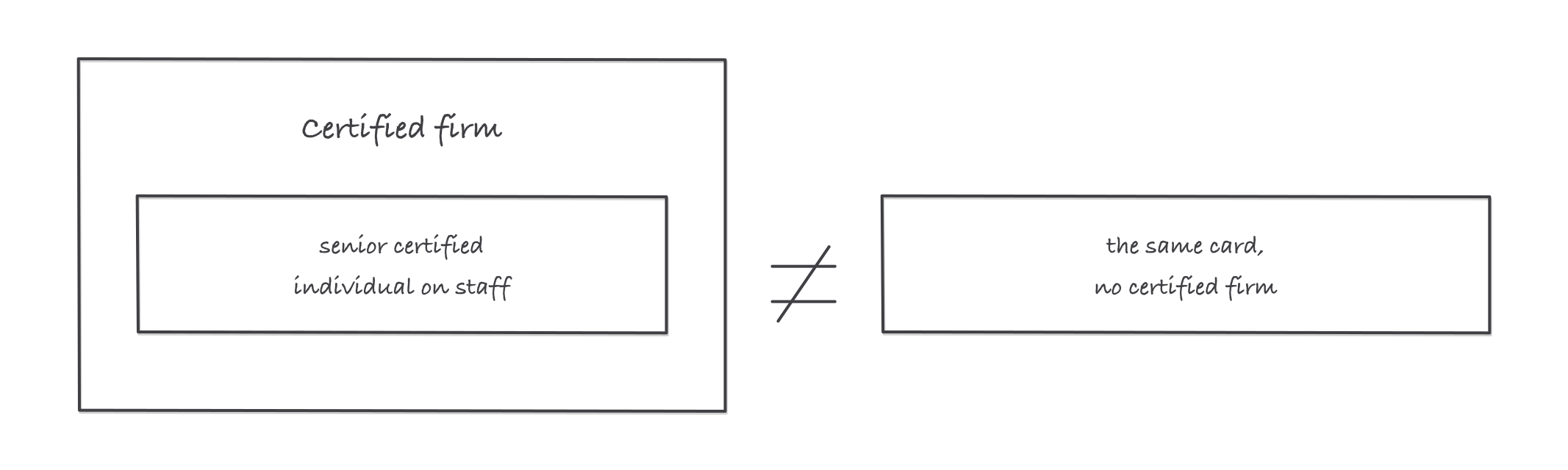
The dependency runs one way: the firm’s standing requires the person, and the person’s card does not supply the firm
How each body handles it
Three different mechanisms, one shared shape: a company’s standing in the program rests on the certified people it employs, and a certified person’s authority to sign rests, in at least one of the programs, on the company employing them.
Reading a spec line
A mechanical specification says the testing, adjusting and balancing shall be performed by an agency certified by NEBB, AABC or TABB. Read that carefully, because it is asking about the agency.
- “Agency” means the company. Sending a resume showing your technician’s card does not answer this.
- Check which program the company actually holds standing in. These are three unaffiliated bodies with no reciprocity, so being recognized under one says nothing about the others.
- Then check who will sign the report. That is a separate question with its own answer, covered below.
- If your company has none of the three, subcontracting the TAB scope is the honest route. Acquiring firm-level standing is not a submittal-week exercise.
The reverse spec exists too. Where the requirement names a certified individual performing or supervising the work, a company certificate does not answer it, and you need the named person on that job.
Who may sign the report
NEBB is explicit that only Certified Professionals working for certified firms may authenticate official reports. Both conditions, at once: the right person, at the right kind of company. A Certified Professional who moves to an uncertified firm does not carry that authority across.
The TABB structure separates the roles a different way, with technicians preparing reports and TABB certified supervisors reviewing them. In AABC, the TBE is the individual who oversees technical operations, certifies reports and supervises technicians, and every member agency must have one on staff.
Same lesson in all three: a report is authoritative because of a specific person in a specific position, not because a company name appears on the cover.
Where it bites
- “SMACNA certified” appears in specs and in marketing and it is not a thing. SMACNA develops consensus standards and certifies nobody, firm or individual. If a spec uses that phrase, it needs clarification before you bid it.
- AABC certification is employment-gated. It is open only to eligible employees of independent, approved AABC member companies, so it is not a certification you pursue as a free agent and take anywhere.
- The senior person is a single point of failure for the company. Where firm standing depends on employing one certified professional or engineer, that person leaving is a business event and not only an HR one.
- No reciprocity between the three. Holding one body’s certification does not convert to another’s, at either the individual or the company level.
- The accreditation belongs to the issuer. ICB holds the ISO/IEC 17024 accreditation from ANAB as a personnel certification body. Attributing it to TABB, or to a firm, or to yourself, is wrong in three different ways.
Exam relevance
Certification questions here test whether you can separate the two axes under pressure. Expect to be asked who may authenticate a report, what a firm must have in order to hold firm-level standing, and whether one body’s certification satisfies another’s requirement. The requirements themselves come from each body and they change, so confirm them with the certifying body before you act on any of it.