Business · Sheet Metal
Becoming a Sheet Metal Contractor
Part of Sheet Metal to TAB Certified · step 22 of 23 · next: Moving From Installer to TAB Technician
In learning paths: Sheet Metal to TAB Certified
Going out on your own in sheet metal means clearing two gates that have almost nothing to do with each other. The first is a state contractor license, which in most of the country is a mechanical or HVAC contractor license rather than a sheet metal one. The second only appears if you want the testing and balancing work: some of that market is specified at the level of the company, and your own certification does not carry the company across.
Why it matters on the job
Sheet metal is a small trade with a deep ladder. BLS counts about 127,000 sheet metal workers in the US in 2024, with roughly 10,600 openings a year and 2 percent employment growth projected over 2024 to 2034. The trade is not expanding quickly, so the growth in your own earnings comes from moving up the ladder rather than from riding a wave. Contractor is the last rung, and the two gates below decide whether you can bid the work you already know how to build.
Gate one is the license on the business
There is generally no standalone “sheet metal contractor” license. Sheet metal work rides on the mechanical or HVAC contractor licensing that each state runs, which means the qualifying exam, the experience you must document, the bond and the insurance all come from a board whose title has nothing to do with sheet metal. Some states delegate part of this to counties and cities.
Two consequences follow. Your journeyman hours count toward that license only if the board recognizes them, so read the board’s experience definition before you assume a decade on ductwork qualifies you. And the exam will cover mechanical scope wider than the sheet metal you fabricate, because the license authorizes the wider scope.
Start at the state board that licenses mechanical or HVAC contractors where you intend to work. That is the authority, and it is the only place the current requirement lives.
Gate two is the firm’s standing in the TAB market
If your business plan includes testing, adjusting and balancing, the specification you are bidding may not be asking about you at all. It may be asking about the company.
Read that as a hiring constraint, because that is what it becomes. The senior certified person is not a nice-to-have on the org chart. In both of those programs the company’s standing depends on employing one, which means losing that person can cost the company its standing in the market you built the business around.
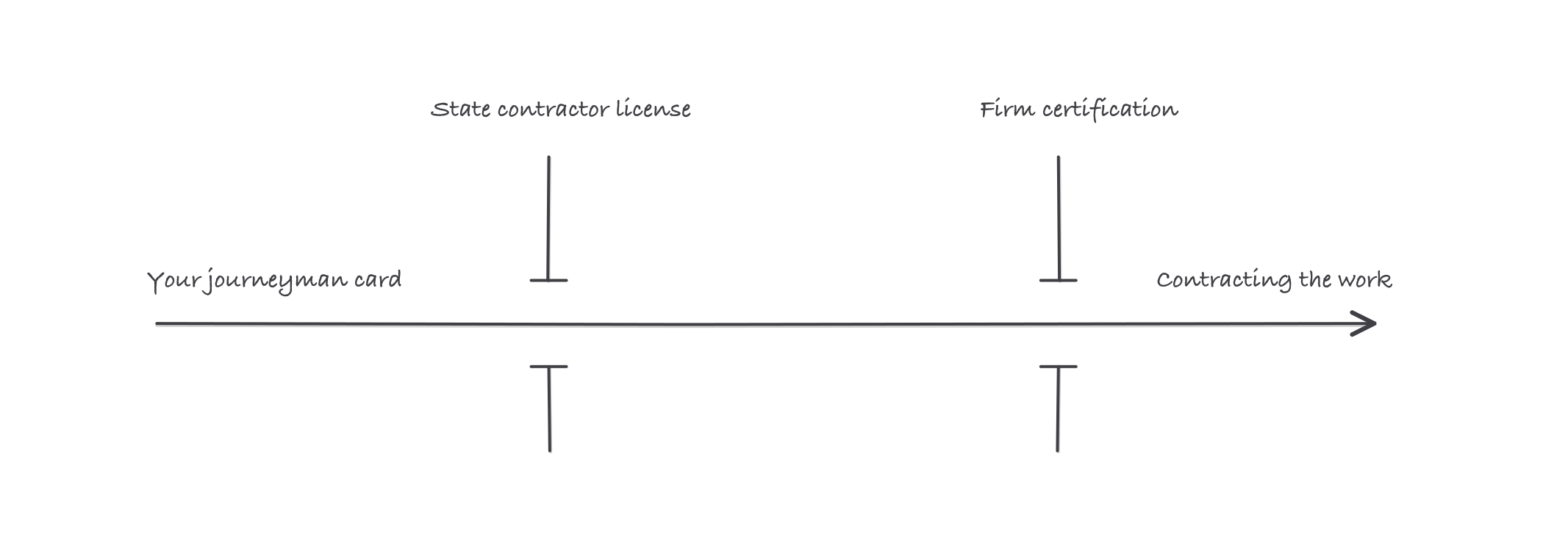
Two independent gates: the state licenses the business, the certifying body recognizes the firm, and your own card opens neither
A concrete exemplar
Take a four-person balancing shop that wants to bid AABC-specified work.
- The owner holds the state mechanical contractor license. That gate is clear, and it lets the company contract for the work.
- Nobody in the shop holds an AABC Test and Balance Engineer certification. The TBE requires 8 years of test and balance experience, with 4 years credited for an engineering degree, plus an 8-hour written examination.
- The owner has 9 years of balancing experience, so the experience side is met. Without an engineering degree, no credit applies and the full 8 years must be genuine test and balance work.
- The company cannot become an AABC-Certified Member Agency until it has that individual, and the individual cannot pursue AABC certification without already being an eligible employee of an approved AABC member company.
That circularity is real and it is the reason this route is usually entered by joining or acquiring an existing member agency rather than by starting from zero. The other two bodies are structured differently, and the lesson on firm versus individual certification lays out all three side by side.
What the business actually sells
The technical ladder and the business are different skills. As a journeyman your product is fabrication and installation. As a contractor your product is a priced, scheduled, insured promise about work other people will perform, measured against a standard someone else wrote.
The SMACNA standards your crews build to are consensus documents, published by the contractors’ association and accredited through ANSI, and the specification will name the document and the edition it expects. Knowing which of those documents governs a given scope is a bidding skill, not a shop skill, and it is covered in the lesson on which SMACNA standard governs what.
Where it bites
- “SMACNA certified” is not a status you or your company can hold. SMACNA develops consensus standards and is accredited by ANSI as a standards developer. It does not certify people and it does not certify companies. Work is built to a SMACNA standard; a business advertising itself as SMACNA certified is describing something that does not exist.
- Your certification and your firm’s certification are separate assets. A card belongs to a person and moves when that person moves. Firm standing belongs to the company and depends on continuing to employ the right person. Selling the business does not transfer either automatically.
- The state board’s language will not say “sheet metal.” People lose months looking for a license that matches their trade name. Search the mechanical and HVAC contractor categories first.
- The apprenticeship system does not train you for this. The ITI curriculum that SMART and SMACNA jointly sponsor is excellent on the craft and includes foreman and project management material, and none of it substitutes for the state’s qualifying exam on contracting law and business.